
The pregnant looking rare Amur leopard in northeast China's Heilongjiang province [Photo: Chinanews.com]
Excitement over sightings of what was thought to be a pregnant rare Amur leopard has been dashed after it was revealed the animal was a male that had eaten too much.
The overweight leopard was spotted in a Siberian tiger national nature reserve in northeast China's Heilongjiang province, according to experts from the Longjiang Forest Industry, quoted by Chinanews.com on Saturday.
Rangers in the reserve filmed the leopard, with a big belly which almost touched the ground, and conjectured whether it was pregnant.
But closer inspection of the video by experts at the wildlife research institute in Heilongjiang province revealed the patterns on the back of the leopard appeared similar to those of a male found in September, 2014 in the same area.
The researchers confirmed the leopards were one and the same, and the male leopard's "pregnant" appearance was simply down to eating too much.
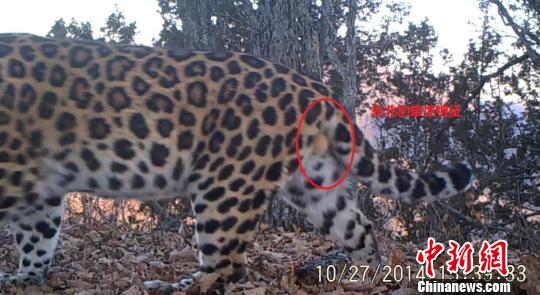
The male Amur leopard in northeast China's Heilongjiang province in this photo taken on October 27, 2014 [Photo: Chinanews.com]
"It's not hard to believe." said Zhou Shaochun, associate researcher at the wildlife research institute in Heilongjiang province. "In the winter of 2016, there were 2.6 roe deer and 3.2 wild boars in every kilometer, which means food was densely distributed. So, leopards eating too much is not hard to understand."
The abundance of wildlife in the national nature reserve in Heilongjiang province has brought joy and hope to staff members. In 2016, Siberian tigers were spotted on five occasions and wild Amur leopards 17 times by cameras. It later turned out that there were four individual Amur leopards and 6 individual Siberian tigers.
Fu Jingfeng, director of the Suiyang Forest Industry Bureau, said that the healthy condition of tigers and leopards are the result of concerted efforts by the whole of society. He said a reduction in tree cutting in the forest had encouraged the breeding of roe deer and wild boars, which provided stable living conditions for leopards which are at the top of the food chain.
The Amur leopard is listed as Critically Endangered on the International Union for the Conservation of Nature (IUCN) Red List. Data published by the World Wildlife Fund indicates that there are roughly 70 adult Amur leopards in the wild today.
 Fire brigade in Shanghai holds group wedding
 Tourists enjoy ice sculptures in Datan Town, north China
 Sunset scenery of Dayan Pagoda in Xi'an
 Tourists have fun at scenic spot in Nanlong Town, NW China
 Harbin attracts tourists by making best use of ice in winter
 In pics: FIS Alpine Ski Women's World Cup Slalom
 Black-necked cranes rest at reservoir in Lhunzhub County, Lhasa
 China's FAST telescope will be available to foreign scientists in April
 "She power" plays indispensable role in poverty alleviation
 Top 10 world news events of People's Daily in 2020
 Top 10 China news events of People's Daily in 2020
 Top 10 media buzzwords of 2020
 Year-ender:10 major tourism stories of 2020
 No interference in Venezuelan issues
 Biz prepares for trade spat
 Broadcasting Continent
 Australia wins Chinese CEOs as US loses