


Oncologists at Sichuan University's West China Hospital in Chengdu delivered cells modified using the CRISPR-Cas9 gene-editing technique into a patient with aggressive lung cancer (pictured in a lung cancer cell)
In a world first, Chinese scientists have injected a human with cells genetically modified to fight cancer.
The team used a controversial technique known as 'CRISPR-Cas9' which works like a pair of genetic scissors to cut very specific sections of DNA.
The tool allows researchers to cut out inherited genes that might cause cancer from cells and replace them with healthy DNA.
It is hoped the technique might provide a new treatment against cancer for patients who have not responded to chemotherapy or radiation therapy.
The trial at Sichuan University's West China Hospital in Chengdu received ethical approval from a hospital review board in July.
The researchers removed immune cells from the patient's blood, and then disabled a gene in them using the controversial technique.
The technique uses tags which identify the location of the mutation, and an enzyme, which acts as tiny scissors, to cut DNA in a precise place, allowing small portions of a gene to be removed.
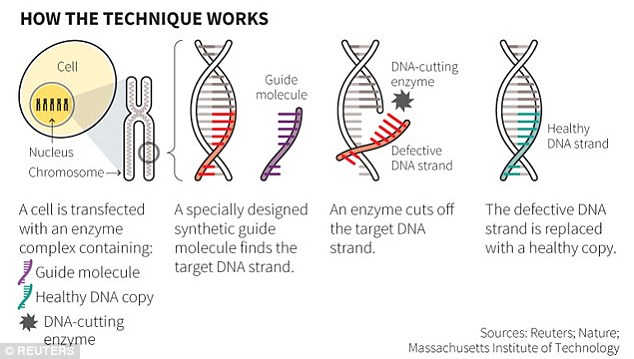
The technique uses tags which identify the location of the mutation, and an enzyme, which acts as tiny scissors, to cut DNA in a precise place, allowing small portions of a gene to be removed
By editing this tag, scientists are able to target the enzyme to specific regions of DNA and make precise cuts, wherever they like.
In this case, the cut turned off the gene which makes the protein, PD-1.
This protein normally puts the brakes on a cell's immune response: cancers take advantage of that function to spread.
The team then cultured the edited cells, increasing their number, before injecting them back into the patient.
They hope that the edited cells will go on to attack and defeat the cancer.
Lu You, who led the study, told Nature: 'Treatment options are very limited.
'This technique is of great promise in bringing benefits to patients, especially the cancer patients whom we treat every day.'
The researchers told Nature that the treatment went smoothly, and that the participant will get a second injection, but declined to give details because of patient confidentiality.
A total of ten people are scheduled to be treated, each who will receive up to four injections.
The trial is primarily to test the safety of the technique, and patients will be closely monitored for six months to determine whether there are any side effects.
The achievement by Chinese scientists could spark a biomedical race between China and the US, experts claim.
'I think this is going to trigger "Sputnik 2.0", a biomedical duel on progress between China and the United States, which is important since competition usually improves the end product,' Carl June, who specializes in immunotherapy at the University of Pennsylvania in Philadelphia told Nature.
 Fire brigade in Shanghai holds group wedding
 Tourists enjoy ice sculptures in Datan Town, north China
 Sunset scenery of Dayan Pagoda in Xi'an
 Tourists have fun at scenic spot in Nanlong Town, NW China
 Harbin attracts tourists by making best use of ice in winter
 In pics: FIS Alpine Ski Women's World Cup Slalom
 Black-necked cranes rest at reservoir in Lhunzhub County, Lhasa
 China's FAST telescope will be available to foreign scientists in April
 "She power" plays indispensable role in poverty alleviation
 Top 10 world news events of People's Daily in 2020
 Top 10 China news events of People's Daily in 2020
 Top 10 media buzzwords of 2020
 Year-ender:10 major tourism stories of 2020
 No interference in Venezuelan issues
 Biz prepares for trade spat
 Broadcasting Continent
 Australia wins Chinese CEOs as US loses