

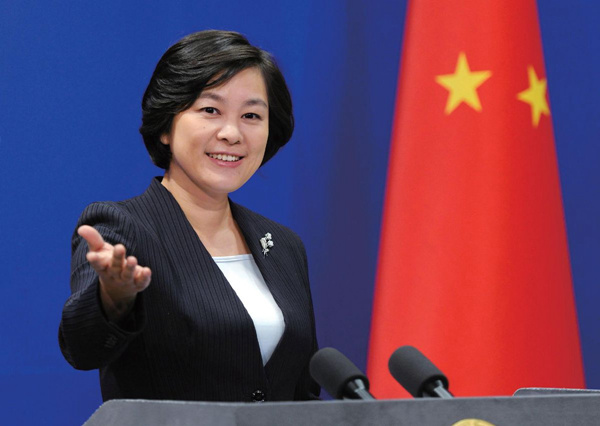
Foreign Ministry spokesperson Hua Chunying (Xinhuanet file photo)
BEIJING, Nov. 4 -- China on Friday urged the United States to stop deployment of the Terminal High Altitude Area Defense (THAAD) in the Republic of Korea (ROK).
Army Gen. Vincent K. Brooks, U.S. Forces Korea (USFK) commander said earlier Friday that the THAAD anti-missile system would be deployed to ROK soil in the next eight to 10 months.
"The U.S. deployment of the THAAD in the Republic of Korea severely undermines regional strategic balance and harms strategic and security interests of countries in the region, including China," Foreign Ministry spokesperson Hua Chunying said at the daily press briefing.
Hua added that THAAD deployment goes against efforts to maintain peace and stability in the Korean Peninsula.
"China has repeatedly expressed concern and opposition to the issue,"she said, stressing that China will take necessary measures to safeguard its national security interests.
He urged relevant sides to pay due attention to China's legitimate concern and immediately stop the deployment process.
The size of the THAAD battery, which Seoul and Washington agreed in early July to install in southeastern ROK, would be bigger than the one deployed to the island of Guam, according to the report.
 Fire brigade in Shanghai holds group wedding
 Tourists enjoy ice sculptures in Datan Town, north China
 Sunset scenery of Dayan Pagoda in Xi'an
 Tourists have fun at scenic spot in Nanlong Town, NW China
 Harbin attracts tourists by making best use of ice in winter
 In pics: FIS Alpine Ski Women's World Cup Slalom
 Black-necked cranes rest at reservoir in Lhunzhub County, Lhasa
 China's FAST telescope will be available to foreign scientists in April
 "She power" plays indispensable role in poverty alleviation
 Top 10 world news events of People's Daily in 2020
 Top 10 China news events of People's Daily in 2020
 Top 10 media buzzwords of 2020
 Year-ender:10 major tourism stories of 2020
 No interference in Venezuelan issues
 Biz prepares for trade spat
 Broadcasting Continent
 Australia wins Chinese CEOs as US loses