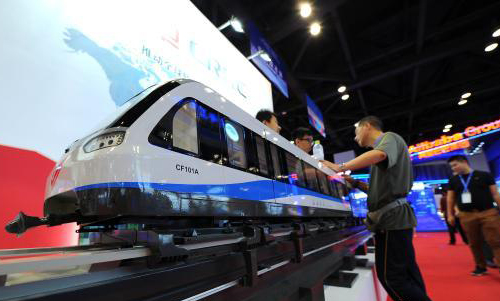
A Chinese firm will start researching and developing a magnetic levitation (maglev) train that can run 600 km per hour, which would be faster than any other maglev train currently in operation.
CRRC Corp. Ltd., China's largest rail transportation equipment maker, said it will build a maglev rail line no less than 5 km long to test the train.
The company will also develop maglev trains that travel at 200 km/h, with the goal of establishing domestic technology and standard systems for new-generation medium- and high-speed maglev transportation that can be applied globally, said Sun Bangcheng, a CRRC official.
In addition, the firm will kick off research and development of cross-border high-speed trains that can run 400 km per hour and alternate between different track gauges ranging from 60 cm to 1.676 meters.
Such trains will consume 10 percent less energy than the country's 350 km/h bullet trains currently in use, said Sun.
China has seen rapid development of its high-speed railways in recent years, with their total length exceeding 20,000 km, the world's longest high-speed rail network.
The country started operation of its first home-grown maglev rail line in May, with trains running at a maximum speed of 100 km per hour.
 Fire brigade in Shanghai holds group wedding
 Tourists enjoy ice sculptures in Datan Town, north China
 Sunset scenery of Dayan Pagoda in Xi'an
 Tourists have fun at scenic spot in Nanlong Town, NW China
 Harbin attracts tourists by making best use of ice in winter
 In pics: FIS Alpine Ski Women's World Cup Slalom
 Black-necked cranes rest at reservoir in Lhunzhub County, Lhasa
 China's FAST telescope will be available to foreign scientists in April
 "She power" plays indispensable role in poverty alleviation
 Top 10 world news events of People's Daily in 2020
 Top 10 China news events of People's Daily in 2020
 Top 10 media buzzwords of 2020
 Year-ender:10 major tourism stories of 2020
 No interference in Venezuelan issues
 Biz prepares for trade spat
 Broadcasting Continent
 Australia wins Chinese CEOs as US loses