
China-Saudi Arabia economic and trade ties draw more attention as Chinese President Xi Jinping kicked off his state visit to the Middle East country on January 19. Analysts believed besides their energy cooperation, China can lend a helping hand as Saudi Arabia seeks to diversify its energy-dominated economy.
China and Saudi Arabia have been deepening their economic and trade ties since they established diplomatic ties in 1990.
In recent years, Saudi Arabia and other resource-abundant Gulf Region countries began to seek multiple sources of income to reduce economic reliance on the oil industry.
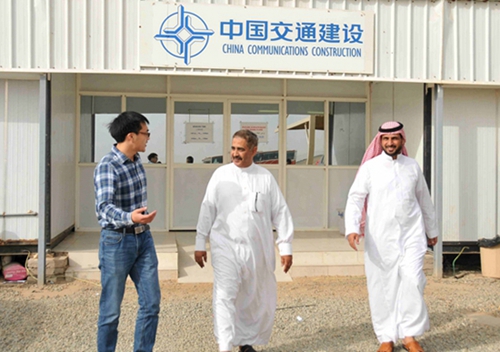
Chinese and local staff of the Saudi Arabian branch of China Communications Construction Company Ltd. talk at a stormwater drainage project site in Jeddah, the country’s port city, on February 12, 2015.
Amid the background, 160 China-funded companies covering railway, telecommunications and power have invested in Saudi Arabia.
YASREF, a 10-billion-dollar refinery invested by Saudi Aramco and China’s Sinopec, is one example.
“Highly dependent on export of crude oil, the Saudi economy is susceptible to the fluctuations of oil price. The country, therefore, has been seeking to diversify its economy to reduce risks,” explained Wu Bingbing, member of the Center for China-Arab States Cooperation Forum Studies, adding that the refinery industry is more resilient to price fluctuation.
The expert also expected a promising prospect for new energy cooperation, pointing out that the Middle East country has a thirst for new energy such as nuclear power, where China can offer its expertise.
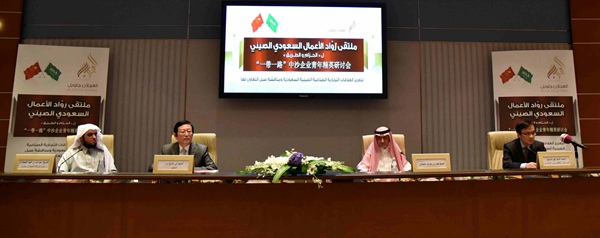
This photo is taken at a symposium between Chinese and Saudi youth on China’s proposal to build the Silk Road Economic Belt and the 21st-Century Maritime Silk Road held in Riyadh, the capital of Saudi Arabia, on December 3, 2015.
Saudi Arabia has also been China’s top crude oil supplier as well as its largest trade partner in West Asia and Africa for years, while China is the Middle East nation’s second largest trade partner.
Hailing their energy cooperation as an important backup of Sino-Saudi ties, Wu said that Saudi Arabia contributed 16 percent of China’s imported oil. It is of strategic importance, he added.
Wu Sike, former Chinese Special Envoy on the Middle East Issue and Ambassador to Saudi Arabia, agreed that as major energy producer and consumer respectively, the two countries need each other.
“Their energy cooperation will also promote cooperation in other fields,” he added.
Data showed that China became Saudi Arabia’s largest trade partner in 2013 for the first time. Their two-way trade amounted to $69.1 billion in 2014, over 230 times more than that in 1990.
(Source: People's Daily)
 PLA holds joint air-ground military drill
 Charming female soldiers on Xisha Islands
 Beautiful skiers wear shorts in snow
 Getting close to the crew on China's aircraft carrier
 Chinese stewardess celebrate test flight at Nansha Islands
 World's first 'underwater skyscraper'
  Pentagonal Mart becomes the largest vacant building in Shanghai
 "Rent me as your girlfriend!"
 A beauty's dancing youth
 Top 20 hottest women in the world in 2014
 Top 10 hardest languages to learn
 10 Chinese female stars with most beautiful faces
 China’s Top 10 Unique Bridges, Highways and Roads
 Xi arrival shows commitment to Mideast
 Chinese firm aims to build ‘world’s largest cloning factory’
 Qinghai Lake aircraft ban reveals risky trend in wildlife photography
 Foreigners flock to China for cancer, chronic disease treatments
Day|Week


