



EU tightens migration chain as return rules approved

This photo taken on Jan. 29, 2025 shows the Berlaymont Building, the European Commission headquarters, in Brussels, Belgium. (Xinhua/Meng Dingbo)
Under the new Return Regulation, EU countries will operate under common return procedures, including a new European Return Order, and gain the option of establishing so-called "return hubs" in non-EU countries.
BRUSSELS, Oct. 1 (Xinhua) -- The European Union (EU) member states on Thursday gave final approval to a new regulation to accelerate the return of people with no legal right to stay, adding an enforcement mechanism to migration and asylum rules that took effect in June.
Under the new Return Regulation, EU countries will operate under common return procedures, including a new European Return Order, and gain the option of establishing so-called "return hubs" in non-EU countries.
According to the EU figure, around two in three people ordered to leave the bloc currently do not actually depart. The regulation complements the EU Pact on Migration and Asylum, which took effect on June 12.
The pact sets common rules for screening, asylum procedures, responsibility among member states and solidarity mechanisms, while the new regulation focuses on returning peoplefound to have no right to stay.
The European Commission earlier described returns as the "missing piece" of the pact, while European Parliament rapporteur Malik Azmani called return the "final piece in Europe's migration system."
PRESSURE FOR GREATER CONTROL
The tougher return rules came after a turbulent summer that again pushed migration high up Europe's agenda.
On July 30 and 31, tens of thousands of migrants crossed from Morocco into Spain's North African enclave of Ceuta, prompting Madrid to deploy the military and triggering calls from several European governments for tighter border controls.
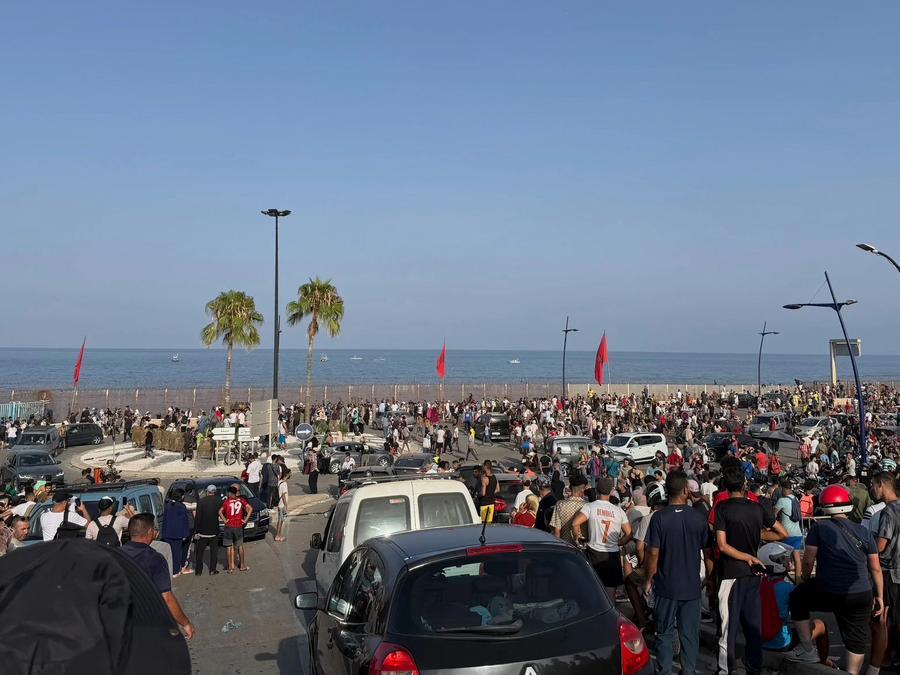
People gather on the Moroccan side of the border with Spain's North African enclave of Ceuta, preparing to cross into the enclave, on July 30, 2026. According to the Spanish government, at least 67 people died during the recent migrant crisis, while more than 48,000 of the nearly 50,000 migrants who entered Ceuta had returned to neighboring Morocco within 48 hours. (Photo by Liu Wenyong/Xinhua)
The crisis came only weeks after the migration pact entered into application and added urgency to a broader push for tougher enforcement.
Claire Kumar, head of policy and senior research fellow at ODI Europe, told Xinhua that public concern over irregular migration was strongly linked to a perceived "lack of control," with people expecting governments to demonstrate that borders and migration rules were effectively managed.
That pressure has become politically significant as mainstream parties face sustained pressure from right-wing and far-right forces advocating stricter migration controls, she added.
Pressure for further restrictions is also growing. Greece on Thursday proposed a mechanism that would allow EU countries to temporarily suspend asylum applications during large-scale arrivals deemed instrumentalized, with Germany, Austria, Denmark and Poland open to considering the idea.
These discussions suggest that the adoption of the Return Regulation may not mark the end of the EU's tightening migration agenda.
ENFORCEMENT MEETS REALITY
Yet passing a common return law does not guarantee a sharp rise in actual returns.

Spanish Prime Minister Pedro Sanchez (C) observes the work of the Civil Guard in Spain's North African enclave of Ceuta, on July 31, 2026. (La Moncloa/Handout via Xinhua)
The German Institute for International and Security Affairs (SWP) said in a recent analysis that return hubs are likely to remain limited in scale and heavily dependent on cooperation with third countries.
It said that persistent obstacles include establishing migrants' identities, obtaining travel documents, securing cooperation from countries of origin, and finding third countries willing to host return facilities. Such problems cannot simply be bypassed by moving parts of the return process outside Europe.
At the same time, Europe's aging economies still need migrant workers, Kumar said.
She said that beneath increasingly restrictive political rhetoric, labor demand remains a powerful driver of migration. If adequate legal pathways are unavailable, workers may still fill those jobs through irregular or informal channels, increasing risks of exploitation and labor-market informality.
The next test is implementation: whether the EU can turn its new legal powers into more effective returns while its aging economies continue to need migrant labor.
Photos



Related Stories
- EU pays extra 100 bln euros for fossil fuel imports amid U.S.-Iran conflict
- Ireland begins EU presidency with focus on competitiveness, security
- Consistently divided
- EU isn't 'losing' in mutually beneficial trade with China
- Clued-in | EU's 'de-risking' from China: A slippery slope toward 'de-cooperation'
- Clued-in | So-called 'de-risking' approach cannot resolve Europe's industrial challenges
- Hungary greenlights Ukraine's EU accession negotiations after minority rights progress
- China's int'l trade promotion body voices opposition to EU's cybersecurity act revision
- The EU should neither engage in nor afford a 'trade war with China'
- EU downgrades growth forecast, fueling stagflation concerns
Copyright © 2026 People's Daily Online. All Rights Reserved.
