



Inheritor reinvigorates blue calico printing and dyeing
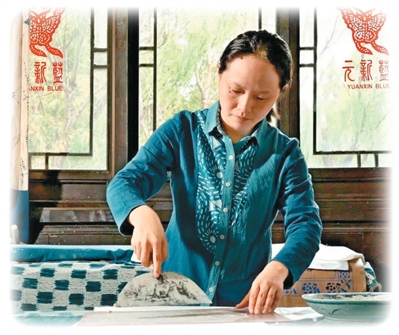
Wu Lingshu works on a piece of blue calico artwork. (Photo courtesy of the interviewee)
Wu Lingshu is a provincial-level inheritor of blue calico printing and dyeing, a craft listed as national intangible cultural heritage, and curator of the Nantong Blue Calico Museum in Nantong, east China's Jiangsu Province. She grew up in a blue calico workshop, watching her father dye and wash fabrics.
In early autumn 2000, she went to Konkuk University in South Korea to further her studies. While browsing materials in the library, Wu came across a Korean-language book on traditional textile dyeing that caught her attention. As she turned the pages, a familiar motif appeared before her eyes: a classic pattern of Chinese blue calico.
"Those crafts and patterns passed down from our ancestors had already crossed borders and were being carefully documented in a different cultural context," Wu said. At that moment, she felt an indescribable sense of pride. It was also the first time she had looked at the craft from an outsider's perspective.
After graduation, Wu returned to Nantong and immersed herself in the dyeing workshop. The blue calico craft involves five key steps, and each one embodies generations of wisdom and tests the patience of its inheritors.
For beginners, the most challenging technique is using a carving knife like a brush to creatively shape the dots, lines and planes of blue calico patterns.
During her early years of training, Wu's fingers were often worn raw and blistered, and summers in the workshop left her soaked in sweat. Encouraged by her father and mentors, she practiced repeatedly.
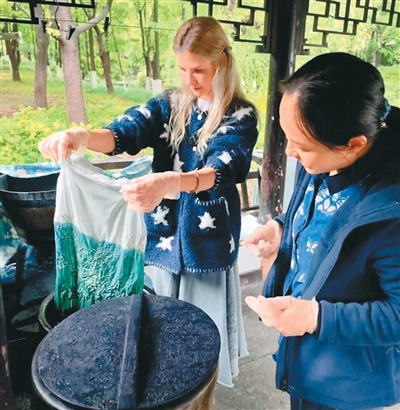
Wu Lingshu (right) introduces the craft of blue calico printing and dyeing to an international visitor. (Photo courtesy of the interviewee)
Today, most older people who experienced the era when blue calico was widely used in daily life are in their 90s, with some older than 100.
Over the past decade or so, Wu and her father have led their team across more than 20 provinces, including Jiangsu, Zhejiang, Hunan and Hubei, rescuing more than 20,000 blue calico artifacts.
The museum's collection has grown from more than 2,000 pieces at its founding to more than 60,000, including 28 sets of second-grade and 106 sets of third-grade cultural relics. Yet the greater challenge lies in their preservation, restoration and research. Many old fabrics have deteriorated over time, with fragile materials and damaged patterns making conservation work extremely difficult. Tracing the origins of patterns and mapping the evolution of different artistic styles are equally demanding.
To address these challenges, Wu and her team built the country's first blue calico pattern database. The team has photographed each pattern in high definition, then processed, classified and archived the images, while also conducting preliminary research into the patterns' historical origins and folk meanings.
Over the years, Wu has led her team in exploring new possibilities. In craftsmanship, they transformed traditional single-sided printing into double-sided printing, greatly expanding the use of blue calico in high-end clothing and home furnishings. In color, they moved beyond the traditional single-blue palette by developing a multi-tone dyeing technique that creates richer layers and rhythms reminiscent of ink-wash paintings. In materials, they extended blue calico techniques to natural fabrics such as silk, cashmere and linen.
For pattern design, Wu has studied the composition and cultural meanings of traditional motifs while incorporating geometric elements and minimalist forms. These innovative designs have been widely used in clothing, bags, wall hangings, footwear and other products, with her team securing 256 national design patents.
Nantong blue calico works have been exhibited in more than 20 countries and regions, including South Korea, Japan, Germany, France, the United States, Switzerland, Russia and Italy.
Under Wu's leadership, the Nantong Blue Calico Museum has developed a comprehensive inheritance model integrating collection, research, preservation, education and innovation. She has also established a blue calico master studio at Nantong University, launched an elective course on blue calico craftsmanship, and introduced traditional dyeing courses as compulsory classes at the School of Textile and Clothing, helping this ancient craft take root among young students.
Photos


Related Stories
- Young people build careers by reviving Li brocade
- The art of the reveal
- Zhuang brocade weaving thrives through innovation in China's Guangxi
- Exhibition of intangible cultural heritage opens to visitors during Summer Davos in China's Dalian
- Dragon boat festival intangible cultural heritage fair held in Nairobi, Kenya
Copyright © 2026 People's Daily Online. All Rights Reserved.
