



Chinese scientist spends 20 years mitigating geohazards in Pakistan
Cui Peng, an academician of the Chinese Academy of Sciences (CAS), has long dedicated himself to geohazard mitigation research spanning China and Pakistan.
His Beijing office near Olympic Park looks out onto lush greenery. Sunlight fills the bright, orderly room, quiet but for the crisp tapping of a keyboard.
Focused and immersed in piles of documents, Cui devotes himself entirely to his work. Though streaks of silver trace his hair, he remains energetic and robust. Constant dedication to scientific research defines his daily life.
'I do not pursue science for fame or honors'
A distinguished geologist specializing in geohazards, Cui has never confined his research within China's borders and has dedicated two decades to disaster-reduction work in Pakistan.
In May this year, the Pakistani government granted him the Sitara-e-Imtiaz award in recognition of his outstanding commitment to China-Pakistan scientific and technological cooperation.
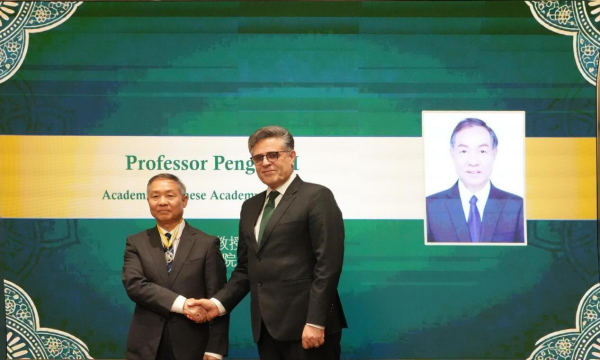
Cui Peng (left) receives the Sitara-e-Imtiaz award in Beijing, the capital of China, May 15, 2026. (Photo provided to People's Daily Online)
Cui learned of the honor while attending the World Technology and Development Forum in 2025.
"Khan Muhammad, then science and technology counselor of Pakistani Embassy in China, informed me of the news," Cui said. "I shared it with my team immediately because this honor doesn't belong to me alone."
Asked about the award, he stayed grounded. "It's surely an honor to receive such recognition," he said. "Yet it will not change my commitment to geohazard risk-reduction work."
China-Pakistan cooperation a shared endeavor
Cui's long-term partnership with Pakistan traces back to October 2005, when a 7.6-magnitude earthquake struck the country. Tens of thousands lost their lives, millions were displaced, and extensive infrastructure was destroyed. The Karakoram Highway (KKH) expansion project suffered severe setbacks triggered by massive secondary geohazards.
Shortly after the earthquake, at an academic forum hosted by the International Center for Integrated Mountain Development, Cui presented his research on geohazard mechanisms and mitigation technologies. His work drew the attention of Muhammad Asif Khan, a CAS foreign academician and then-director of the National Centre of Excellence in Geology at the University of Peshawar. The Pakistani scholar invited Cui to provide technical advice for post-quake reconstruction.
Driven by the belief that geoscience should serve the well-being of all humanity, Cui traveled to Pakistan without hesitation in early 2006, beginning a 20-year journey of China-Pakistan cooperation in geohazard research.
"In fact, it's impossible to completely avoid risks," said Wu Yaqiao, Cui's student and assistant. "But we always assess risks and make thorough preparations before every field mission." Even so, harsh mountain environments can bring unexpected dangers.
In January 2010, a massive landslide in northern Pakistan blocked the Hunza River, forming the Attabad barrier lake and submerging nearly 19 kilometers of the KKH. The unstable dam could also give way at any moment, threatening a catastrophic flood downstream. To assess water conditions both upstream and downstream, Cui had to cross the lake by boat.
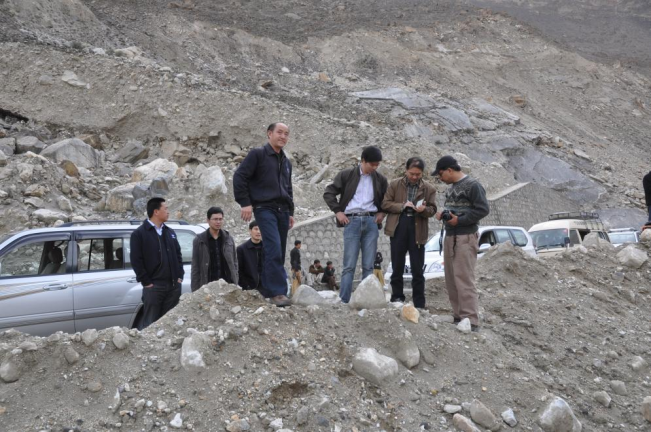
Cui Peng (second from right) investigates at Hunza Valley in northern Pakistan in 2010. (Photo provided to People's Daily Online)
"We had no option but to take a local wooden canoe," Cui recalled. Overloaded with heavy luggage and field equipment, the canoe sat dangerously low on the water. Sudden valley winds made it rock violently.
"I was a little worried, indeed," Cui said with a smile. "But I have grown accustomed to all kinds of extreme environments and unexpected incidents." In his eyes, nothing could outweigh people's lives. Fortunately, locals came to their rescue with a larger boat, enabling the team to cross safely.
Cui brought with him hard-won experience from the 2008 Wenchuan earthquake in China. His team had evaluated 256 barrier lakes and identified 17 high-risk sites. Drawing on that expertise, the China-Pakistan team dug diversion channels on the Attabad dam. The water level dropped by 30 meters, and breach risks were largely eliminated. The submerged KKH section reemerged, and Attabad Lake has since become a scenic tourist spot.
Joint strengths of both sides proved critical again during Pakistan's catastrophic 2022 summer floods, which triggered widespread landslides and mudflows. Cui and the team used satellite remote-sensing to analyze and quantify the damage, while Pakistani professionals ventured into disaster zones to validate field data. Joint briefings provided key support for Pakistan's emergency response.
Cultivating talent for lasting scientific cooperation
For sustainable China-Pakistan geoscience cooperation, Cui said that lasting institutional platforms were essential. He led the founding of the China-Pakistan Joint Research Center on Earth Sciences (CPJRC) and served as its first director on the Chinese side.
Though he has stepped down from administrative roles, Cui remains deeply involved in core research and talent cultivation. From advancing disaster risk simulation and early-warning systems to organizing workshops for thousands of Pakistani students and officials in partnership with the University of Science and Technology of China and the University of Chinese Academy of Sciences, Cui's efforts have yielded fruitful, enduring outcomes for bilateral scientific collaboration.
Even amid a heavy research schedule, Cui continues to supervise doctoral candidates, including many Pakistani students.
"These Pakistani students study very hard, because opportunities to pursue overseas education are precious to them," he said.
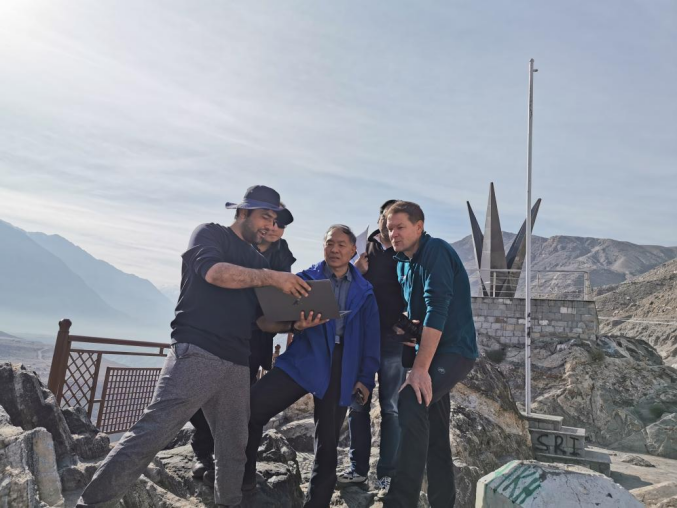
Cui Peng (middle) inspects the construction of the field observation network of the China-Pakistan Joint Research Center on Earth Sciences in Pakistan in 2023. (Photo provided to People's Daily Online)
Some Pakistani graduates stay at CPJRC to help run a Karakoram environmental-hazard observation station it operates. Others return home to work in Pakistani universities and research institutes. The seeds of scientific collaboration sown two decades ago have taken firm root, passing knowledge and friendship from one generation to the next.
Reflecting on two decades of cross-border research, Cui put it simply: "The goal of our scientific work is geohazard mitigation, to tackle common risks facing humanity. Whether working at home or abroad, our mission remains the same: to minimize disaster losses and safeguard human lives."
Photos



Related Stories
- AIIB, ADB support panda bond issuance for infrastructure projects in Pakistan
- Pakistan facilitates transfer of Iranian crew members from vessel seized by U.S.
- China-Pakistan joint initiative -- a pragmatic, feasible approach to Mideast peace
- Pakistan to host quadrilateral meeting on regional developments: state media
Copyright © 2026 People's Daily Online. All Rights Reserved.
