



Uganda starts exporting chili peppers to China following agricultural tech cooperation
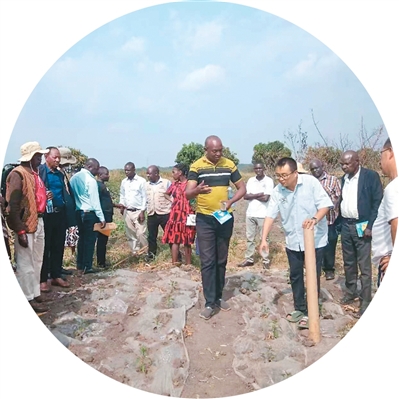
Chinese technicians guide Ugandan officials and farmers in standardized planting and field management techniques on a chili pepper demonstration farm in Uganda. (Photo courtesy of Kehong Chili Pepper Industry Uganda Co., Ltd.)
In Uganda's Kamuli district, lush chili pepper fields sway gently in the breeze. They are among the most visible outcomes of the third phase of the Food and Agriculture Organization of the United Nations (FAO)-China-Uganda South-South Cooperation project.
More than three years after the project was launched, chili pepper cultivation has expanded steadily across Uganda. Last November, the country's first shipment of 11 tonnes of dried chili peppers was exported to China.
Long Wenjing, an associate researcher at the Rice and Sorghum Research Institute of Sichuan Academy of Agricultural Sciences and a member of the project's expert team, knows firsthand how much selecting the right varieties matters.
"Uganda enjoys favorable temperatures, abundant sunshine, and a climate that supports year-round pepper cultivation. However, local production was relatively small-scale and farming practices were still underdeveloped," Long said.
When the project was launched in November 2022, selecting varieties suited to Uganda's growing conditions became the team's top priority.
After evaluating more than 30 chili pepper varieties from China and abroad, Long and his colleagues selected three disease-resistant, high-yield cultivars well adapted to local conditions. Two of these varieties, from southwest China's Sichuan Province, were chosen as the primary varieties for promotion.
The China-Uganda Agricultural Cooperation Industrial Park, built by Kehong Group from Sichuan, became the ideal hub for testing and demonstration.
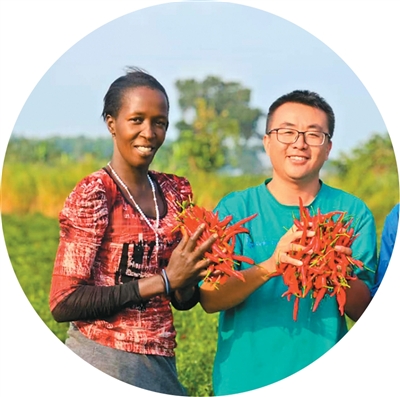
A Chinese technician and a Ugandan industrial worker pose for a picture, each holding red chili peppers in their hands. (Photo courtesy of Kehong Chili Pepper Industry Uganda Co., Ltd.)
According to Liu Xiancai, who heads the park's chili pepper cultivation project, the company began investing in Uganda's chili pepper industry in 2023. Working with the project's expert team, the company introduced nearly 100 pepper varieties for adaptability trials and established a 16-member Chinese-Ugandan technical team.
By the end of 2024, the park had attracted investors from central China's Henan Province, one of China's major chili pepper-producing regions. Last year, its demonstration chili pepper planting area expanded to more than 500 mu (33 hectares), said Liu.
Since the project began, experts have visited several regions in Uganda, offering field demonstrations, on-site guidance and technical manuals, according to Luo Tingyue, the project's plant protection specialist.
The Busoga Consortium for Development (BCD) has been another key partner. Anthony Mula, director general of the consortium, said the BCD has worked closely with Chinese experts, chili pepper companies, and the FAO to provide technical support throughout the entire production process. Chili peppers generate roughly three times the income of traditional crops such as banana, cassava and maize, greatly boosting farmers' willingness to plant them.
"Chili peppers have now been officially recognized in Uganda as an important cash crop capable of helping farmers escape poverty," Mula said.
Uganda's chili pepper planting area has expanded from just over 200 mu at the start of the project to more than 600 mu today, directly boosting the incomes of more than 100 farming households.
To give farmers greater confidence in growing chili peppers, the project also introduced a model that incorporates companies, production bases and farming households, which has proven successful in China. "The very first harvest produced encouraging results," Liu said.
Mula believes contract-based farming has been an effective way of encouraging farmers to adopt chili pepper as an alternative cash crop.
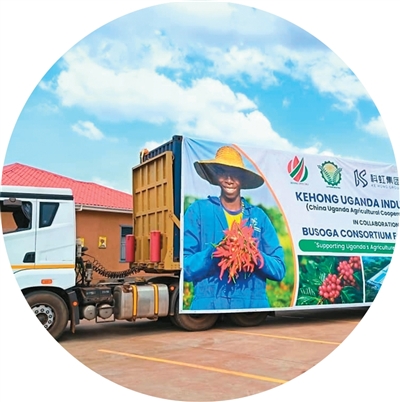
Uganda exported chili peppers to China for the first time in November 2025. (Photo courtesy of Kehong Chili Pepper Industry Uganda Co., Ltd.)
At the 2024 Summit of the Forum on China-Africa Cooperation (FOCAC), China and Uganda signed a protocol on phytosanitary requirements for exporting dried chilies from Uganda to China, creating new opportunities for the country's chili pepper industry.
Uganda successfully exported its first-ever shipment of dried chilies to China on Nov. 20, 2025, an 11-tonne consignment marking the country's debut in the Chinese market.
Starting May 1 this year, China fully implemented a zero-tariff policy for African countries with which it has diplomatic relations.
"This is a major boost for our business," Liu said. The company is now conducting pilot cultivation projects across nine regions of Uganda and aims to reach an annual production target of 50,000 tonnes of dried chilies within five years.
To help develop local expertise, the Sichuan Academy of Agricultural Sciences established a workstation in Uganda. During his three and a half years in the country, Long has trained many Ugandan technicians.
Photos

Related Stories
- Chinese anti-epidemic medical expert team arrives in Uganda: spokesperson
- Uganda flags off first shipment of canned pineapples to China
- Xi's special envoy to attend presidential inauguration ceremonies of Djibouti, Uganda
- Rising Chinese demand fuels surge in Uganda's coffee exports
- Chinese community in Uganda honors fallen Chinese experts in national stadium construction
- Xi congratulates Yoweri Museveni on re-election as president of Uganda
- Museveni praises growing Uganda-China ties
- China's zero-tariff policy opens new doors for Ugandan coffee exports: entrepreneur
- Chinese doctors donate medical supplies to Ugandan hospital
- Chinese capital driving Africa's development: Ugandan president
Copyright © 2026 People's Daily Online. All Rights Reserved.
