



Smart education opens new possibilities for every student in Yinchuan
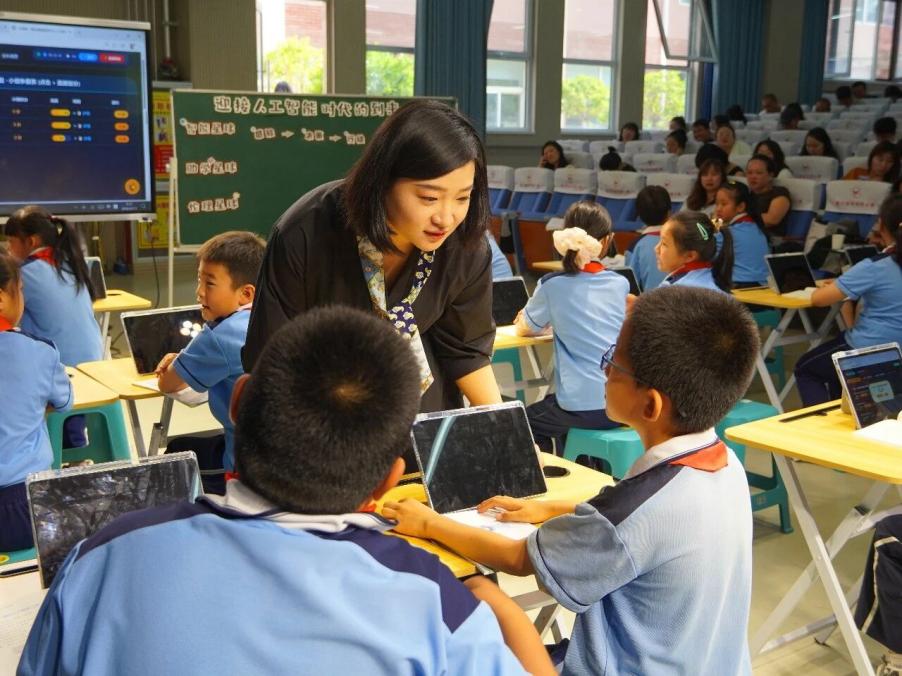
A demonstration event is held in Yinchuan, northwest China's Ningxia Hui autonomous region to showcase achievements in AI-assisted teaching for primary schools, June 11. (Photo courtesy of the education bureau of Xixia district, Yinchuan)
In Yinchuan, capital of northwest China's Ningxia Hui autonomous region, a group of seventh graders from Ningxia No. 15 Middle School have developed a smart bird-repelling system to protect goji berry fields.
The system automatically detects birds approaching the fields and plays pre-recorded raptor calls to deter them. Powered by AI image recognition, it protects crops without harming wildlife.
This is an example of the school's efforts to build a distinctive curriculum that integrates general education with AI.
"Several companies have already contacted us about turning the students' idea into a real product," said Xie Wei, principal of the school. He summarized the school's goals in simple terms: "We want to lighten teachers' workloads and give our students more room to grow."
The transformation brought by smart education can be felt throughout the campus.
For Chinese teacher Bao Ling, lesson preparation used to be a time-consuming process. "I used to spend several evenings preparing audio and video materials for a single class," she recalled.
Now, she routinely uses AI tools to turn textbook content into animated lessons. While teaching the essay Pear Blossoms Along the Post Road, she transformed the text into an immersive visual experience, with pear blossoms blooming across the screen and the story unfolding in vivid detail.
"A single video can help students grasp the entire text," Bao said. "Students are more engaged and spend more time looking up and participating, while lesson preparation has become much more efficient."
AI has also made literature feel more personal. Through AI-generated characters, students can "talk" with famous Chinese writers such as Lu Xun and Lao She, turning authors into interactive companions rather than distant historical figures.
The changes are equally evident outside the classroom.
For English teacher Ma Yan, oral practice used to be a major challenge. With classes of 50 or 60 students, it was impossible to give everyone enough speaking time during lessons. Homework assignments that required reading aloud often left some students as little more than "silent spectators."
Now, students record their speaking exercises simultaneously on tablets, and an AI system provides instant evaluations. The system can identify whether pronunciation is accurate, whether intonation is natural, and even whether vowel sounds are being swallowed.
"AI has also greatly accelerated grading," Ma explained. "After assignments are submitted, the system first identifies common problems, allowing teachers to focus on individual difficulties. It's like having several teaching assistants in the classroom."
Across the campus, a dynamic learning-profile system continuously tracks students' academic progress and pinpoints their weaknesses.
"For example, if a student performs well on reading comprehension but struggles with grammar questions, the system automatically creates a targeted learning group and recommends customized exercises," Xie said.
Seventh grader Wang Yinuo knows firsthand how much of a difference this can make. He used to avoid speaking English because he lacked confidence in his pronunciation. Today, the intelligent scoring and annotation system on his tablet has changed that.
"Now I'm willing to speak, and I actually enjoy it," he said.
In a makerspace classroom, Wang demonstrated a smart-home system he designed himself, which can control lights and curtains through voice commands.
"I think learning isn't just about passing exams," he said. "It's about using technology to create something new."
Yinchuan's journey toward smart education began years ago.
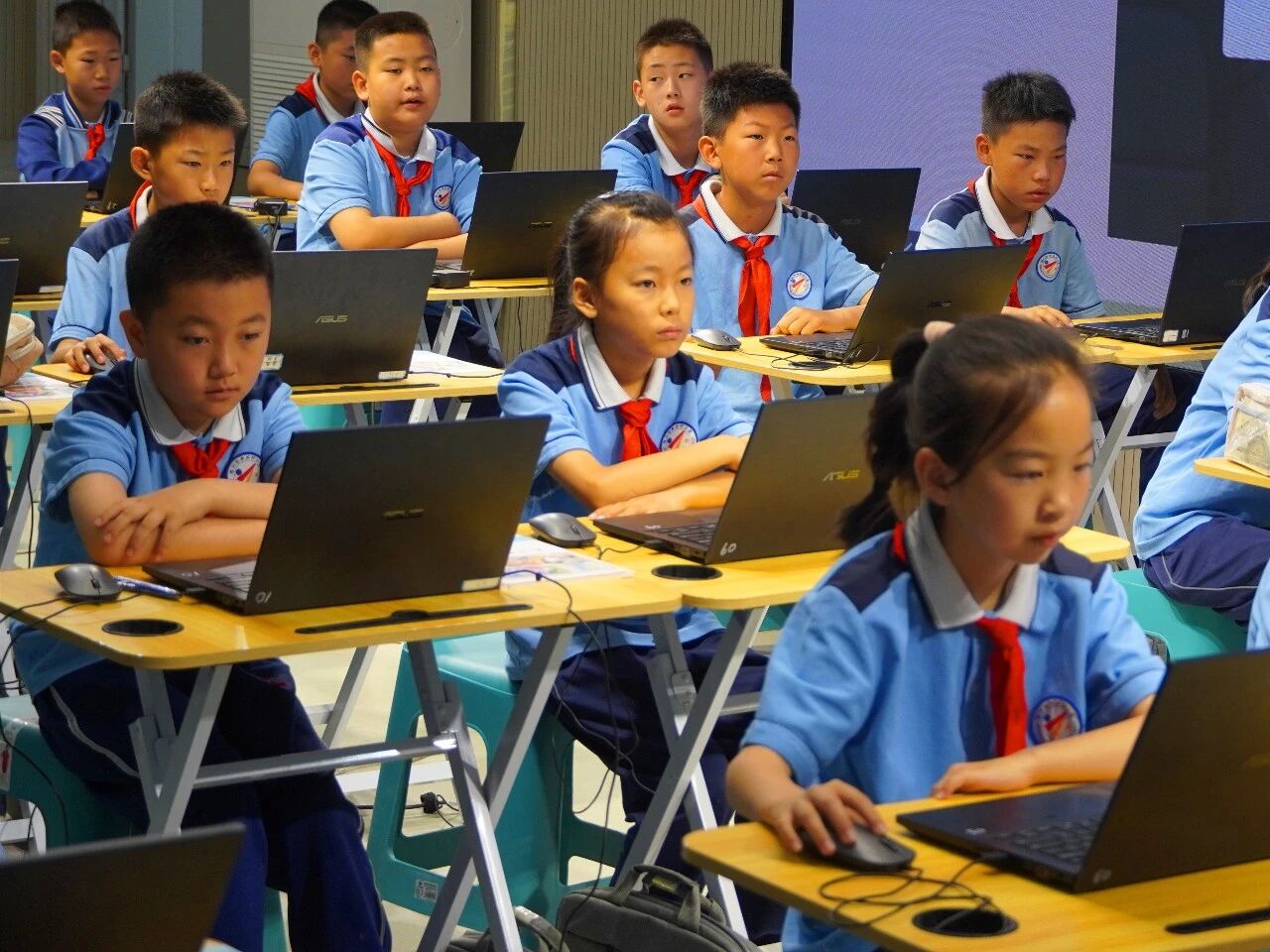
A demonstration event is held in Yinchuan, northwest China's Ningxia Hui autonomous region to showcase achievements in AI-assisted teaching for primary schools, June 11. (Photo courtesy of the education bureau of Xixia district, Yinchuan)
In 2018, the education department of Ningxia Hui autonomous region invested 10 million yuan ($1.47 million) and designated Ningxia No. 15 Middle School as a regional model school for an internet-assisted education initiative. Since then, the school has established 17 smart classrooms and equipped students with more than 900 learning devices.
Today, the school has achieved interconnection between the Smart Education of China platform, Ningxia's smart education platform and its school-based platform. Teachers can access lesson preparation, classroom teaching and teaching research services with a single account.
The platform not only brings together high-quality educational resources from across the autonomous region but also hosts more than 6,000 QR codes linked to key knowledge points, allowing students to learn independently with just one scan.
The digital transformation extends well beyond a single school. Across Ningxia, internet access now reaches 100 percent of schools. Ningxia's smart education platform has more than 1.6 million registered users and updates over 25 million pieces of high-quality teaching resources every year, covering all educational stages and subjects. The platform supports the entire educational process, from content creation and learning assistance to assessment, monitoring, and management, through cloud-based services.
"Technology must be applied smartly and flexibly to meet each student's personalized needs," Xie noted. "At its core, education aims to sustain long-term development. Sound educational practices will light up classrooms far and wide."
Photos

Related Stories
- China's Guangxi enhances services of basic education development
- Feature: At a Chinese school, the lesson is lunch and everything before it
- China adds new university majors to support national strategic needs
- Chinese vice premier urges deepened efforts for high-quality basic education
- Digital technologies proving smart choice for Chinese education
- Students from Xizang and Beijing attend pairing-up educational aid program
- Digital education platform launched in south China to connect universities across tropical regions
- China launches national vocational training ground for embodied robots
- Chinese vice president attends World Digital Education Conference
- 2026 World Digital Education Conference kicks off in China's Hangzhou
Copyright © 2026 People's Daily Online. All Rights Reserved.
