



Recycling process: transforming black mass into battery materials

Photo shows an integrated circular economy industrial park managed by Brunp Recycling in the Yichang Hi-tech Industry Development Zone in Yichang, central China's Hubei province. (Photo/Du Xiaomeng)
Industry projections indicate that China generated nearly 400,000 tonnes of end-of-life electric vehicle (EV) power batteries in 2025, with that volume expected to surpass 1 million tonnes by 2030.
What happens to these batteries once they reach end-of-life? A recent visit by People's Daily reporters offers a closer look.
Trucks laden with retired EV batteries arrive daily at an integrated circular economy industrial park managed by Brunp Recycling, a holding subsidiary of Chinese battery giant CATL. Located in the Yichang Hi-tech Industrial Development Zone in Yichang, central China's Hubei province, this is where these batteries begin a new journey through the recycling chain.
"Upon arrival, retired batteries are sorted and stored according to their models, conditions, and sources," said Chen Zhaozhe, production manager at Yichang Brunp Recycling Technology Co., Ltd. The company recycles more than 150,000 tonnes of power batteries annually.
Inside the storage area, rows of battery packs were neatly stacked. "All these power batteries have degraded to less than 80 percent health," Chen noted. "They suffer slower charging speeds, reduced driving range, diminished power output, and elevated risks of thermal runaway."
Historically, gaps in battery management sometimes allowed end-of-life batteries to re-enter the market. Others ended up in unauthorized workshops with inadequate facilities and recycling technologies, posing significant safety and environmental risks.
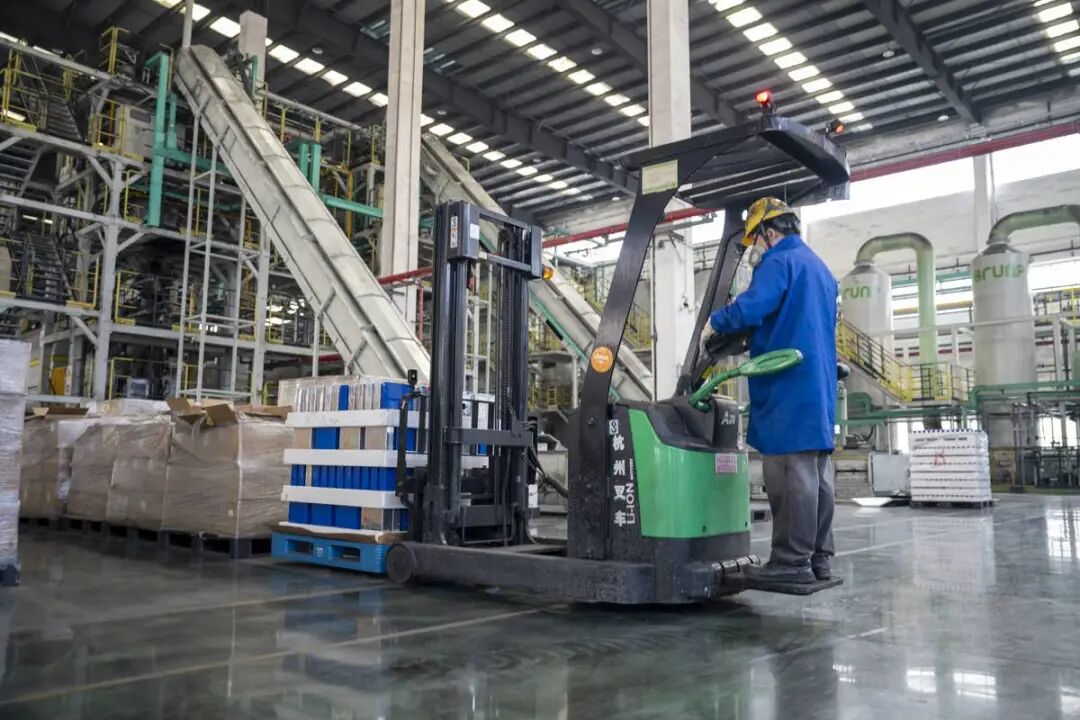
Retired batteries are handled in a workshop. (Photo/Xia Xiaojun)
To address these issues, China launched a national traceability information platform for new energy vehicle power batteries on March 31 this year. Every battery is now required to have its digital identification number recorded throughout its entire lifecycle from manufacturing and vehicle installation to operation, maintenance, retirement, and recycling.
"This not only helps ensure that we follow standardized procedures, but also allows vehicle owners to track where their batteries ultimately go," Chen said. "That increases their willingness to sell retired batteries to authorized recyclers."
The company has established a comprehensive traceability system that tracks every stage of the recycling process, from incoming materials and production procedures to final product shipments.
Once a battery's digital identity is verified, the retired pack moves to an automated dismantling line. Robotic arms skillfully remove the outer casing, revealing densely packed, brick-sized battery cells inside.
These cells, still potentially unstable, undergo a complete discharge process first to reduce their voltage to safe levels.
Following discharge, the cells are processed in crushing equipment, breaking them into uniformly sized fragments. The resulting mixture enters a nitrogen-protected furnace for high-temperature pyrolysis. Subsequent procedures, including dispersion, screening, and sorting, separate constituent materials such as casings, copper, and aluminum.
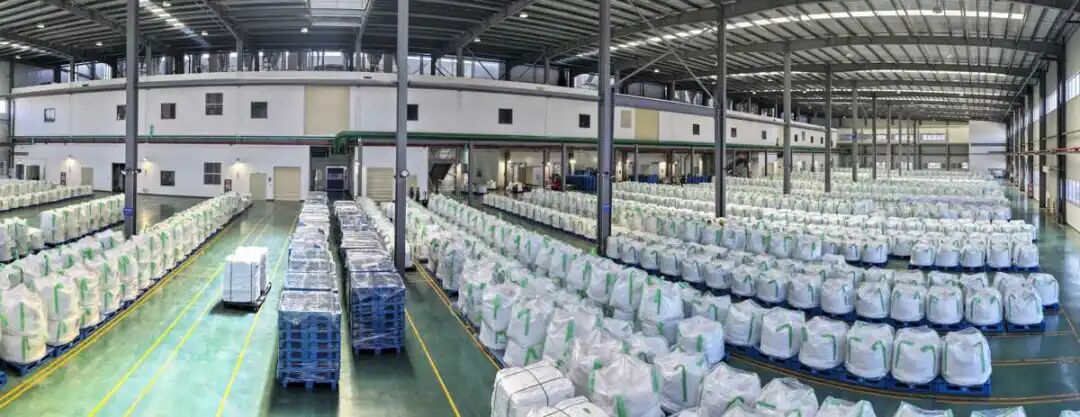
Photo shows lithium iron phosphate powder awaiting delivery to downstream manufacturers. (Photo/Xia Xiaojun)
"Some of these separated materials can be reused directly," said Wang Hao, technical director at Yichang Brunp Recycling Technology Co., Ltd. "What remains is a high-purity black powder known as black mass."
This "black mass" is the most valuable material recovered from the cell, containing concentrated quantities of high-value elements such as lithium, nickel, cobalt, and manganese -- the critical raw materials for future batteries.
In the hydrometallurgical workshop, the black mass is fed into enormous reaction tanks and mixed with specially formulated acidic solutions. Under carefully controlled conditions, an intense chemical reaction takes place. The solid black mass dissolves completely, and its metal elements enter the solution in ionic form, creating a complex "metal soup."
For years, a major challenge in the industry was efficiently and accurately separating and purifying individual metals from this intricate mixture.
"Traditional recycling methods often suffered from low recovery rates, poor product purity, high energy consumption, and the generation of large amounts of difficult-to-treat waste residue," Wang said.
To overcome these limitations, the company developed a direct recycling technology. Using this process, the combined recovery rate for nickel, cobalt, and manganese reaches 99.6 percent, while lithium recovery reaches 96.5 percent.
After passing through multiple processing stages, the dissolved black mass is ultimately transformed into high-purity lithium carbonate and iron phosphate. These newly regenerated raw materials can then be transported directly via pipelines or short-distance logistics to nearby downstream battery manufacturing facilities located just across the road.
"The iron phosphate and lithium carbonate supplied by Brunp Recycling are precisely blended and processed to manufacture new high-performance lithium iron phosphate cathode materials," said Shi Jiang, head of the cathode materials division at another company under Brunp Recycling.
Compared with battery materials produced from newly mined ores, the next-generation lithium iron phosphate batteries made with recycled materials deliver outstanding performance.
"EVs equipped with these batteries offer faster charging speeds and longer driving ranges," Shi said. "They are better able to meet market demand for fast charging, extended range, and greener, lower-carbon transportation."
The full regeneration cycle from discarded battery packs to new raw cathode materials takes just a week.
In recent years, the industrial park has also established a closed-loop system of reverse product design. Lessons learned from the recycling process are fed back to battery manufacturers, helping them design batteries that are easier to recycle.
"For example, we recommend optimizing battery pack structures so they can be dismantled more easily through automated processes after retirement," Chen explained. "We also suggest adjusting the composition of certain metal materials so they can be separated and purified more efficiently during future recycling."
Photos




Related Stories
- New Chinese battery offers fresh hope for hydrogen storage
- Chinese battery giant CATL launches module assembly in eastern Hungary
- Chinese researchers develop new lithium-sulfur battery to help drones fly farther
- Chinese battery giant CATL partners with Türkiye's Togg to develop new EV platform
- Chinese authorities stress regulation on competition order in power, battery energy storage sector
- Chinese scientists achieve safety breakthrough in sodium-ion batteries with self-protective electrolyte
- Chinese researchers achieve important breakthrough in lithium battery technology
- China achieves breakthrough in extracting lithium from salt lakes
- China successfully debuts safety tech for lithium battery air cargo
- China's power battery sales up 48.9 pct in first 3 quarters
Copyright © 2026 People's Daily Online. All Rights Reserved.
