



SMILE satellite marks new chapter in China's space science development
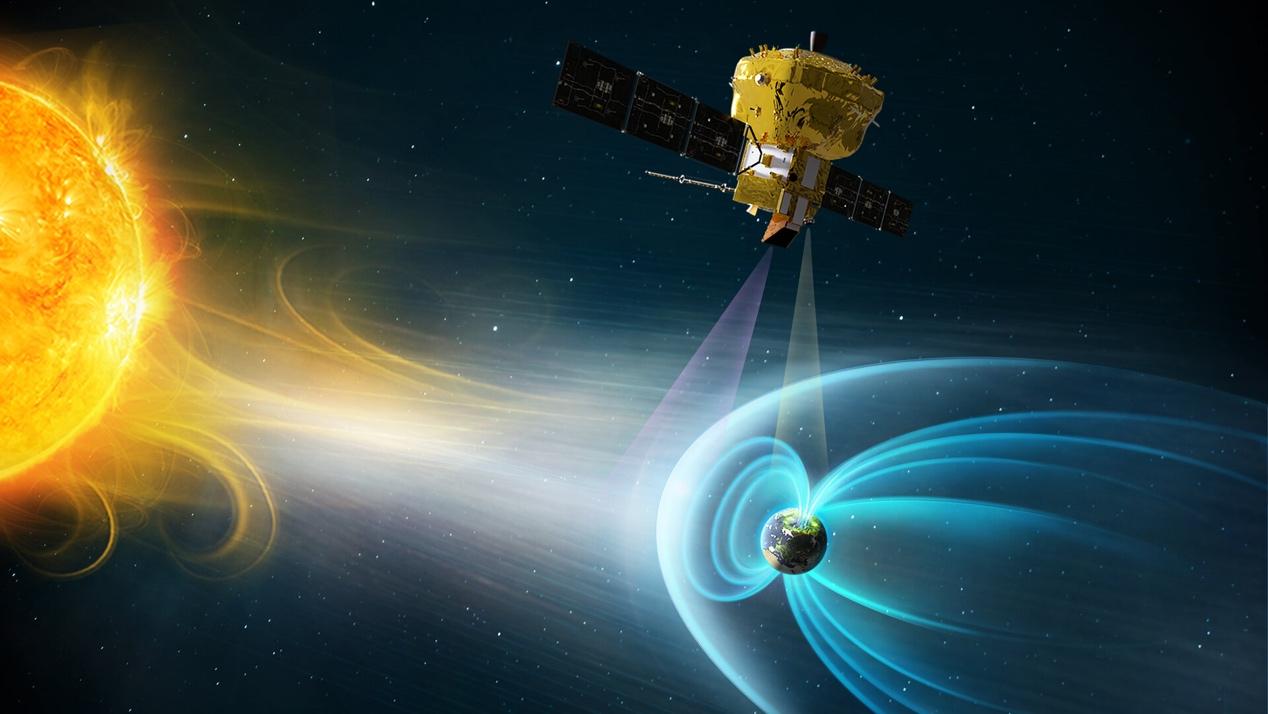
An illustration of the Solar wind Magnetosphere Ionosphere Link Explorer (SMILE) satellite in orbit. (Photo by ESA)
The newly launched Solar wind Magnetosphere Ionosphere Link Explorer (SMILE), a collaborative satellite mission between China and Europe, has successfully entered its designated orbit. This mission marks a groundbreaking advance in solar-terrestrial exploration. Using innovative soft X-ray imaging -- a global first -- SMILE will achieve panoramic imaging of the Earth's magnetosphere.
As the last mission of the strategic pioneer program on space science (Phase II) of the Chinese Academy of Sciences, SMILE addresses a gap in China's space exploration capabilities and marks a pivotal transformation -- from isolated breakthroughs to a constellation of space science satellites.
Space science defines the frontier of deep-space exploration and serves as a key benchmark of national scientific and technological strength. For many years, China's space science program operated from a relatively modest foundation, lacking self-developed high-end exploration satellites and independent data streams. Research largely depended on publicly available foreign datasets, creating major constraints on advanced, frontier scientific research.
A structured national program dedicated to space science satellites began in 2011. This launched a concerted effort over the subsequent decade. A series of dedicated science satellites were successfully developed and launched, including the Dark Matter Particle Explorer (DAMPE) Satellite, the world's first quantum science satellite Micius, the X-ray astronomy satellite Insight-HXMT (Hard X-ray Modulation Telescope), and the Advanced Space-based Solar Observatory (ASO-S), the country's first comprehensive solar observation satellite, achieving major breakthroughs across multiple fields.
DAMPE has detected high-energy cosmic particles all year round in its ongoing search for dark matter, generating critical data to help unravel the mysteries of the universe's origins. Micius was the first to achieve space-to-ground quantum communication over distances of more than 1,000 kilometers, placing China at the forefront of space-based quantum applications. Insight-HXMT has monitored extreme astrophysical phenomena, precisely detecting burst signals from black holes and neutron stars and yielding a series of major original achievements.
Each of these missions pursued distinct scientific objectives with unique capabilities. Progress across multiple fields within space science has been remarkable, propelling China from a late entrant to a significant global contributor. This progression has steadily fortified the technological bedrock essential for future deep-space endeavors.
As deep-space exploration progresses, the inherent limitations of conducting observations using single, independent satellites have become increasingly clear. These include constrained observational scope, gaps in temporal continuity, and data primarily confined to a single dimension or measurement type. This makes it challenging to reconstruct complex dynamic processes that occur in space. Drawing on years of operational experience and research insights, China's space science program is now embracing a new paradigm characterized by constellations of satellites working in concert and integrated networks combining space-based and ground-based observations.
SMILE plays a pivotal role within this evolving structure of systematic exploration. It is designed to function synergistically with ASO-S and the Chinese Meridian Project (CMP), also known as the Ground-based Space Environment Monitoring Network. Together, this integrated space-ground system delivers comprehensive and precise monitoring of the solar-terrestrial space environment. This capability provides vital support for a range of activities, including spacecraft operations, communications, and navigation.
China has also established the world's first three-satellite constellation on the Distant Retrograde Orbit (DRO) in the Earth-moon region of space and yielded a variety of original scientific and technological achievements, laying a solid foundation for future Earth-moon space utilization and cutting-edge deep-space exploration.
Technological self-reliance underpins confidence in systematic space exploration. Today, every critical link in the chain -- from satellite platforms and core payloads to precise on-orbit TT&C (telemetry, tracking and command) and raw data processing -- relies entirely on domestically developed technologies.
At the same time, China remains committed to an open and mutually beneficial approach to international space cooperation. Through collaborative programs such as the SMILE mission, China shares exploration data and co-develops research platforms, integrating into the global space exploration network on the basis of independent innovation while demonstrating the openness and responsibility of a major player in outer space.
Space technology enables space science exploration, while the goals of space science, in turn, drive breakthroughs in space technology. The national mid and long-term development program for space science (2024-2050) released in 2024, outlines a three-step strategic roadmap for China's space science development. Its implementation is expected to elevate the country's space science capabilities and provide stronger support for building China into a space power and a science and technology giant.
From pioneering single-satellite missions to developing satellite constellations and systematic exploration capabilities, the evolution of China's science satellite missions vividly reflects the country's pursuit of greater self-reliance and strength in science and technology. As more science satellite constellations take shape and begin operating in coordination, the foundation for China's self-reliant development in space science will grow ever more solid, driving deep-space exploration further into the unknown.
Photos




Related Stories
- New upgrades, innovations on China's Shenzhou-23 spacecraft
- China's space program: a quiet romance with the world
- Tianzhou missions: a decade of space innovation in China
- China's commercial space sector: advancing from tech verification to commercial scale
- Chinese experiment sees butterfly emerge in space
- Spaceport's milestone a major boost for Hainan space industry
- Shandong develops integrated commercial space industry anchored in offshore launches
- Mouse astronaut selection vlog
- 'Cosmic snapshot' mirrors China's strength in innovation
- China awards medals to Shenzhou-19 astronauts
Copyright © 2026 People's Daily Online. All Rights Reserved.
