



New upgrades, innovations on China's Shenzhou-23 spacecraft
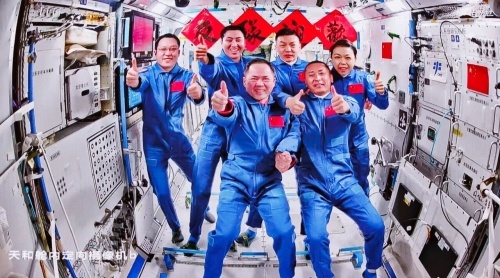
Photo shows a group picture of the crew of Shenzhou-21 and Shenzhou-23 spaceships. (Photo from the official website of China Manned Space)
On the night of May 24, a Long March-2F Y23 carrier rocket lifted off from the Jiuquan Satellite Launch Center in northwest China. With its blazing exhaust lighting up the sky, it successfully sent the Shenzhou-23 crewed spacecraft into its designated orbit. The mission marked a complete success and secured a strong start for China's 2026 crewed space launch program.
What new breakthroughs and innovations does this mission feature? Let's take a closer look.
Upgraded spacecraft windows offering triple-layer anti-ablation protection
One of the most notable upgrades on Shenzhou-23 is the optimization of its viewport window structure.
An expert from the China Academy of Space Technology noted that after cracks appeared in the windows of the Shenzhou-20 spacecraft, astronauts were forced to remain in orbit longer than planned, prompting China's manned space program to carry out its first-ever emergency launch mission.
In response, the Shenzhou engineering team redesigned the window structure. Previously, the windows used a single layer of anti-ablation glass. The upgraded design now incorporates two layers of anti-ablation glass plus an additional interior protective layer, giving the windows triple anti-ablation protection.
The new structure significantly improves resistance to impacts from space debris, adding another layer of safety for astronauts working and living aboard the space station.
Shenzhou-23 and other spacecraft of the same batch have also achieved major improvements in return payload capacity.
Previously, a returning Shenzhou spacecraft could carry only around 50 kilograms of cargo back to Earth, meaning scientific samples had to be carefully prioritized. Following technical upgrades, the new spacecraft can now return more than 100 kilograms of payload, with cargo space tripled compared with earlier models.
Inside the cabin, several newly developed technologies aim to improve both efficiency and safety. A specially customized lightweight display and control console reduces both weight and size while allowing astronauts to monitor complex spacecraft parameters more efficiently. A rapid hatch leak detector can quickly assess sealing conditions by entering or exiting the station. Meanwhile, retractable control sticks made from carbon fiber materials are ergonomically designed to fit naturally in astronauts' hands, improving operational precision.
First-ever 3.5-hour radial docking mission
Another major breakthrough came during Shenzhou-23's mission to the Tiangong space station, when the spacecraft successfully completed China's first radial rendezvous and docking under a 3.5-hour fast-track mode.
Among all docking methods, radial docking is widely regarded as the most technically demanding and is often compared to "threading a needle in space."
According to experts involved in the spacecraft's guidance, navigation and control (GNC) system, conventional front or rear docking approaches benefit from relatively stable intermediate parking points, reducing the control burden on the system.
Radial docking, by contrast, has no stable holding point. The spacecraft must continuously adjust both its attitude and orbit throughout the process, remaining under dynamic control at all times. This requires real-time management of fuel consumption while placing extremely high demands on the responsiveness, precision and autonomy of the GNC system.
Environmental monitoring systems have also been upgraded. Sensors developed by China Electronics Technology Group Corporation can continuously track cabin pressure, temperature, humidity and gas composition. Experts said data collected by these sensitive components enables real-time monitoring of the spacecraft's internal environment.
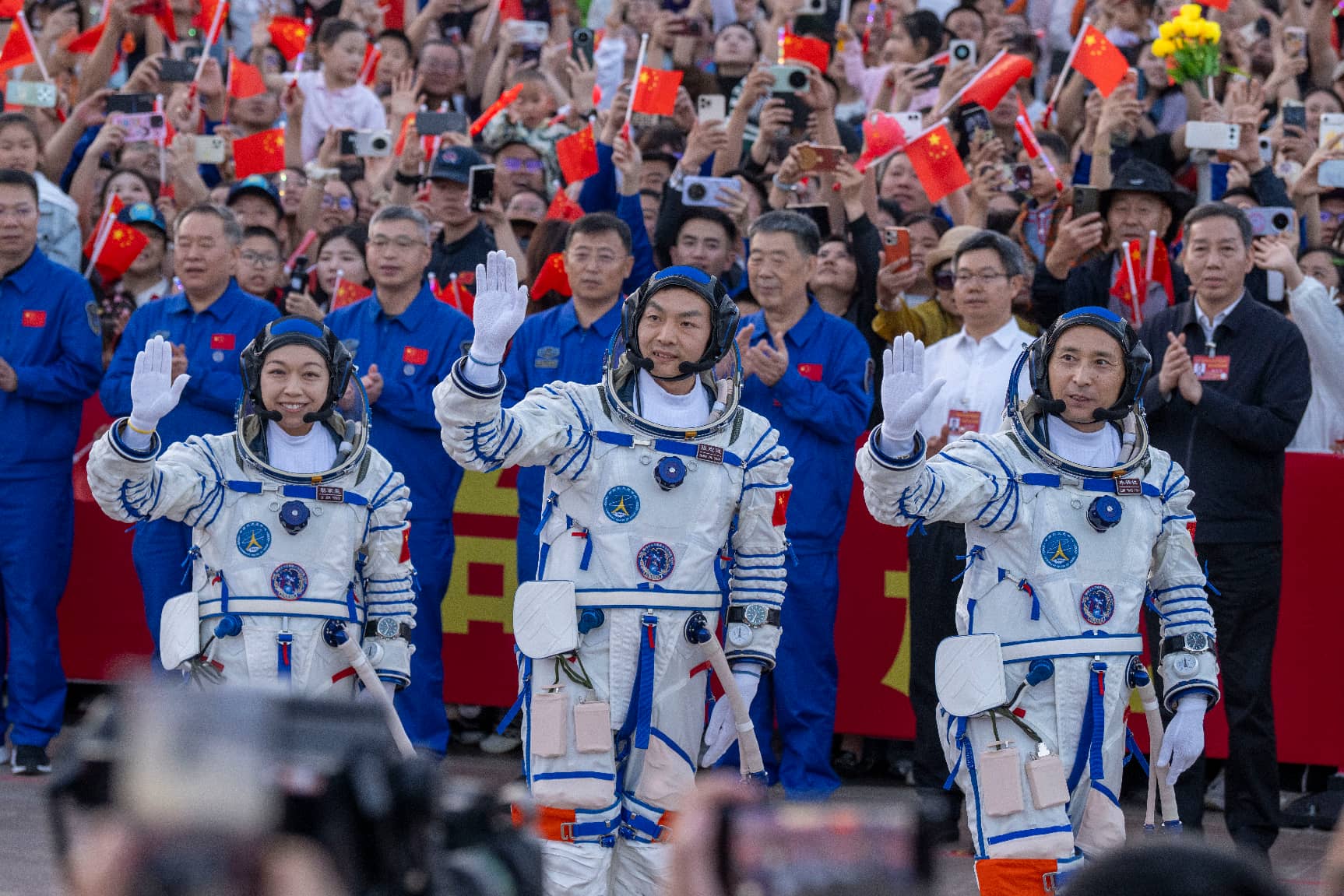
A send-off ceremony for the three Chinese astronauts of the Shenzhou-23 crewed space mission is held. (Photo/Weng Qiyu)
Rice cultivation experiment points toward future lunar farming
Alongside engineering upgrades, Shenzhou-23 is carrying nine scientific experiments into orbit, including studies involving rice seeds, liver cells, nanozymes, actinomycetes and perovskite solar cells.
One key scientific challenge is how to achieve efficient, high-quality and high-yield food production directly in space. This mission will attempt something unprecedented: rice carried aboard Shenzhou-23 will first be harvested in orbit, and the harvested seeds will then be replanted for a second generation of cultivation in space.
The experiment marks the world's first continuous two-generation rice cultivation test conducted in orbit. Researchers hope it will provide valuable data on how long-term microgravity affects the genetic stability and growth of rice.
At the same time, two additional rice samples are being used as comparison groups, one descended from rice that had previously traveled to space, and another making its first journey into orbit. By comparing their growth under space conditions, researchers hope to further explore the scientific foundations for future food production on the Moon or Mars.
Perovskite solar cells are also expected to open a new chapter in space research. Known for their high efficiency, light weight, ultra-high power-to-mass ratio and low-temperature solution processing capabilities, perovskite solar cells are considered a promising future energy solution for space stations and deep-space bases.
During this mission, the Chinese space station will carry out its first dynamic in-orbit performance experiment on perovskite solar cells, collecting data on conversion efficiency degradation under the extreme conditions of space and providing scientists with deeper insights into their long-term performance.
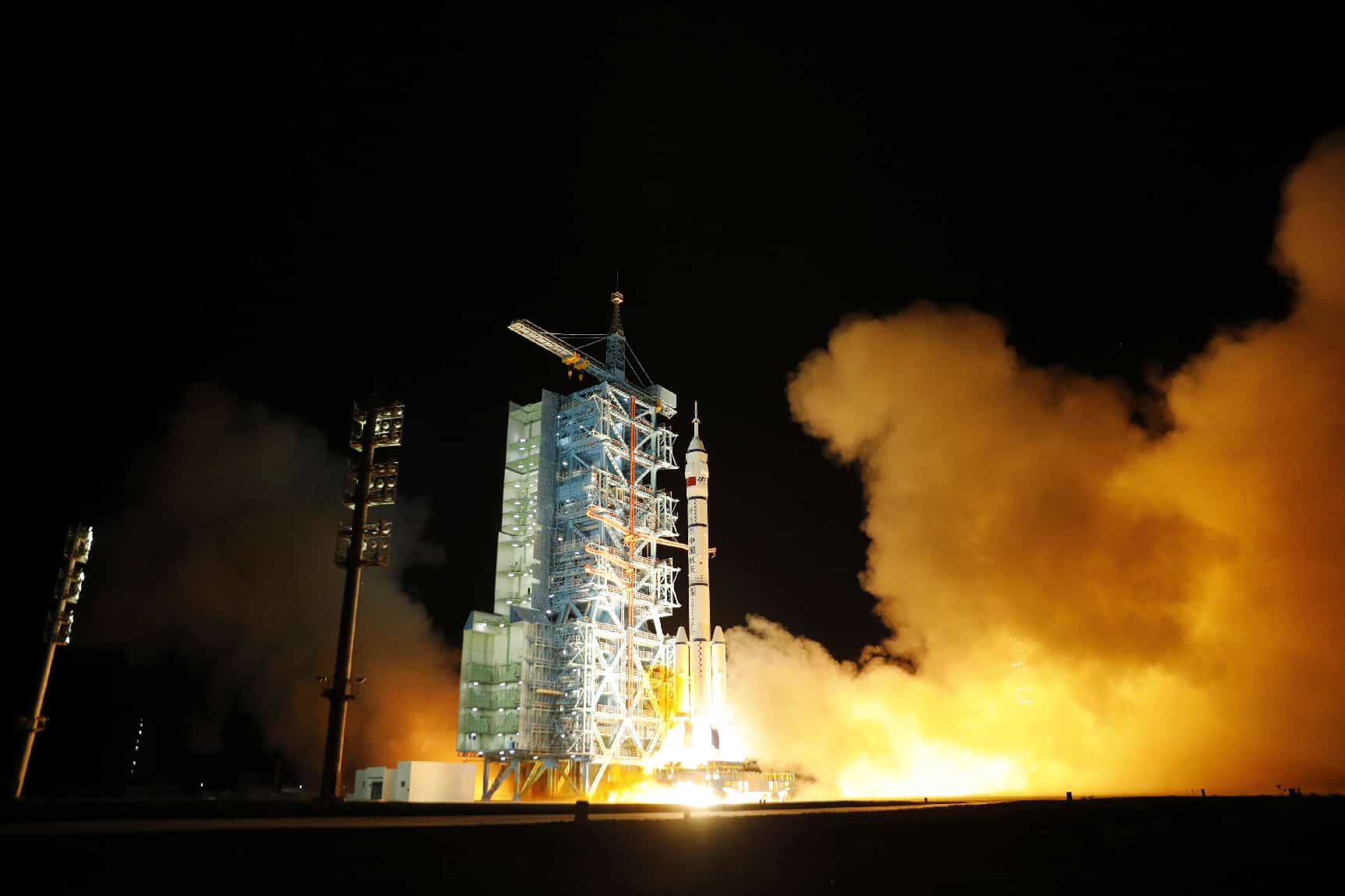
A Long March-2F Y23 carrier rocket carrying the Shenzhou-23 spacecraft lifts off from the Jiuquan Satellite Launch Center in northwest China, May 24. (Photo/Cheng Lin)
Photos


Related Stories
- China's space program: a quiet romance with the world
- Tianzhou missions: a decade of space innovation in China
- China's commercial space sector: advancing from tech verification to commercial scale
- Chinese experiment sees butterfly emerge in space
- Spaceport's milestone a major boost for Hainan space industry
- Shandong develops integrated commercial space industry anchored in offshore launches
- Mouse astronaut selection vlog
- 'Cosmic snapshot' mirrors China's strength in innovation
- China awards medals to Shenzhou-19 astronauts
- China’s Ministry of State Security urges crackdown on space espionage
Copyright © 2026 People's Daily Online. All Rights Reserved.
