



China's new 'space gas station' satellite breaks new ground for in-orbit servicing
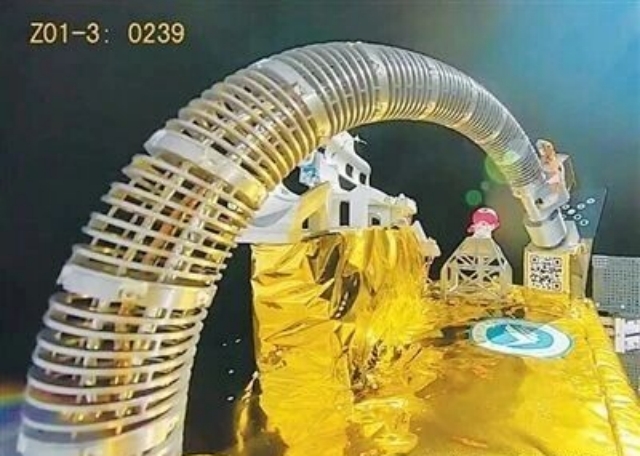
The Yuxing-3 06 satellite conducts in-orbit technological verification for refueling and docking operations with its flexible robotic arm. (Photo provided by Emposat)
In space, every satellite eventually faces the same problem: once its onboard propellant runs out, is the end of its mission inevitable?
Chinese researchers are rewriting this rulebook with a groundbreaking solution: functional, in-orbit satellite refueling. Their vision paints a new era of sustainable space operations, where specialized service satellites cruise through orbit to offer orbital refueling to depleted spacecraft. Equipped with advanced flexible robotic arms, these orbital helpers can autonomously lock onto a satellite's fuel port, top up its propellant tank, and depart to assist the next craft in need -- acting just like mobile gas stations floating in the vacuum of space.
A major step toward that goal came recently with the successful launch of the Yuxing-3 06 satellite from the Jiuquan Satellite Launch Center in northwest China.
Developed by Sustain Space in Suzhou, east China's Jiangsu province, a subsidiary of Beijing-based commercial satellite company Emposat, the satellite has earned the nickname "space gas station."
As China's first commercial experimental satellite equipped with a flexible robotic arm, it carried out a series of complex in-orbit operations hundreds of kilometers above Earth, including simulated propellant refueling tasks using the robotic arm.
The mission verified a number of key technologies and marked an important step forward for China's commercial space sector in the in-orbit space services.
Cao Meng, vice president of Emposat, said the satellite is designed to serve as a future "refuelling assistant" in orbit.
Its intended mission scenario involves rapidly locating the precise position of a target satellite in the vastness of space, then performing carefully controlled orbital maneuvers to enable rendezvous and docking between the two spacecraft with extreme precision, "like threading a needle," before carrying out the refueling process, Cao said.
The most critical component of the technology verification satellite is its flexible robotic arm.
"We made an innovative design to make the flexible robotic arm lighter, more agile and more reliable," said Chen Jing, chief technology officer of Sustain Space.
During the simulated refueling process, the satellite demonstrated three different control modes to adapt to different operational scenarios.
According to Chen, the first mode allows the robotic arm to autonomously plan its movement path after receiving preset mission instructions. In the second mode, ground operators generate control commands in real time based on live camera images, remotely guiding the robotic arm to complete docking operations.
The third mode uses a visual servo system: based on visual target information captured by the camera at the end of the robotic arm, ground operators plan the movement path and generate control commands to guide the arm through the docking process.
Space industry experts believe that as more and more space assets are deployed in orbit in the future, a growing number of spacecraft, including satellites, will require services such as propellant refueling and in-orbit maintenance.
"We hope to build the equivalent of a 'space 4S shop' in orbit," Cao said, referring to China's one-stop automotive service centers. "Our goal is to provide one-stop maintenance and servicing solutions for space assets."
Photos



Related Stories
- China launches Pakistani satellite
- China launches Lijian-1 Y12 rocket to send 8 satellites into space
- China successfully launches test satellite for satellite internet technology support
- China launches new internet satellite group
- China successfully launches new test satellite
- China-Europe SMILE satellite ready for launch
- China's experimental satellite constellation lays foundation for future lunar exploration
- China launches two new satellites
- China shares first Fengyun-4C satellite observation images
- China launches new remote sensing satellite
Copyright © 2026 People's Daily Online. All Rights Reserved.
