



Make AI governance a new 'intersection' for global cooperation
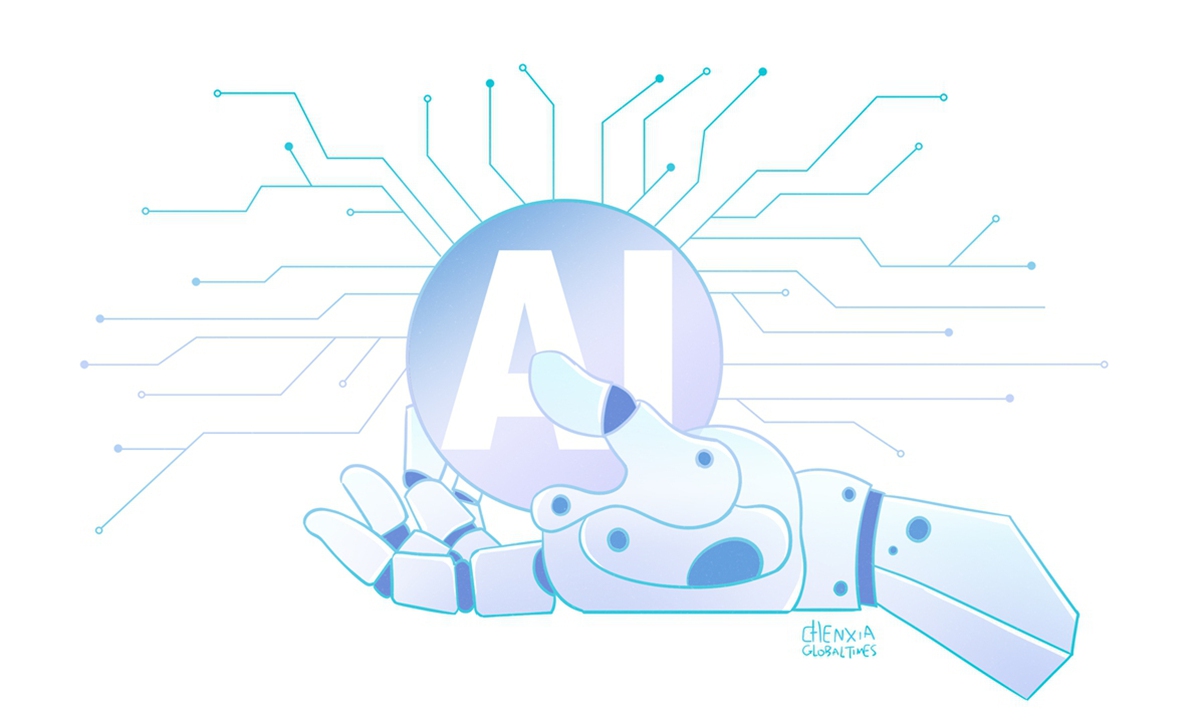
Illustration: Chen Xia/GT
Recently, in a conference hall at the UN headquarters in New York, a discussion on artificial intelligence (AI) development went beyond algorithms and models, focusing instead on the idea of "a shared future." The thematic meeting of the Group of Friends for International Cooperation on AI Capacity-Building, co-chaired by representatives from China and Zambia, brought together more than 120 representatives from over 50 countries and international organizations. From foundational computing power to algorithmic breakthroughs, and from engineering applications to deep-space computing, AI technology is advancing rapidly, while also creating a significant governance vacuum. Ensuring that the principle of AI for good and for all is effectively implemented has therefore become an urgent task for the international community.
As the world enters the AI era, security risks are no longer confined to science fiction. On one hand, there lie unprecedented opportunities; on the other, unpredictable risks emerge. Advanced AI models can solve complex problems and detect vulnerabilities at a speed and scale far beyond human capacity, yet they also lower the threshold for malicious use. Whether in open-source communities or closed-source systems, they all face the daunting challenge of achieving effective governance and preventing the global spread of risks. The columnist of The New York Times, Thomas L. Friedman once offered a vivid analogy: Two guys in a cave with a laptop, access to the latest AI models and a Starlink terminal could attack the critical infrastructure of any society. This is not alarmist talk. Cybersecurity experts warned that frontier AI models have reduced the time needed to identify system vulnerabilities from weeks or even months to just minutes. Attackers only need to find one vulnerability, while defenders must secure them all.
When "governance fails to keep pace with the rapid development of AI" has become a shared challenge for all countries, the need to build a global AI governance framework based on extensive consultation, joint contribution, and shared benefits has become even more urgent.
From deepfakes and cyberattacks to the recent use of AI in military applications in conflicts in the Middle East, the misuse of technology has sounded the alarm bell for humanity. No country can remain unaffected, and regulatory gaps in any single country may become sources of global risk. All parties urgently need to take a broader perspective grounded in building a community with a shared future for humanity, engage in dialogue on their respective regulatory and legislative frameworks and governance standards, and seek broad consensus while strengthening policy coordination on key issues such as AI safety and data flows.
On the issue of global AI governance, China's stance has consistently been proactive, responsible, open, and coherent. Guided by the vision of a shared future for humanity, China has actively implemented the Global Governance Initiative (GGI) and the Global AI Governance Initiative put forward by President Xi Jinping, and has remained committed to contributing to global development and providing public goods. It has successively proposed and advanced initiatives such as the AI Capacity-Building Action Plan for Good and for All, the Global AI Governance Action Plan, and the AI+ International Cooperation Initiative, turning these visions into concrete actions. In July 2024, the 78th session of the United Nations General Assembly adopted by consensus a resolution proposed by China on Enhancing International Cooperation on Capacity-building of Artificial Intelligence, which was eagerly co-sponsored by more than 140 countries. This stands as a typical example of China contributing its wisdom and solutions to global AI governance.
At the practical level, China has already taken the lead. Through responsible top-level planning, the Chinese government ensures that open-source large models such as DeepSeek and MiniMax M2.5 are harnessed to empower a wide range of industries, enhance public welfare, and advance international cooperation.
From universities in Brazil to financial institutions in South Africa, from helping build rescue bridges after a major earthquake in Myanmar to supporting Cambodia's fisheries in transitioning away from extensive practices, China's AI, while serving its own high-quality development, has also benefited the world through technological openness and ecosystem co-building.
Turning "AI for good" into reality is the responsibility and obligation of all countries. No single nation, no matter how powerful, can monopolize this vast field of AI, nor can it bear alone the global risks associated with the technology. Since the beginning of this year, more rational voices have emerged in the US calling for China-US cooperation on AI. On May 6, the Wall Street Journal cited sources as saying that China and the US are considering to conduct a more extensive and formal dialogue on exploring AI governance. This is good news for the world. In fact, the two countries have maintained coordination on AI governance through both official and Track II dialogues in recent years. However, to achieve further progress, the key lies in the US working with China, abandoning its restrictions and suppressive measures against China in the field of AI, as well as its negative attempts to build exclusive blocs internationally.
Clearly, zero-sum thinking and geopolitical rivalry have become the biggest obstacles to global AI governance. AI should not become the private property monopolized by any individual power, nor a tool for closed clubs of select countries, and certainly not a sword hanging over humanity.
Building a global AI governance system that is inclusive, equitable, and sustainable is vital to the future and destiny of humanity. All parties should uphold genuine multilateralism and pool their efforts within the framework of the UN to achieve high-quality development. The sharing of experiences and mutual learning is key to breaking through governance dilemmas. It is hoped that all parties will demonstrate greater sincerity in openness and cooperation, so that AI can become a bridge connecting the world and benefiting society.
Photos



Related Stories
- Feature: Chinese AI robot dogs bring smart tourism experience to Singapore
- China sees surge in one-person companies in AI era
- China calls for equitable sharing of AI-driven digital dividends
- Chinese envoy calls for promoting AI for greater good
- Data center engineers working silently behind booming AI services
- AI drives new career frontiers in China
- Pentagon announces deals with AI companies for classified networks
- China explores, develops better datasets for smarter digital future
- China launches campaign to rectify improper AI content production
- Young Chinese gear up for new job opportunities amid China's tech boom
Copyright © 2026 People's Daily Online. All Rights Reserved.
