



Chinese vehicle makers' global upgrade points to opportunities
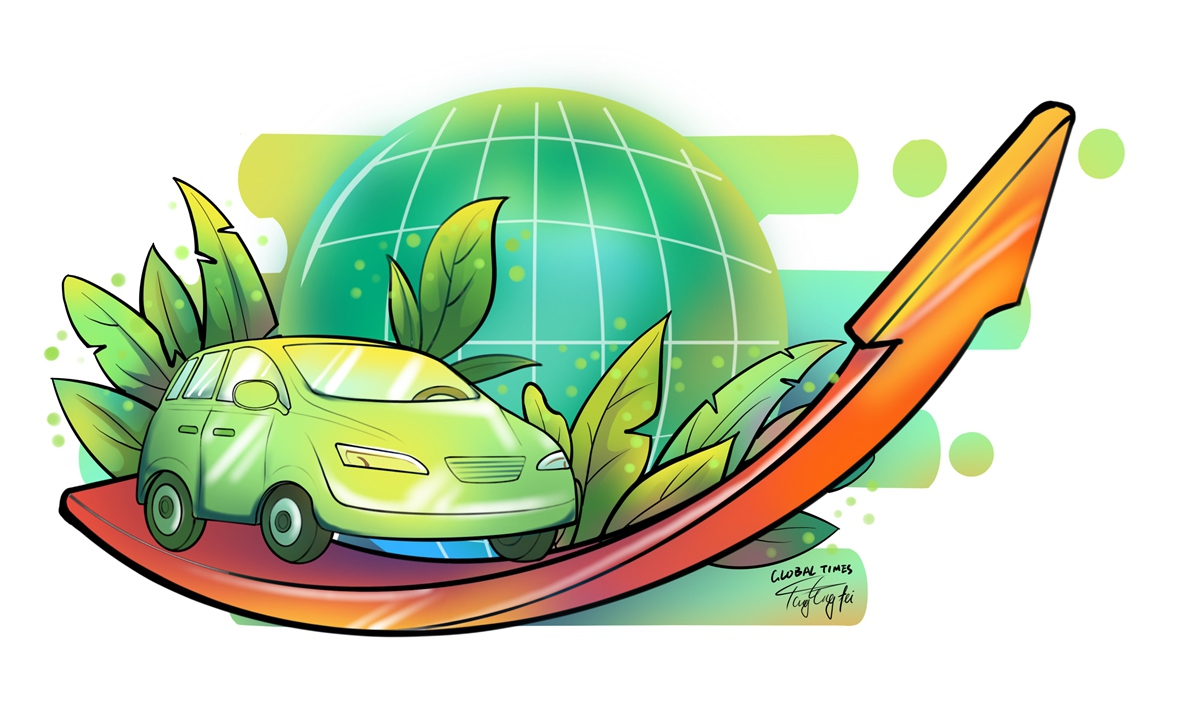
Illustration: Tang Tengfei/GT
After early attempts that largely involved exporting China-designed cars with minor tweaks, Chinese automakers are now re-engineering vehicles from the ground up for foreign buyers, with models in the pipeline from small hatchbacks for Europe to pickup trucks for Australia and Mexico, Reuters reported on Tuesday.
This trend is just one facet of a broader upgrade in Chinese carmakers' overseas expansion. But the upgrade goes far beyond the localization of product research and development (R&D); it extends to in-depth integration across the entire industrial chain, including production, supply chains, and services, fostering more complex and intensive mutually beneficial cooperation between Chinese and European automotive industries.
For a long time, the main approach of Chinese carmakers entering overseas markets was to adapt mature, market-proven domestic models for direct exports. Currently, Chinese automakers' "Going Global 2.0" approach is taking shape, involving deeper research into local demand in overseas markets and increased investment to better integrate into these markets.
Behind this strategic upgrade lies the overall improvement of China's vehicle industry. Developing dedicated models for overseas markets requires a complete forward-engineering development system, a global R&D network, deep knowledge of local regulations and standards, and cross-cultural design and communication capabilities.
This comprehensive localization strategy has naturally given rise to more complex and intensive industrial chain cooperation. Such in-depth integration will only deepen the interdependence between Chinese automakers and European businesses.
European auto parts suppliers have long taken active steps to strengthen ties with their Chinese partners.
For instance, German auto parts giant ZF said in July 2025 that it was intensifying technology cooperation with Chinese automakers, the Xinhua News Agency reported. Bosch has supported about 300 models from Chinese brands in entering overseas markets, according to another Xinhua report. Schaeffler AG Chief Executive Officer Klaus Rosenfeld said on Tuesday that the company sees Chinese manufacturers making cars in Europe as an opportunity for more business as well as expertise from the new entrants, Bloomberg reported.
The pragmatic attitude toward cooperation confirms the profound complementarity between the Chinese and European car industrial chains. Chinese automakers have obvious advantages in electrification, intelligence, and supply chain efficiency, while European suppliers have profound accumulation in precision manufacturing and materials science.
When Chinese vehicle makers enter Europe with a new generation of automotive concepts and some European suppliers show an open attitude for cooperation, the two sides are essentially jointly shaping the supply chain pattern of the future automotive industry. This cooperation is not dependence, but mutual benefit and win-win based on their comparative advantages.
The global car industry is undergoing a dramatic transformation. New technologies such as electric vehicles and autonomous driving are reshaping the industry's landscape. This trend is both an inevitable outcome of the technological revolution and a source of new opportunities for all parties.
Chinese automakers' deep localization creates jobs and contributes tax revenue overseas; openness to cooperation can help Europe maintain its position in auto parts and avoid missing out on the growth dividends of emerging industries.
From a broader perspective, this healthy complementarity and deep collaboration will improve the overall efficiency of the global automotive industry, speed up the market application of new technologies, and ultimately benefit consumers.
This mutually beneficial cooperation, grounded in commercial logic and industrial principles, is not without real-world challenges. Protectionist measures and the "de-risking" rhetoric from certain politicians have recently cast a shadow over normal business collaboration. But experience shows that the fundamental logic of industrial development will ultimately prevail over short-term disruptions.
China-Europe auto cooperation is about letting their complementary strengths shine. As Chinese automakers intensify their localization, both industries are set to achieve deeper integration and shared growth during the ongoing global automotive transformation.
Photos



Related Stories
- Eased range anxiety boosts NEV long-distance travel during May Day holiday
- China's highway NEV charging volume surges 55.6 pct on first day of May Day holiday
- German, Chinese automakers forge deeper ties to seize new energy vehicle opportunities
- At world's largest auto show, rising fuel costs boost China's NEV opportunity
- Beijing Auto Show poised to become world’s largest amid rise of Chinese EV industry
- China's leading EV maker BYD tops global automotive innovation ranking: media report
- Expat test-drives Chinese NEV: 'This thing is so cool!'
- Chinese automaker Chery opens NEV manufacturing plant in Thailand
- At Melbourne Motor Show, Chinese new energy vehicles win attention beyond fuel savings
- China, Thailand to enhance cooperation in NEV talent cultivation: officials
Copyright © 2026 People's Daily Online. All Rights Reserved.
