



Intangible cultural heritage emerges as draw for foreign visitors
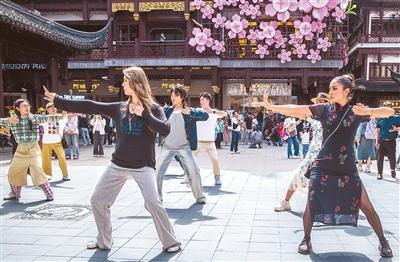
Citizens and foreign visitors practice Baduanjin, an ancient exercise routine and a national intangible cultural heritage, at the central square of Yuyuan Garden in Shanghai. (People's Daily Online/Huang Yongqing)
China's inbound tourism has maintained strong momentum since the beginning of this year, and a growing number of international visitors are arriving with a specific aim: to experience the country's intangible cultural heritage (ICH) firsthand.
From kite-making in east China's Shandong Province to lantern parades in east China's Anhui Province, foreign travelers are moving well beyond sightseeing — actively engaging in traditions that have been passed down for generations.
When a group of Thai tourists arrived in Weifang city, Shandong Province, recently, one of them knew exactly what she had come for. "I came here to fly a kite for the first time in my life," she said. Instructors at the hotel taught them how to make a kite, including building a bamboo frame and painting traditional patterns. "When I watched it lift into the sky, I thought: wow, I really am in the kite capital of the world. It's an immersive cultural experience."
Tuo Yanzheng, an associate professor at Nankai University's College of Tourism and Service Management, said that the distinctive, hands-on nature of ICH aligns naturally with what today's international travelers are looking for. ICH experiences are both a vivid vehicle for sharing Chinese culture with the world and a key lever for strengthening the appeal of inbound tourism, Tuo said.

Thai tourists take part in a kite-making and flying intangible cultural heritage activity in Weifang city, east China's Shandong Province. (Photo/Li Xin)
In Hongcun village, a UNESCO World Heritage Site in Huangshan city, Anhui Province, Norwegian visitor Park carried a rabbit lantern and a fish lantern through stone-paved alleyways during the village's traditional lantern parade. Being surrounded by drumming and light in person is a completely different experience from watching a video, he said.
During this year's Spring Festival holiday, lantern parades in Hongcun village drew large numbers of foreign visitors.
Online travel agency Ctrip data show that during this year's Spring Festival holiday, French arrivals to Huangshan city surged 300 percent year on year, while Canadian and Singaporean arrivals climbed 233 percent and 400 percent year on year, respectively.
According to Ctrip, visits to cultural products on its platform — including museums, ICH experiences and guided tours — rose 13 percent year on year in 2025, while multilingual cultural and museum offerings on its overseas platform climbed 63 percent year on year. During the Qingming Festival holiday, inbound tourism bookings at ICH-related sites surged 540 percent year on year, with seven of the top 10 most-booked inbound destinations falling into that category.
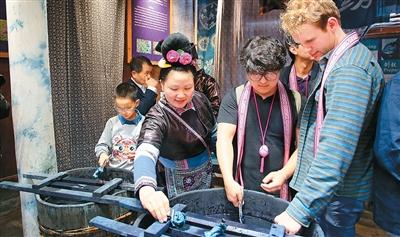
Local villagers teach foreign visitors the art of indigo dyeing in Zhaoxing Dong village, Liping county, southwest China's Guizhou Province. (Photo by Wu Guanghui/Xinhua)
Foreign visitors are no longer content to watch giant pandas behind glass — they want to immerse themselves in Chinese culture, said Zheng Pengfei, a researcher at the Ctrip Research Institute.
In the past, many foreign visitors arrived with their image of China fixed around a few symbols — kung fu, giant pandas, the Great Wall, Zheng said. "After taking part in ICHs like kite-making, they understand that a Chinese kite is not just a recreational object but an art form that carries people's wishes. ICH makes culture tangible and memorable."
At the Wangxian Valley Scenic Spot in Shangrao city, east China's Jiangxi Province, American visitor Marcus encountered the ICH of Nuo dance, a 2,000-year-old ritual to ward off evil and bring good luck, for the first time. Foreign visitors can follow inheritors of the tradition to learn the steps, put on Nuo masks, and join a bonfire celebration — turning what might have been a performance into a cross-cultural interactive experience. According to Ctrip, by April 17, the site had seen inbound visitor numbers rise 273 percent this year compared with 2023, with immersive experiences like an ICH market and the Nuo dance proving the biggest draw.
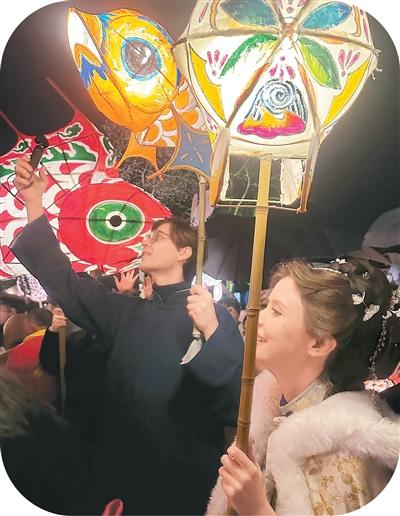
Foreign visitors join a lantern parade in Hongcun village, Huangshan city, east China's Anhui Province. (Photo/Zheng Wen)
Yang Hong, director of the Intangible Heritage Communication Research Center at Communication University of China, said ICH experiences are an in-depth cultural dialogue that transcends language. "A well-designed experience engages visitors sensually, emotionally and intellectually, giving them a practice-based understanding of Chinese wisdom and ways of life. That is the deeper force driving ICH as a new engine for inbound tourism," Yang added.
The best way to protect ICHs is not to lock them behind glass, but to bring them back into everyday life — turning ICHs into tourism products that can be booked, enjoyed and reviewed, said Zheng, who argued that the goal should be to create experiences that naturally resonate with visitors. When ICHs move into streets, villages, hotels and farm stays, and when foreign visitors shift from onlookers to participants, ICHs become a genuine new engine for high-quality inbound tourism.

Foreign visitors take part in a fur ski making experience in Altay, northwest China's Xinjiang Uygur Autonomous Region. (Photo/Ye Jiangjiang)
Photos



Related Stories
- Intangible cultural heritage workshops boost rural revitalization and employment opportunities
- China's intangible cultural heritage shines during Spring Festival
- Passionate advocate brings China's intangible cultural heritage to global audiences
- China's Huaihua blends tech with tradition to boost heritage tourism
- Inheritors make efforts to preserve, revitalize intangible culture heritage in Tai'an, E China's Shandong
- Artisan makes intangible cultural heritage part of modern life in Xining, NW China's Qinghai
- Inheritors integrate intangible cultural heritages into modern life
- Ancient agarwood tradition thrives in Dongguan's Guanxiang Heritage Park
- County in SW China's Guizhou leverages intangible cultural heritages to boost tourism
- China makes notable progress in intangible cultural heritage protection
Copyright © 2026 People's Daily Online. All Rights Reserved.
