



From cargo carriers to power banks: China's containers energize new industries
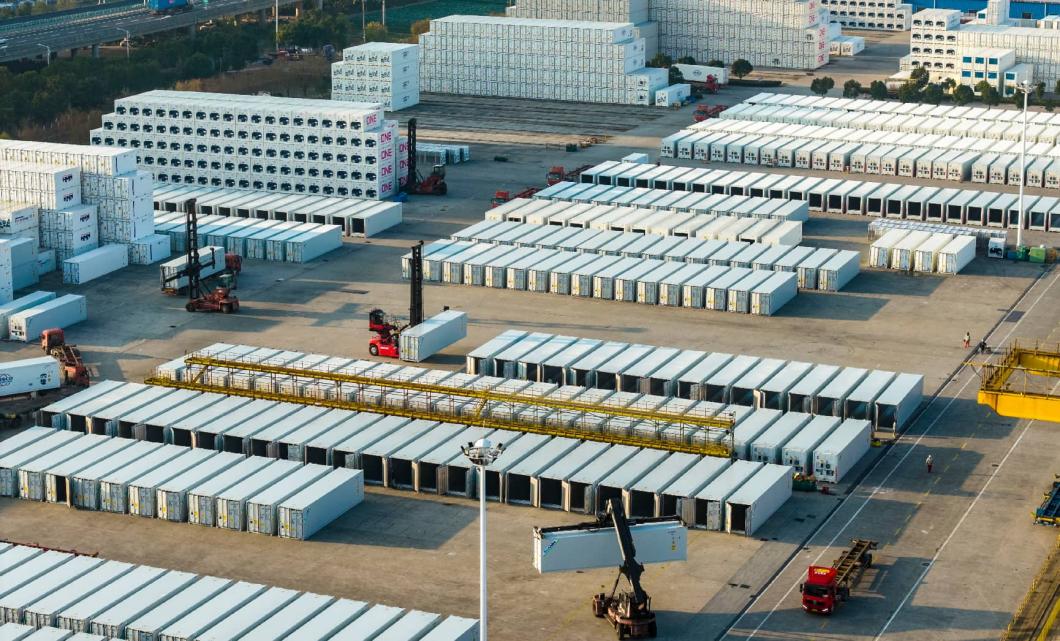
Photo shows refrigerated containers manufactured by Taicang CIMC Reefer Logistics Equipment Co., Ltd. in east China's Jiangsu province. (Photo/Ji Haixin)
China has long been the backbone of the global container industry. In 2024, the country produced more than 8.1 million twenty-foot equivalent units (TEUs), up 268.2 percent year on year, accounting for 96 percent of global output.
Today, these steel structures transcend their traditional role as standardized shipping units, evolving into creative urban modules and critical infrastructure for renewable energy sectors.
At Dong Fang International Container's Jiangsu facility, rows of newly manufactured units await shipment to European clients via Shanghai's Yangshan Port. Though externally identical to standard containers, their interiors reveal sophisticated battery arrays integrated with safety systems, thermal controls, and environmental management technology -- essentially transforming them into massive "power banks."
"Modern container manufacturing extends far beyond welding steel boxes," explains Zhai Jianxing, the company's technical director. "Material science is now paramount." Energy storage containers demand radically different specifications from shipping units: requiring 20+ year lifespans (versus 2-year warranties for standard units) and meeting rigorous standards for explosion prevention, fire resistance, and corrosion protection.
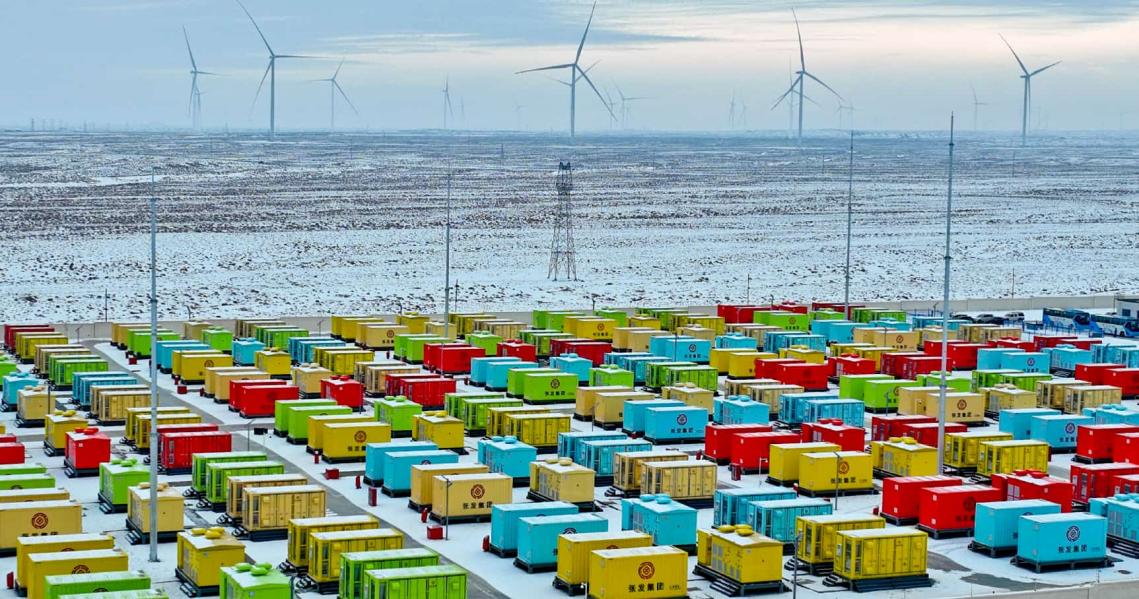
Photo shows an energy storage station in Linze county, Zhangye, northwest China's Gansu province. (Photo/Wang Jiang)
To meet these challenges, manufacturers have pioneered advanced materials. Traditional weather-resistant steel with triple-layer paint has been replaced by zinc-aluminum-magnesium coated steel, offering self-healing properties and exceptional resilience in high-salinity coastal environments.
Other innovations have followed. Ceramic wool insulation has been added for fire protection; environmentally friendly water-based coatings have replaced traditional oil-based paints; and bamboo flooring has been introduced to reduce reliance on timber resources.
These advancements enable containers to serve diverse new functions across renewable energy generation, computing centers, and modular construction. Beyond industrial applications, containers are revitalizing communities.
In Huanghu township, Hangzhou, east China's Zhejiang province, two stacked containers sit in an open space in a smart agriculture park. Inside, lettuce grows on metal racks while tomatoes thrive under artificial lighting. This mobile, digitally controlled plant factory offers a striking example of innovation.
"Through precise environmental control systems, we tailor light formulas, nutrient solutions, and temperature and humidity conditions for plants," said Lei Lina, head of the facility. As a flexible cultivation unit, container-based plant factories can be assembled and transported like building blocks, making it easier to supply fresh produce locally.
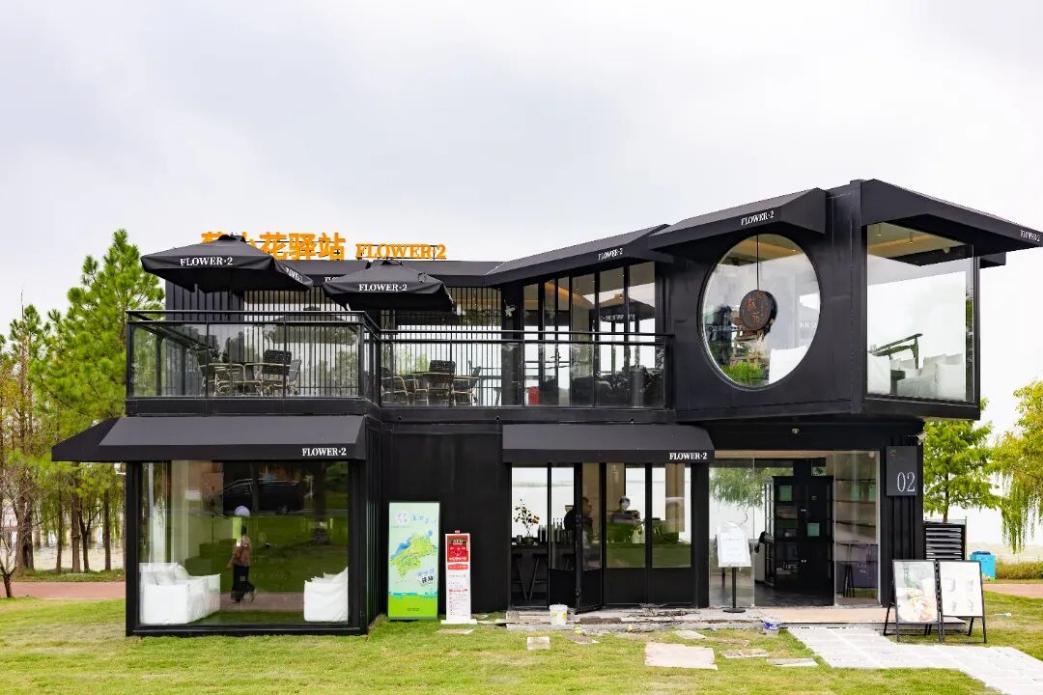
Photo shows a cafe built from specialized containers in Suzhou, east China's Jiangsu province. (Photo from the official account of Taihu New Town on WeChat)
Meanwhile, along the East Taihu Lake in Suzhou, Jiangsu province, visitors are drawn to a stylish cafe. Built from four specialized containers, the structure combines aesthetic appeal with practical functionality.
"To adapt these containers for civilian use, we incorporated soundproof panels, fire-resistant magnesium oxide boards for flooring, and high-strength steel just 6 millimeters thick for structural support," said Qian Xiaohui, head of Suzhou Zhongnan Steel Structure Co., Ltd. "This ensures safety while maximizing interior space."
The expanding versatility of containers is closely tied to advances in smart manufacturing.
At an intelligent factory of a logistics equipment company under China International Marine Containers (CIMC) in Ningbo, Zhejiang province, more than 500 robots perform welding, assembly, and painting with millimeter-level precision. Steel plates are transformed into standard dry cargo containers along automated production lines.
"By leveraging 5G, artificial intelligence (AI), and digital twin technologies, we've achieved automated and intelligent production," said Zhang Kechao, the company's general manager. "Per capita efficiency on a single production line has increased by over 30 percent, and capacity utilization has reached 95 percent."
At CIMC's refrigerated container base in Qingdao, east China's Shandong province, AI-powered industrial models enable the production of a high-end refrigerated container in just 220 seconds on average. In Xinhui, south China's Guangdong province, more than 300 automated spray guns operate on fully automated powder-coating lines, ensuring seamless and comprehensive coverage.
From a "green revolution" in materials to breakthroughs in application scenarios and upgrades in intelligent manufacturing, the transformation of China's container industry reflects the integration of new quality productive forces into traditional sectors.
As technologies such as AI and the Internet of Things continue to develop, this "Made-in-China" product is poised to play an even greater role in global trade, energy transition, and urban development.
Photos



Related Stories
- Three Gorges Ship Lock marks 22 years of operation, handles over 2.24 billion metric tons of cargo
- Cargo giants from Middle East tap further into Chinese market, boosted by rising cross-border e-commerce
- China-US cargo routes bustle again
- Central China’s Henan Province launches 16 new air cargo routes to boost cross-border e-commerce expansion
- Intelligent robots debut in spotting malfunctions in China's cargo railway, achieving 100% identification for common faults
- China adds 75 international air cargo routes in first four months, nearly 90% to Asia, Europe
- Guangzhou launches direct shipping route to South America
- Air cargo carriers add 19 routes to Europe in Jan-Feb, reflecting growing trade
- First China-Europe Express of cargo ship completes maiden voyage in just 26 days
- Rapid rail cargo trains launched, connecting various city clusters in China as market-oriented reform deepens
Copyright © 2026 People's Daily Online. All Rights Reserved.
