



China offers examples in pursuit of zero-waste cities
Three Chinese cities — Hangzhou, Sanya and Suzhou — were named to the inaugural "20 Cities Towards Zero Waste" initiative under the United Nations Secretary-General's Advisory Board on Zero Waste on March 27.
Each day in Dongxin neighborhood, Binjiang district, Hangzhou, east China's Zhejiang Province, a 67-year-old resident surnamed Wang pulls out her phone and scans a QR code on a smart recycling cabinet to dispose of her kitchen waste.
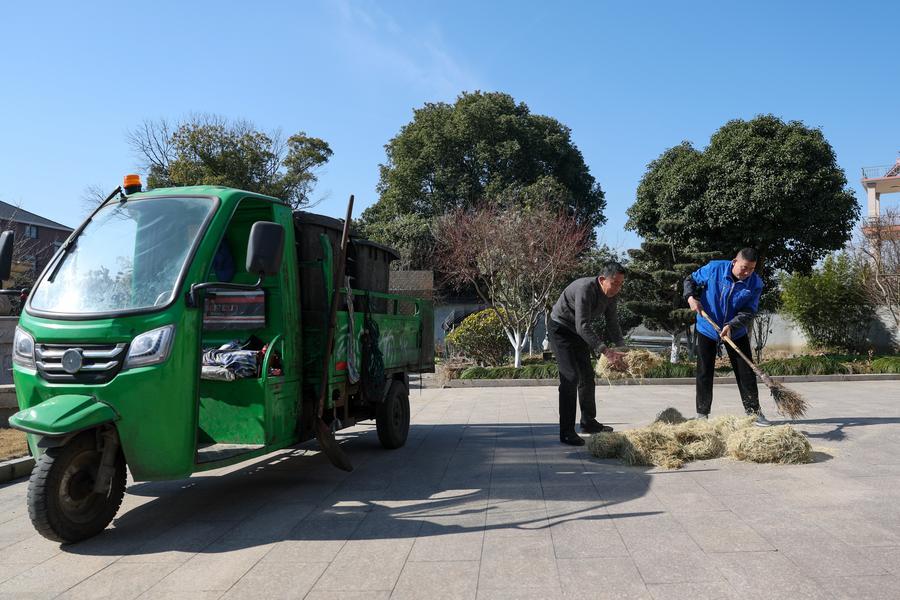
A staff member (R) collects recyclable waste at a villager's home in Puning village of Hangzhou, east China's Zhejiang Province, Jan. 14, 2026. (Xinhua/Jiang Han)
Through smart recycling infrastructure and a points-based reward system, resident participation in waste sorting in the neighborhood has steadily increased.
Binjiang district has rolled out smart recycling equipment across multiple residential communities and introduced a "carbon points" incentive scheme, under which properly sorted waste earns points redeemable for household goods or credits toward community-service fees. Once collected, recyclables are loaded onto GPS-equipped garbage trucks and transported to sorting centers for recycling.
Behind this increasingly routine picture of smart waste recycling lies a broader ambition: Hangzhou is building a citywide digital governance platform for household waste, covering every stage from sorting and collection to transportation and disposal.
Yang Min, deputy director of Hangzhou's administrative law enforcement bureau, said the platform uses big-data analytics to issue real-time alerts and enable smart dispatching. It provides decision-making support for optimizing waste drop-off points, planning collection and removal routes, and allocating disposal facilities. Online appointment systems and doorstep pickup services make it easier for residents to participate in waste sorting and recycling.
In 2025, Hangzhou recycled 2.46 million tonnes of recyclable materials, up 5.13 percent year on year, with household-generated recyclables rising by 18.26 percent.
The platform connects in real time to 7,361 household waste collection points, 1,780 GPS-enabled waste transport vehicles, nine waste incineration plants and 11 perishable waste treatment facilities across the city.
"Waste governance in Hangzhou is shifting toward a digitally integrated paradigm," Yang said.
In Sanya, south China's Hainan Province, a beach-cleaning robot can cover more than 3,000 square meters of beach per hour, according to Zhao Guocheng, an assistant researcher at the Hainan Research Institute of Shanghai Jiao Tong University.
The deployment of robots and new technologies is just one piece of Sanya's zero-waste puzzle.
Sanya's household waste incineration plant processes up to 2,850 tonnes of household waste per day and generates roughly 450 million kilowatt-hours of electricity annually.
At the plant, real-time emissions data scrolls across a large display screen. Readings for particulate matter, sulfur dioxide, nitrogen oxides and other pollutants all remain below national standards.
To date, Sanya has established 676 "zero-waste cells" — designated entities committed to advancing the city's zero-waste objectives — along with 218 routine checkpoints to enforce its plastics ban.
The city reduces consumption of single-use plastic products by an average of roughly 8,000 tonnes per year and recovers nearly 30,000 tonnes of waste plastic annually.
Within the Circular Economy Industrial Park of Suzhou Industrial Park in Suzhou, east China's Jiangsu Province, waste from various enterprises and production stages is systematically reorganized, redistributed and utilized, forming a stable, self-sustaining circular system.
Wang Zhibin, deputy director of Suzhou's ecology and environment bureau, said the city has pushed ahead with creating "zero-waste factories" and "zero-waste industrial parks." The initiative brings waste governance down to the enterprise level, enabling coordinated processing and resource recycling across industrial parks.
The city's comprehensive utilization rate for bulk industrial solid waste has reached 98.1 percent. Meanwhile, 64 industrial parks and clusters, along with several major enterprises, have launched zero-waste governance programs.
Photos


Related Stories
- Turning waste into wealth: China's grassroots path toward a "zero-waste" future
- China's Xiamen combats emerging pollutants
- Waste oil recycled into products in SW China's Sichuan
- New technology keeps waste facilities odor under control
- EU proposes new rules to reduce wasteful packaging
- China to improve utilization of industrial solid waste
- China endeavors to turn construction waste into resources
- China's first radioactive waste glassification facility operational
- China eats its fill as take-out boxes scaled back
- In green milestone, China to end solid waste imports
Copyright © 2026 People's Daily Online. All Rights Reserved.
