



Migratory birds flock to wetland park in E China's Anhui on northward journey
Caizi Lake National Wetland Park in Anqing, east China's Anhui Province, is awakened by the chirping of migratory birds. Covering an area of 2,539 hectares, the park serves as a major gathering place for birds in spring.
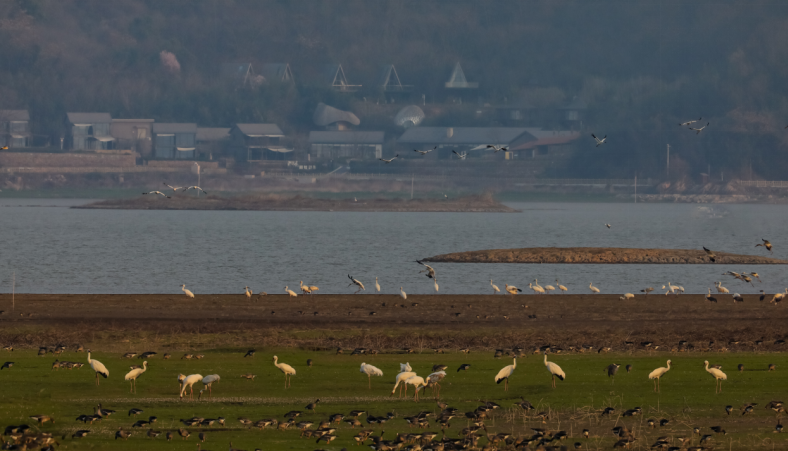
Birds are seen at Caizi Lake National Wetland Park in Anqing, east China's Anhui Province. (Photo/Chen Jun)
The latest data show that 889 Siberian cranes, a wild species under China's first-class state protection, have been spotted in the park, more than double the previous record of 440, which was itself a historic high.
Siberian cranes, often referred to as "living fossils," have exceptionally high environmental requirements. Their presence along the northward migratory route in spring reflects the park's sound ecological conditions.
In addition to Siberian cranes, other migratory birds have also gathered at the park, including 40 hooded cranes and 55 oriental white storks. Both species are under China's first-class state protection, said staff member Chen Chunli.
At Caizi Lake National Wetland Park, eight high-definition video monitoring devices operate around the clock. Annual resource surveys and bird banding research complement the system, forming a monitoring network that covers space, air and land. In addition, a team of patrol staff and volunteers keeps watch for activities that may harm the environment.

Photo shows Caizi Lake National Wetland Park in Anqing, east China's Anhui Province. (People's Daily Online/Gao Feiyue)
Caizi Lake is an important channel of the water diversion project that transfers water from the Yangtze River to the Huaihe River. It also forms a key part of the region's high-grade waterway network, with undeniable value for shipping and navigation.
However, since 2023, the waterway has enforced a seasonal shipping ban from November to March to create a quieter environment for migratory birds. Thanks to these measures, the park now attracts around 100,000 migratory birds each winter.
Photos




Related Stories
- Migratory birds pictured in China's Heilongjiang
- Caspian terns gather at Xinglin Bay in SE China's Xiamen
- Large number of herons seen in Jinjiang River in Chengdu, Sichuan
- In pics: birds seen at rice field in Bulacan Province, the Philippines
- Feature: Guardian's 40 years of protecting migratory birds at China's largest freshwater lake
- Migratory birds grace mangroves in S China's Guangxi
- Pic story of two generations of bird guardians in China's Jilin
- Migratory cranes march about the Yangtze
- Lanzhou uses acoustic technology to monitor, protect birdlife
- Bridge over Yangtze River sets up enclosed noise barrier to protect birds
Copyright © 2026 People's Daily Online. All Rights Reserved.
