



Integrated monitoring network protects tiger and leopard habitats in NE China
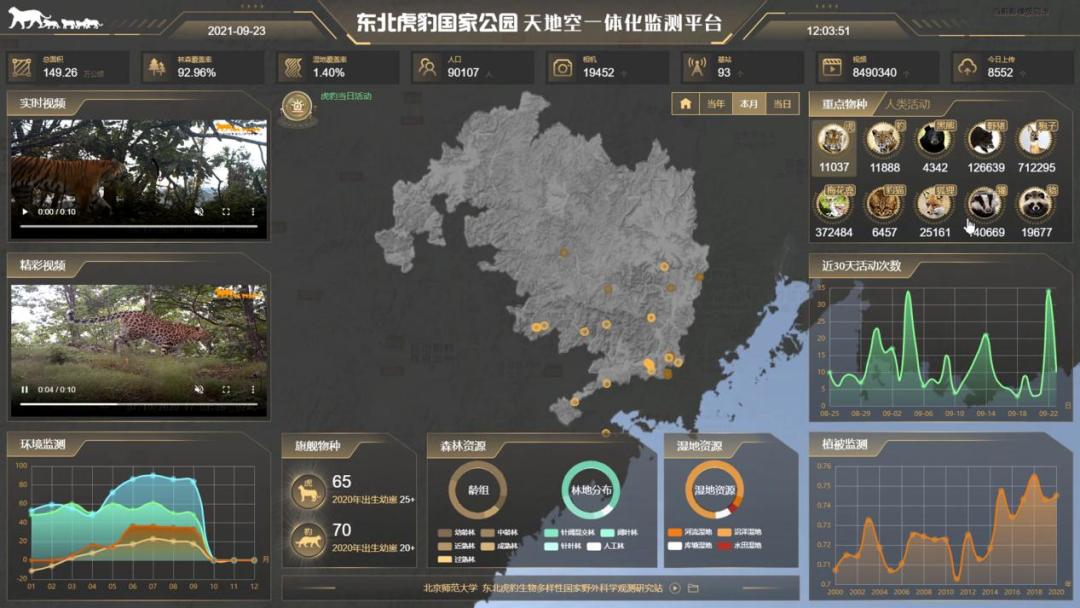
Photo shows an integrated ground-air-space monitoring platform for the Northeast China Tiger and Leopard National Park in Hunchun, northeast China's Jilin province. (Photo provided by Beijing Normal University)
As March brings warmer temperatures to northeast China, the snow and ice blanketing its forested mountains begin to thaw.
At 8:30 a.m., a People's Daily reporter arrived at a research base of the Northeast China Tiger and Leopard National Park in Hunchun, northeast China's Jilin province, and joined Feng Limin -- director of the monitoring and research center for Siberian tigers and Amur leopards under the National Forestry and Grassland Administration and a professor at Beijing Normal University (BNU) -- for a trek into the mountains. The trip offered both a field survey and a glimpse into the daily work of researchers deep in the forest.
Not long after entering the woods, the crisp air and birdsong set the scene, while herds of sika deer could be seen leaping through the trees.
As they moved deeper into the forest, Feng suddenly stopped, his eyes lighting up. On a patch of unmelted snow lay a dense cluster of tracks -- interwoven footprints of sika deer and roe deer, mixed with signs of wild boars. Pointing to a larger, rounder print, he said excitedly, "That's a tiger's footprint!"
"Imagine yourself as a tiger, how would this forest feel?" Feng said, mimicking a tiger's gait with childlike enthusiasm.
"When I enter the forest, I instinctively step outside the human perspective. Only by seeing the forest through the animals' eyes -- observing how they move, forage, and live -- can we advance meaningful research and conservation," Feng explained.
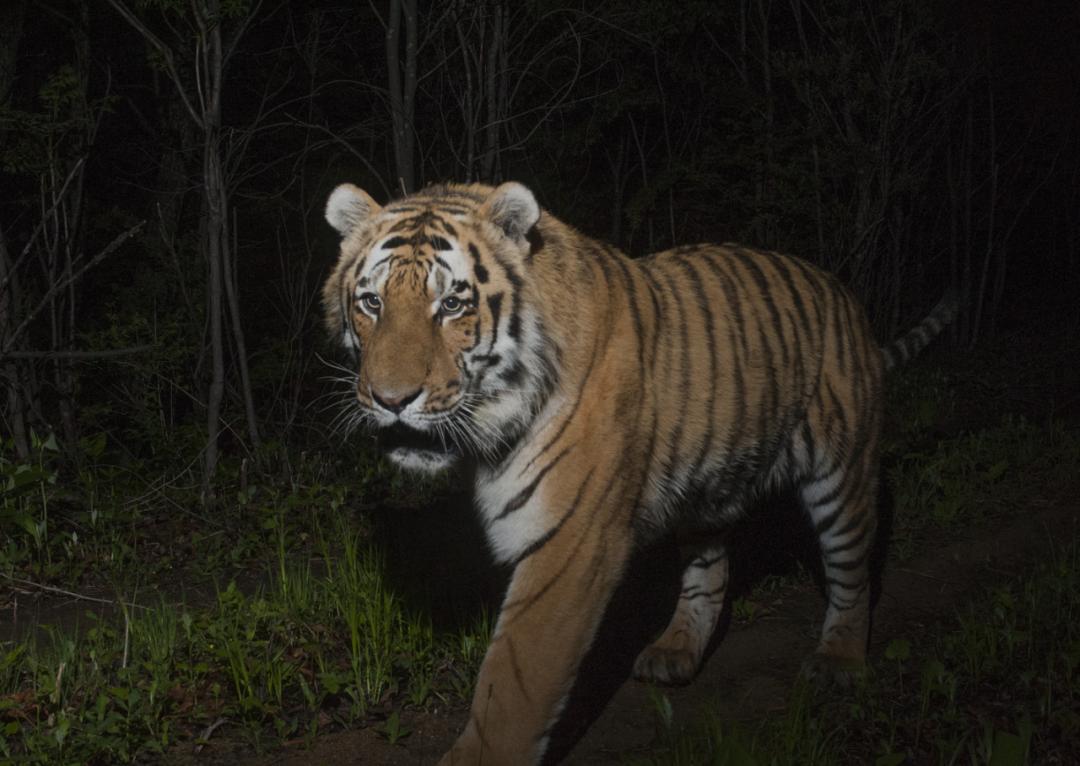
A Siberian tiger photographed in the Northeast China Tiger and Leopard National Park in Hunchun, northeast China's Jilin province. (Photo/Feng Limin)
The rich variety of tracks in the snow serves as tangible evidence of the park's improving ecosystem.
In Miaoling, a rural village, two elderly residents strolled along a local road. "In my youth, deer sightings were rare," remarked Diao, a septuagenarian. "Now we watch herds graze on the hills right from our windows. The environment here has truly transformed."
Infrared cameras, each fitted with solar panels, lined the forest trails. "More than 20 years ago, we had to go into the mountains to replace batteries and retrieve film from these cameras, which meant long delays," Feng explained. "Now, with solar power and real-time data transmission, most camera sites in the national park can send back real-time images and videos in real time."
Feng's team at BNU developed an integrated ground-air-space monitoring platform, enhancing transparency and efficiency in species tracking, patrols, anti-poaching operations, and fire prevention.
He displayed a sequence of clips: a villager carrying wire appeared before a camera; days later, a roe deer passed the same spot; then, a hunter dragged the deer downhill. By the next day, forest police were documented collecting evidence against the suspected poacher.
In recent years, Jilin province has carried out special campaigns to remove illegal traps from the park. With the comprehensive real-time monitoring system, illegal activities have virtually nowhere to hide.
Today, the national park operates a large-scale, integrated monitoring network: nearly 30,000 ground-based infrared cameras run around the clock, supported by satellite remote sensing from space and drone patrols in the air, achieving near-complete coverage.
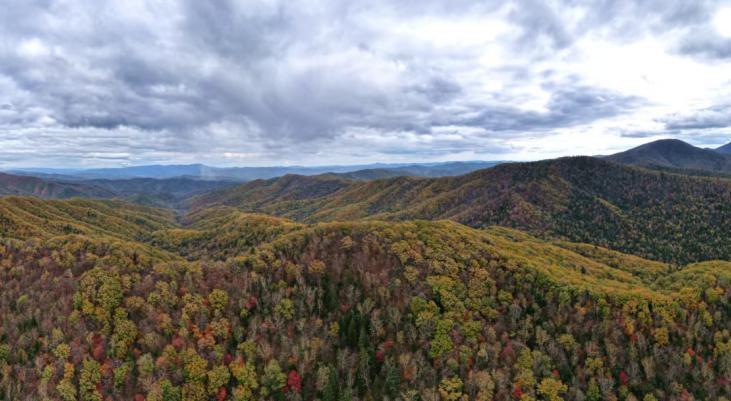
Photo shows the Northeast China Tiger and Leopard National Park in Hunchun, northeast China's Jilin province. (Photo/Feng Limin)
With advanced technology and sustained conservation efforts, results are becoming increasingly evident. The populations of Siberian tigers and Amur leopards have grown from 27 and 42 to around 70 and 80, respectively.
"Another discovery!" Feng exclaimed after discovering tiger scat following the earlier footprint. "Collecting feces is an important non-invasive sampling method. It contains valuable information about the tiger's diet, genetic makeup, and health -- crucial for research."
Reflecting on key milestones, Feng outlined a timeline: Jilin province banned hunting of terrestrial wildlife in 1996; national nature reserves were established in Hunchun and Wangqing in the early 2000s; commercial logging in key state-owned natural forests was halted in 2015; and in October 2021, the Northeast China Tiger and Leopard National Park was officially established, covering 14,100 square kilometers.
At 3 p.m., the group returned from the mountains. Still full of energy, Feng headed off to meet a group of high school students from an affiliated school of BNU, where he was scheduled to give a science outreach lecture. No matter how busy he is, he always makes time for public education -- reaching an audience of over 1 million people.
Photos



Related Stories
- China's pioneering push to bring back snow leopard to Helan Mountains
- Leopard house at Xining Wildlife Park reopens after renovation
- Highland Creatures: A snow leopard shares a Moment
- Population of snow leopards in Qinghai reaches 1,200, signaling key progress in endangered species protection
- Mountain county changes its spots to ensure leopards thrive
- Chubby leopard's resemblance to Zootopia's Officer Clawhauser goes viral
- Rare snow leopard spotted in Qilian Mountains of China
- Snow leopard spotted in China's giant panda national park
- Monitoring system aids wild animal protection efforts in NE China
- Rare North China leopard captured on film in forest in N China's Shanxi
Copyright © 2026 People's Daily Online. All Rights Reserved.
