



Xiong'an: building a city around green space
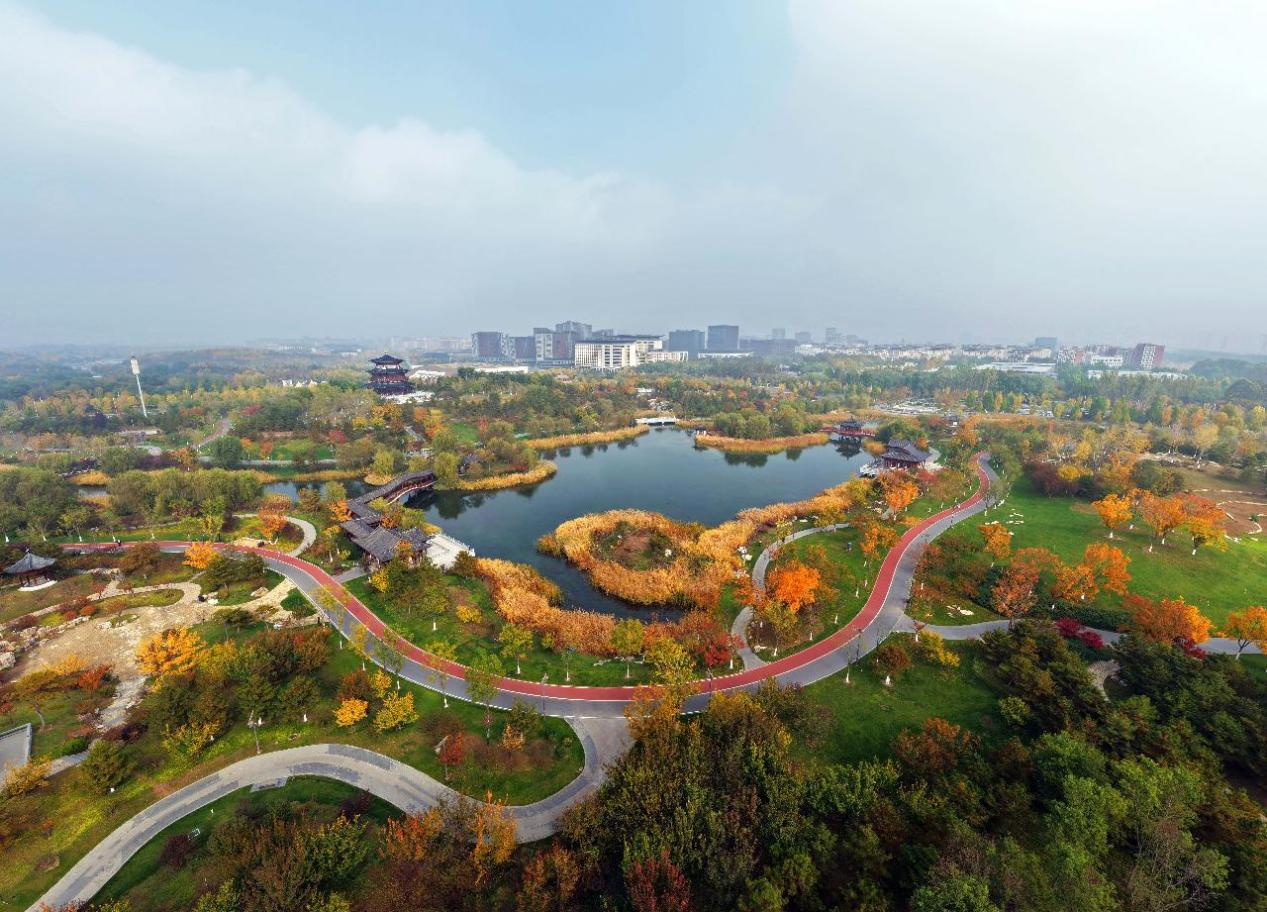
Photo shows the Yuerong Park. (People's Daily/Lei Sheng)
From above, the Central Green Valley in the start-up zone of Xiong'an New Area stretches across 500 hectares like a green artery, linking clusters of buildings into a cohesive whole.
"Five years ago, this was largely undeveloped land. Today, it is lush and green as far as the eye can see," said Wu Fangfang, deputy general manager of Ecological Construction Company under China Xiong'an Group.
Stretching roughly 7 kilometers from north to south -- connecting the northern forest belt to Baiyangdian Lake -- and spanning roughly 3.2 kilometers east to west, the Central Green Valley forms the core ecological framework of the start-up zone.
Its design features one corridor connecting functional zones, two valleys creating a harmonious blend of dense and open spaces that integrate the city with its waterways, three scenic lakes, and 18 distinctively designed parks catering to diverse recreational needs.
Green development is the defining ecological feature of Xiong'an New Area. Since its establishment, the area has adhered to the principle of prioritizing ecological conservation and pursuing green development. Initiatives such as the "millennium forest project" and the environmental restoration of Baiyangdian Lake have laid the groundwork for an ecological foundation in which blue-green spaces will account for 70 percent of the total area.
The Daqing River forest area marked the starting point of the "millennium forest project". Nearly nine years after the first sapling was planted, green space has steadily spread across the region, forming a dense ecological barrier -- like an unfolding emerald necklace.
Using a near-natural afforestation model that combines mixed species, multi-layered structures, and trees of different ages, Xiong'an has completed afforestation on 32,200 hectares. The total forest area has reached 49,533 hectares, with forest coverage rising from 11 percent before the area's establishment to 35.1 percent today.
Biodiversity metrics confirm ecological success: bird species have increased by 90 to 296 since 2025, including first-recorded Eastern Crowned Warblers and stable populations of globally endangered Baer's Pochards. As environmental indicators, these species validate ecosystem recovery.
Balancing production, living, and ecological spaces to enhance urban livability is a key objective of China's urban development. Livability means more than just adequate housing; it requires accessible, high-quality natural environments.
In Xiong'an New Area, residents enjoy green views from their windows and can reach a park within minutes of their homes. Covering 160 hectares, Yuerong Park embodies traditional Chinese aesthetics, unfolding along the south-north central axis of Xiong'an like a long, unfolding landscape painting.
"A well-designed park should feel integrated into the city and easily accessible," said Zhang Liwei, chief engineer of Xiong'an Planning Institute, adding that "greening first, then building the city" is a guiding principle. From the outset, the ecological blueprint prioritized blue-green spaces. The locations of parks were determined first, with roads and land-use planned around them. At Central Green Valley Park, the boundaries blur seamlessly with urban roads, allowing free movement between spaces.
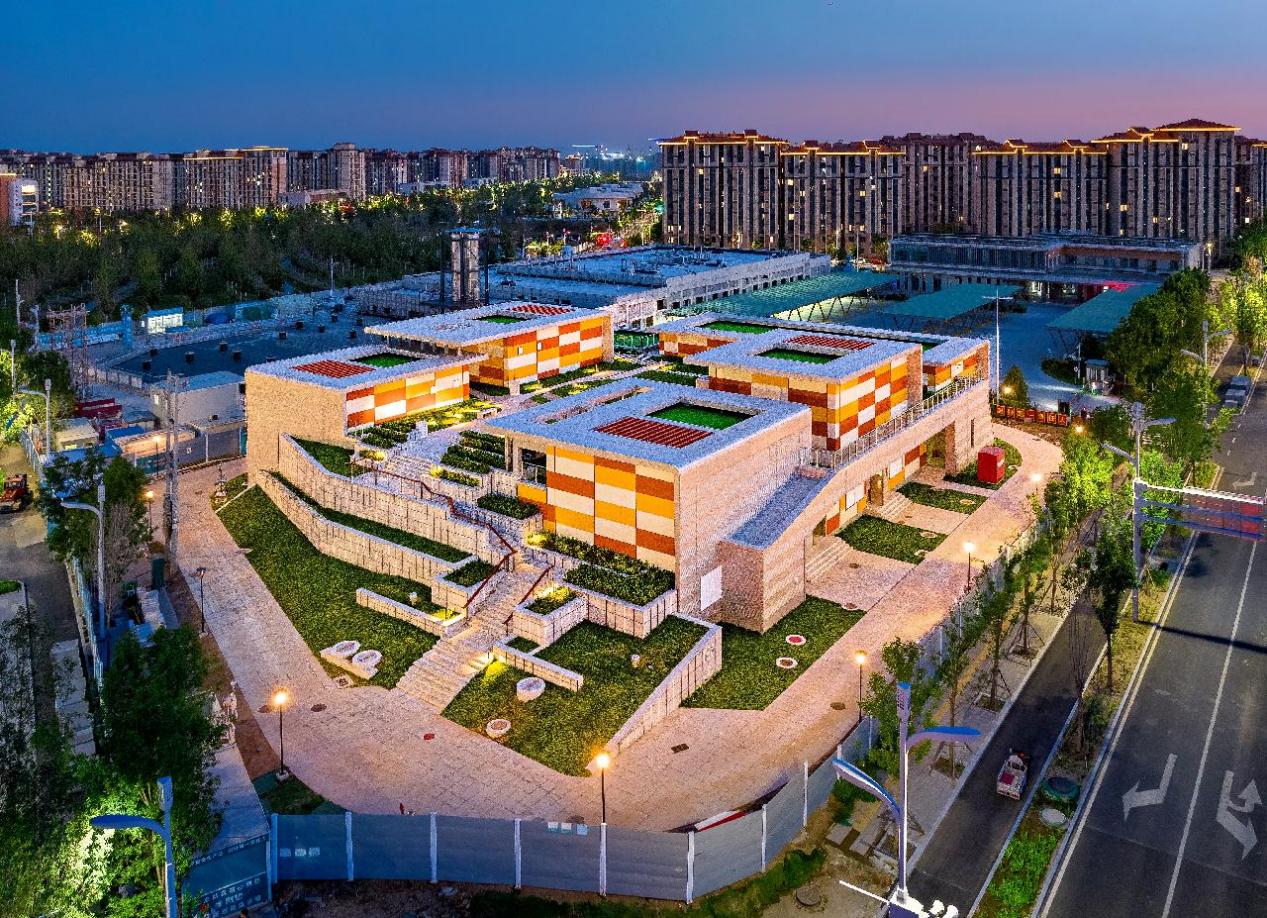
Photo shows a 110kV transformer substation in Xiongdong zone of Xiong'an New Area. (Photo/Yang Junfeng)
More than 20 urban parks have been planned and built across the start-up area and other key zones like the fifth cluster of the initial development area, Rongdong, Rongxi, Zangang, and Xiongdong, covering approximately 4,400 hectares in total. Xiong'an is demonstrating a new paradigm for urban development, placing nature at its core.
According to Zhang, residents can reach a woodland within three kilometers, a forest belt within one kilometer, and a community park within 300 meters -- with recreational green spaces woven throughout the city.
Meanwhile, parks are being upgraded with increasingly versatile facilities, enriched cultural offerings, and people-centered design in every detail.
By continuously expanding and connecting blue and green spaces, nurturing harmony between people and nature, and integrating the new city closely with Baiyangdian Lake, the planners and builders of Xiong'an New Area are laying a vivid, green foundation for a modern city with an ecological vision.
Photos
Related Stories
- Track-laying operation of Xiong'an-Xinzhou high-speed railway kicks off
- Explore Xiong'an New Area: A tech-driven city of tomorrow
- Tied-arch bridge part of Xiong'an-Xinzhou high-speed railway successfully closed
- Humble reed now used in building panels
- Xiong'an-Xinzhou high-speed railway under construction in China's Hebei
- Xiong'an innovation center moves toward zero carbon
- Discovering Eastern aesthetics in Xiong'an
- 'City of the future' champions green energy
- Xiong'an: An emerging hub of innovation, livability
- A glimpse of Xiong'an sports center
Copyright © 2026 People's Daily Online. All Rights Reserved.
