



Express delivery sector surges ahead of Spring Festival
Since mid-to-late January, the express delivery sector has entered its annual "Chinese New Year goods season." As the festive atmosphere intensifies, booming demand for holiday shopping and gift-sending has driven a surge in parcel volumes. According to the State Post Bureau, from Feb. 2 to 8, express delivery volume reached nearly 4.69 billion packages in China, up 3.19 percent from the previous week.
At dawn, Kang Hongshan, a courier from China's express delivery giant SF Express, is already busy packaging and delivering Chilean cherries.
"These boxes will be airlifted to northeast China's Heilongjiang Province. Orders placed today will arrive tomorrow," Kang said. As the peak season is underway, he packs over 200 boxes of cherries daily, sending them to Jiangsu and Zhejiang provinces, Shanghai, and northern provinces.
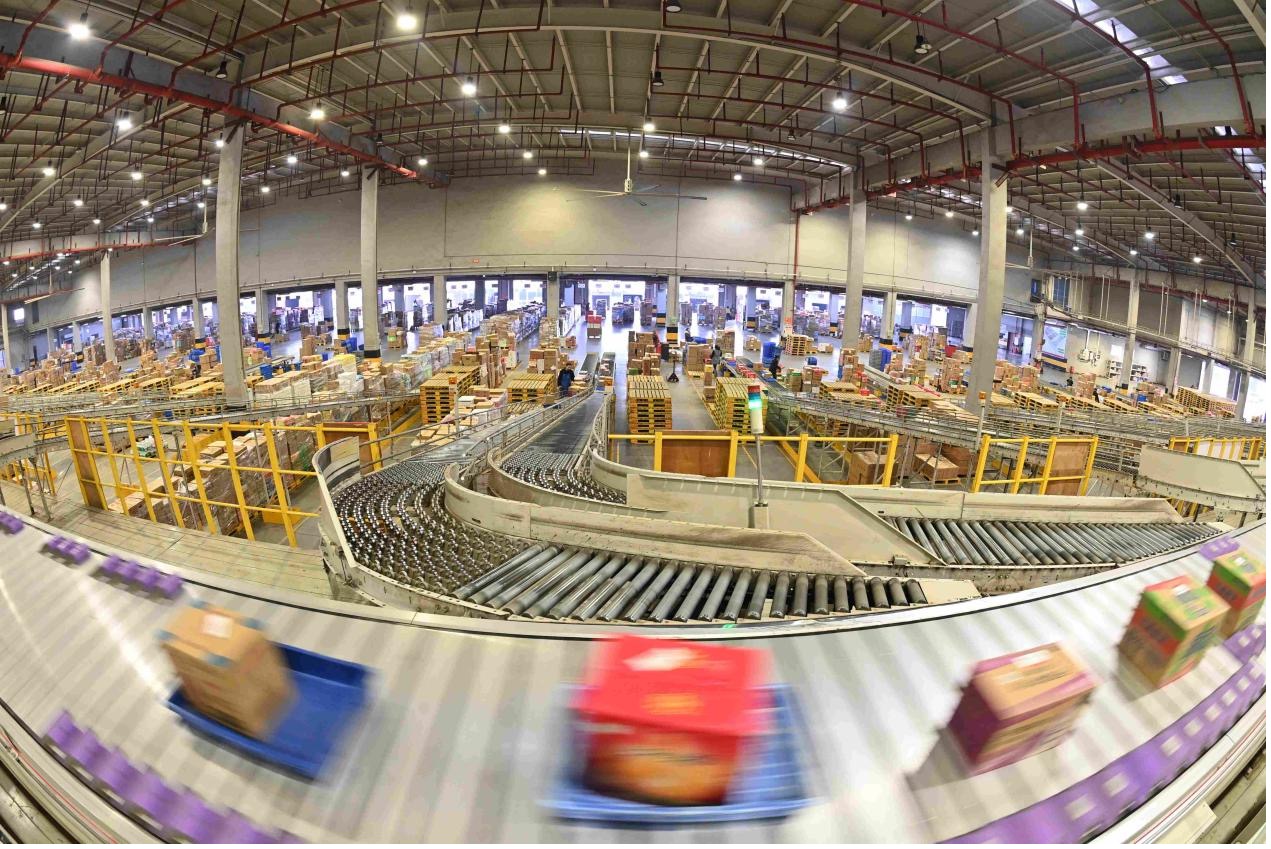
Parcels are automatically sorted at a delivery center of a logistics company in Shapingba district, southwest China's Chongqing municipality. (Photo/Sun Kaifang)
Kang works at the Jiaxing Fruit Market in east China's Zhejiang Province. It is the largest fruit distribution hub in east China. During the Chinese New Year shopping season, cherries take center stage, and fruit imports reach their annual high. During last year's Spring Festival shopping season, the market imported around 10,000 containers of cherries. This year, that figure has already exceeded 17,000.
Since January, cargo carrier YTO Airlines has been flying seafood directly from countries such as Bangladesh and Pakistan to Zhejiang and southwest China's Yunnan Province.
At the Dounan Flower Market in Kunming, Yunnan, sales of Chinese New Year flowers are in full swing. Over the past week, parcel volumes at courier outlets such as ZTO Express and JD.com have jumped nearly 20 percent compared with earlier periods. In addition to blooms like roses, a growing number of shoppers are snapping up more exotic varieties, including the King protea.
In Xi'an, capital of northwest China's Shaanxi Province, the transfer center of ZTO Express stays brightly lit long after nightfall. Inside the facility, conveyor belts operate at full throttle, and scanners swiftly sort packages. Each day, more than 100,000 parcels are dispatched from here to destinations across northwest China's Xinjiang Uygur Autonomous Region.
Among these parcels are large items like snowboards or skis and ski boots, as well as smaller items like helmets, goggles, and gloves.
With the Spring Festival, or the Chinese New Year, approaching, interest in winter sports is rising. In January, ski-related deliveries in Urumqi, Xinjiang, through ZTO Express, increased by over 35 percent year on year.
Thanks to the expansion of free shipping to Xinjiang by e-commerce platform Taobao, ski gear sales in Xinjiang have soared after the Chinese New Year shopping season kicked off, with orders for equipment such as snowboards or skis and ski headgear up by more than 120 percent year on year.
This year, China will build on the progress made in strengthening the rural delivery and logistics network, further integrate it with rural e-commerce, ensure that services truly reach the countryside, that the network runs reliably, and that residents find it convenient and easy to use, according to an official from the State Post Bureau.
The latest round of subsidies for consumer goods trade-ins has boosted demand for electronic products such as home appliances. Since January, orders for home appliance delivery, installation, and repair services have climbed by around 30 percent on JD.com.
The Chinese New Year shopping season has brought together strong consumer demand and supportive policies, creating new opportunities for delivery services and energizing the consumer market.
At SF Express' outlet in Wangjing subdistrict, Chaoyang district, Beijing, digital product orders surged 68 percent year on year in January. Smartphones, tablets, and wearables covered by consumer trade-in subsidies made up over 72 percent of these orders.
Photos




Related Stories
- China builds world's largest express delivery network, fueling dynamic economy
- Revolutionizing river life: drone delivery brings convenience to Yangtze crews
- Booming express delivery industry reflects new drivers of China's economic growth
- China's express delivery sector posts steady growth in first 10 months
- China's express delivery volume rises as services get faster
- China's Cainiao to expand global 5-day delivery service to six more countries
- China continues push for greener packaging
- China's market watchdog summons three food delivery platforms for regulated development
- Chinese researchers develop band-aid for organs, facilitating drug delivery
- China unveils new regulations on express delivery sector
Copyright © 2026 People's Daily Online. All Rights Reserved.
