



Booming express delivery industry reflects new drivers of China's economic growth
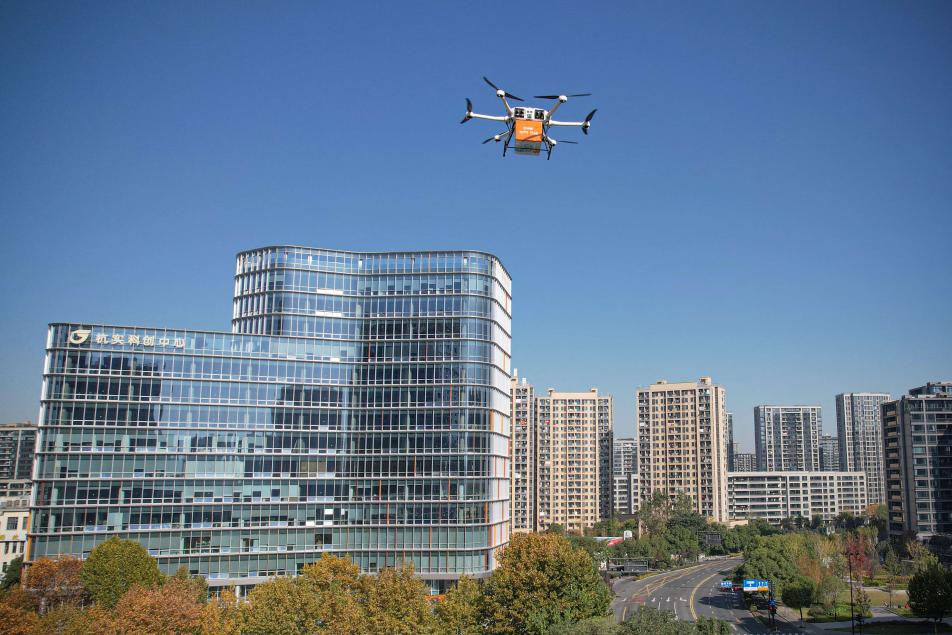
A drone is on a delivery mission in Hangzhou, east China's Zhejiang province. (Photo/Wang Chuan)
China's express delivery industry has recorded sustained growth for three consecutive years, underscoring new momentum in the nation's economy. Parcel volume reached 120 billion in 2023, surpassed 150 billion in 2024, and hit a record 180 billion this year.
Often seen as a "barometer" of economic vitality, the express delivery sector reveals key trends through three illustrative scenarios:
Scenario 1: Unmanned delivery and intelligent logistics
China's 180 billionth parcel was delivered in Shenzhen via an unmanned delivery model. After a resident surnamed Li ordered a smart learning device, the parcel was sorted and dispatched from an automated warehouse. Upon arriving at the last-mile station, it was transferred by an unmanned delivery vehicle and completed with courier doorstep delivery -- all within the same day.
Automation has significantly accelerated the process. Inside the smart warehouse, autonomous and vertical-lift robots move swiftly between shelves. At an intelligent sorting center, AI-powered recognition systems enhance sorting efficiency. At delivery stations, unmanned delivery vehicles coordinate with couriers to reduce last-mile delivery time.
More than 1,300 automated sorting centers are operating nationwide, alongside thousands of unmanned vehicles, and over 3 million parcels have been delivered by drones. Across China, logistics parks and express delivery outlets are increasingly integrated with next-generation information technologies, forming a world-leading intelligent logistics network.
In warehousing, shelving, picking, and outbound processes are becoming fully unmanned, yielding substantial efficiency gains. AI vision systems achieve millisecond-level recognition, minimizing errors, damage, and loss. In transportation, vertical AI models help dynamically optimize routing. In pickup and delivery, drone and unmanned vehicle pilot programs continue to expand, effectively lowering operational costs.
"Science and technology are a strong driving force, injecting sustained vitality into the express delivery market," said Liu Jiang, director of strategic planning at the Development and Research Center of China's State Post Bureau.
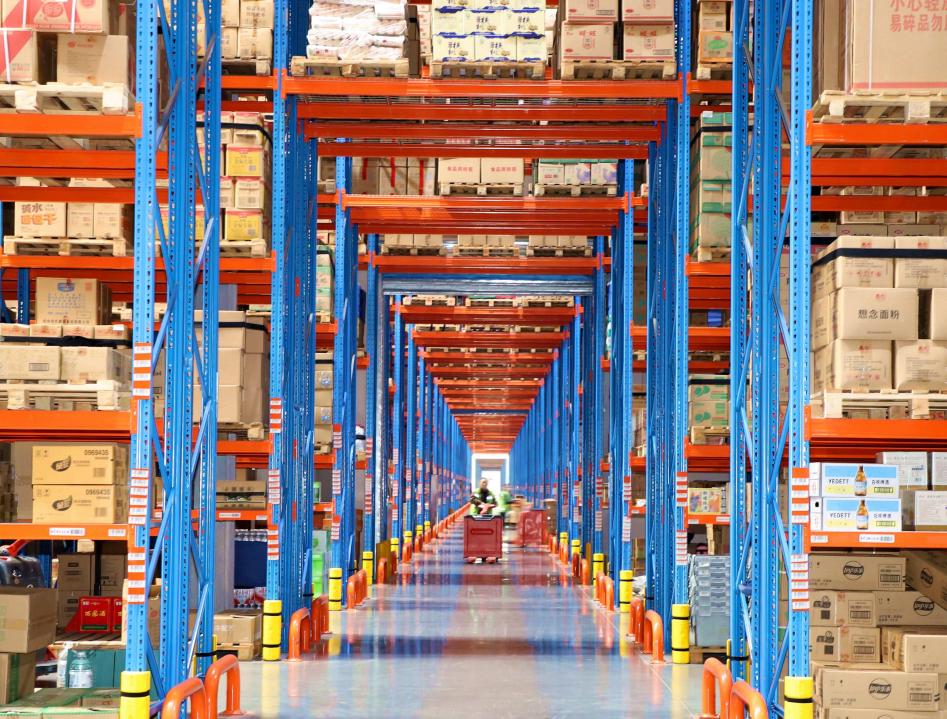
Photo shows a logistics center of an industrial park in Nanyang, central China's Henan province. (Photo/Gao Song)
Scenario 2: Upgrading consumption through logistics
During this year's Double 11 online shopping festival, demand for consumer goods trade-in remained strong. Taking advantage of relevant subsidies, a woman surnamed Wang from Linyi, east China's Shandong province, ordered a new set of furniture. The courier arrived on time, completed delivery and assembly, and finalized the entire process in under an hour.
China's expanded consumer goods trade-in program has effectively stimulated demand for product upgrades, providing strong momentum for the express delivery sector. In the first 10 months of this year, Chinese logistics giant SF Express reported a 30 percent year-on-year increase in large-item deliveries, including furniture and home appliances.
This year, SF Express has built over 30 new air-cargo facilities dedicated to large items, reducing average processing time by more than three hours. It also upgraded more than 20 ground transit hubs to improve sorting efficiency and introduced new reverse-logistics models that integrate old-item pickup with new-item delivery. These measures have strengthened the company's service capabilities for the consumer goods trade-in program.
On the one hand, China's express delivery sector is embedding itself across diverse consumption scenarios from tourism and culture to sports and entertainment, driving economies of scale. In the first 10 months of this year, express delivery contributed to a 6.3 percent increase in online retail sales of physical goods.
On the other hand, by developing new service models such as in-factory logistics and international supply chains, China's express delivery industry is becoming more deeply embedded in industrial operations. This integration is extending industrial and value chains, fostering closer alignment between logistics services and production dynamics.
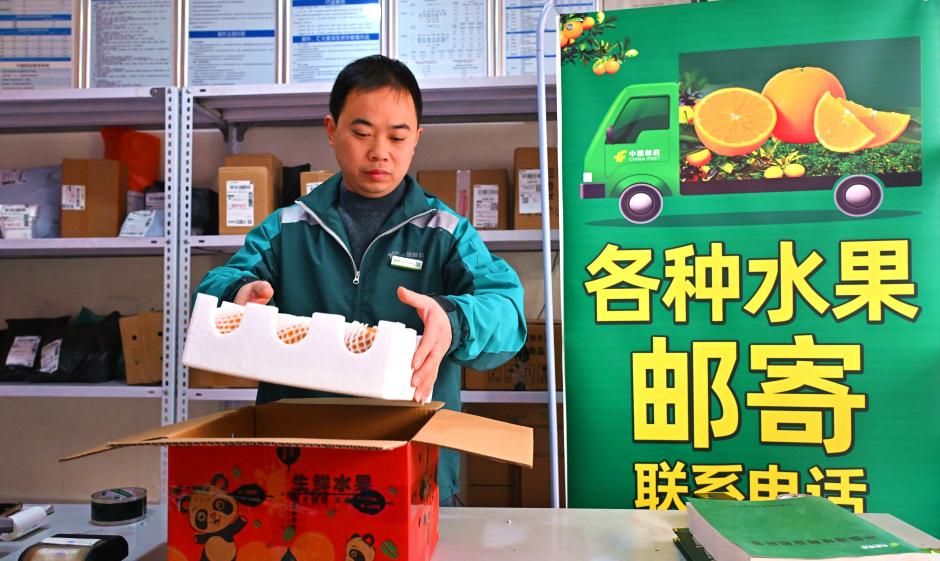
A courier packs at an express delivery station in Shunlong village, Renshou county, Meishan, southwest China's Sichuan province. (Photo/Pan Shuai)
Scenario 3: Rural logistics boosting regional development
In a warehouse of a fruit trade company in northwest China's Shaanxi province, workers sort, pack, and label boxes of apples for shipment. "With couriers stationed directly in the village, parcels can be collected and shipped the same day," said the company's e-commerce manager. During peak harvest season, the facility processes around 100,000 orders daily.
The rapid expansion of express delivery networks into rural areas is unlocking new consumption potential. In the first 10 months of this year, Chinese express delivery company ZTO Express handled more than 12.9 billion parcels, covering over 96 percent of townships in China. Shipments of agricultural products from rural to urban markets increased by 21.5 percent year on year.
From the rich tea leaves of Baoshan in Yunnan to the fresh matsutake mushrooms of Nyingchi in Xizang, products from China's central and western regions are reaching markets nationwide with remarkable efficiency, enabled by an increasingly robust express delivery network.
This year, China's rural delivery and logistics system has become more complete, with central and western regions such as Guizhou, Shaanxi, Ningxia, and Xinjiang all reporting over 30 percent year-on-year growth in express delivery volume during the first 10 months.
Liu noted that the express delivery industry not only precisely connects production and consumption, but also facilitates the flow of resources across regions, contributing to the development of building a unified national market.
Photos




Related Stories
- China's express delivery sector posts steady growth in first 10 months
- China's express delivery volume rises as services get faster
- China's Cainiao to expand global 5-day delivery service to six more countries
- China continues push for greener packaging
- China's market watchdog summons three food delivery platforms for regulated development
- Chinese researchers develop band-aid for organs, facilitating drug delivery
- China unveils new regulations on express delivery sector
- China's courier sector sees robust growth in parcel handling
- Instant delivery industry thrives in China
- China's delivery services at full throttle to meet festival shopping boom
Copyright © 2026 People's Daily Online. All Rights Reserved.
