



Revolutionizing river life: drone delivery brings convenience to Yangtze crews
Life aboard vessels navigating China's Yangtze River has entered a new era of convenience: passengers can now order takeout even while ships are underway.
"It's just as easy as ordering food on shore—burgers, desserts, drinks, whatever you crave," said Lu Jingyu, owner of the cargo vessel Xinmao 8868, as he enjoyed a meal delivered by drone.
On January 16, while sailing from Tongling in Anhui province to Nanjing in Jiangsu province, and his order arrived promptly, exceeding his expectations.
The Yangtze River, China's longest river, sustains a vast floating workforce. Approximately 1 million licensed mariners operate along its water, with over 2,000 vessels transiting the Nanjing section daily. Many crew members live and work on board for long periods, making resupply a persistent challenge.
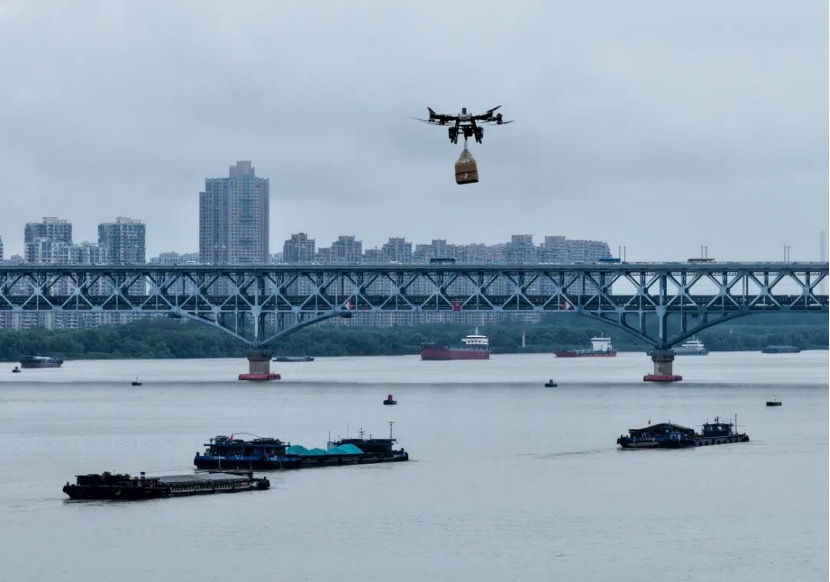
Photo shows drones are on delivery missions on the Yangtze River. (Photo from Nanjing Daily)
Lu explained that due to complex waterways and currents, cargo vessels on the Yangtze cannot dock freely under current regulations. Stops are permitted only at ports, service areas, or designated anchorages. Even when docking is possible, shore access remains cumbersome, compounding daily difficulties for crews.
In Nanjing, one of China's first pilot zones for civilian unmanned aerial vehicles (UAVs), transport authorities have built a low-altitude service system that offers full-area coordination and end-to-end support.
In 2024, Changjiang Hui, a tech firm providing overwater e-commerce services based in Jiangsu province, launched an overwater delivery platform, using drones to service anchored vessels. Following a 2025 service upgrade, the platform now delivers to ships underway.
Lu has become a frequent user of the platform. At 11:30 a.m. that day, he opened the platform's mini-program on WeChat to order food for the crew.
"After pre-registering my details -- name, phone number, vessel name, and nine-digit ship ID -- I simply select our sailing direction and service provider," he noted. His 77-yuan ($11.07) order included 11 items from three restaurants.
Upon order receipt, the drone operator's staff forwarded details to a food delivery app. A courier delivered the meals to the operator's storage area within 30 minutes. Operator Zhang Kai then prepared the order while tracking Xinmao 8868's real-time position. When the ship entered a three-kilometer radius of the base at 2 p.m., Zhang attached the package to a drone and contacted Lu.
Through an intercom system, Zhang informed Lu that a drone was approaching the red buoy No. 142 and confirmed that it was already in sight.
"The drone is lowering now. Please don't stand under the drone and stay safe. Wait until it moves away before picking up the package," Zhang said. Shortly afterward, the food was successfully delivered. The whole process was finished in just two minutes.
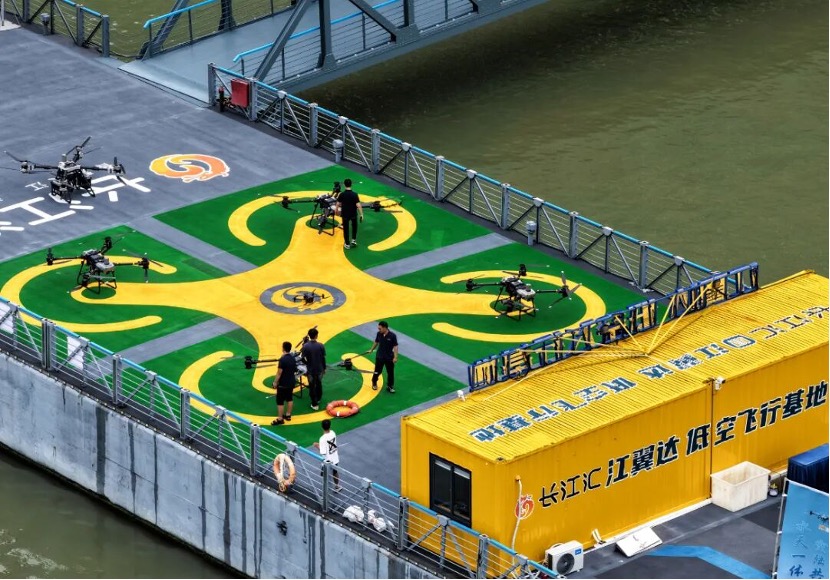
Photo shows a drone flight base. (Photo from Nanjing Daily)
How do drones locate moving ships and deliver accurately? "Our proprietary edge computing module is key," stated Zhai Haifeng, general manager of Changjiang Hui. The system combines the ordering phone's GPS data with AI-powered analytics and visual recognition to predict the vessel's location. The drone then syncs its speed and course to hover above the ship, autonomously locking onto the landing zone.
As Zhang monitored his screen, the drone stabilized and lowered the package via cable. Upon touchdown, the cable automatically detached and retracted. "High-speed propellers make manual retrieval hazardous," Zhai emphasized. "Our weight-sensing system triggers immediate disengagement after delivery."
Behind this convenience lies coordinated support from transport authorities. At the drone base servicing Lu, a 5G station and miniature weather station flank the hangar. Maritime safety regulations are prominently displayed in the office.
At present, four such bases have been established along the Nanjing section of the Yangtze River, with two more under construction. Each base has a different focus depending on its location -- some specialize in fresh fruits and vegetables, others in prepared meals, and still others in staples such as rice, flour, and cooking oil. On average, the four bases together handle about 200 orders per day, with delivery times ranging from one to two hours from order placement to receipt.
"Now it's so much easier to grab a bite while sailing," Lu said. "Some crew members even order flowers to brighten up their day. Life on the water keeps getting more colorful!"
Photos

Related Stories
- China's large drone completes pioneering plateau logistics flight
- Booming express delivery industry reflects new drivers of China's economic growth
- Ship crews on China's Yangtze River can now order food delivered by drones
- 82-year-old woman in E China becomes drone pilot
- Chinese hydrogen-powered drone sets longest distance flight record
Copyright © 2026 People's Daily Online. All Rights Reserved.
