



China livestock powerhouse improves pasture management in eco-friendly productivity quest
HOHHOT, Feb. 12 (Xinhua) -- In the vast pastures of north China's Inner Mongolia Autonomous Region, a humble blade of grass is being transformed into the cornerstone of a modern agricultural titan, fueling the region's dominance in China's dairy and meat industries.
As China's leading livestock region breeding over 140 million head of grass-fed animals annually, Inner Mongolia faces immense demand for forage. In response, cities like Bayannur, Hohhot and Tongliao in this region are pioneering a modern forage and pasture industry through artificial planting, natural grassland restoration and silage production, in its efforts to strike a grass-livestock balance.
The results are tangible. In 2025, Inner Mongolia's artificial forage planting area exceeded 20.9 million mu (about 1.39 million hectares), with total forage supply surpassing 75 million tonnes. This amount of feed effectively supports key livestock industry chains, including dairy and beef, with a combined output value nearing 500 billion yuan (roughly 72 billion U.S. dollars).
Based in Dengkou County, Bayannur of Inner Mongolia, Shengmu Hi-tech Ecological Grass Industry Co., Ltd. has solidified its position as one of China's flagship enterprises in the greening of desert areas with organic grass as silage.
The company has developed approximately 15,333 hectares of organic pasture and feed cultivation bases, growing a range of organic feed crops such as silage corn, alfalfa, corn, oat grass, sunflowers and wheat.
"By optimizing crop varieties and meticulously planning harvests, we've significantly boosted yield and quality," said Li Jun, manager of the company's alfalfa park, which boasts a high yield of around 15 tonnes of this premium livestock grass per hectare.
Meanwhile, at the national grassland technology innovation center in Hohhot, capital of Inner Mongolia, researchers have developed a new series of lipopeptide-based bio-fertilizers. Technician Du Hongzhi explained that these products enhance plant nutrient uptake, stress resistance and root health, thereby aiding in degraded grassland restoration and forage yield increases.
"The series has passed all field trials and is ready for large-scale application," Du said.
In Horqin Left Wing Middle Banner in the city of Tongliao, local policies promote shifting the use of land from crop growing to forage cultivation, which is more productive and able to directly support the local beef cattle industry.
In 2025, Tongliao's silage corn planting area had reached 5.36 million mu, cementing its status both as China's largest producer of silage corn and a leading beef cattle breeding city.
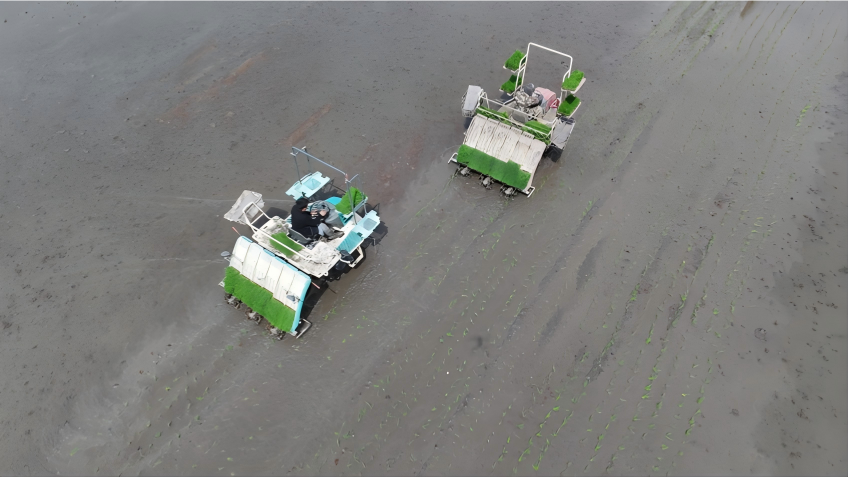
To balance grain and forage production, Inner Mongolia regions like Chifeng and Ulanqab are piloting crop rotation systems. For example, growing forage oat grass using potato fields has been proved useful in enhancing land and water efficiency.
"With precision irrigation and fertilization, we get two harvests per year without extra land, adding 3,000 tonnes of quality forage," said Huang Xiangyu, head of Yanfeng Grass Industry Co., Ltd. in Alu Horqin Banner, Chifeng.
Photos

Related Stories
- Ancient dairy aroma inspires innovation, tourism in Inner Mongolia
- China's Yakeshi sees surge in cold-area automotive testing and tourism
- Snow scenery of Hongya Tableland in China's Inner Mongolia
- Prairie wind propels green computing power development in north China
- Winter scenery of Genhe in N China's Inner Mongolia
Copyright © 2026 People's Daily Online. All Rights Reserved.
