



Exoskeleton robots help people regain mobility in E China's Zhejiang
An assistive hip joint exoskeleton robot recently drew attention at a shopping event at Wushan Square in Hangzhou, east China's Zhejiang Province, with people eagerly lining up to try the device.
One user said wearing the exoskeleton felt like being gently lifted, making it effortless to raise his leg.
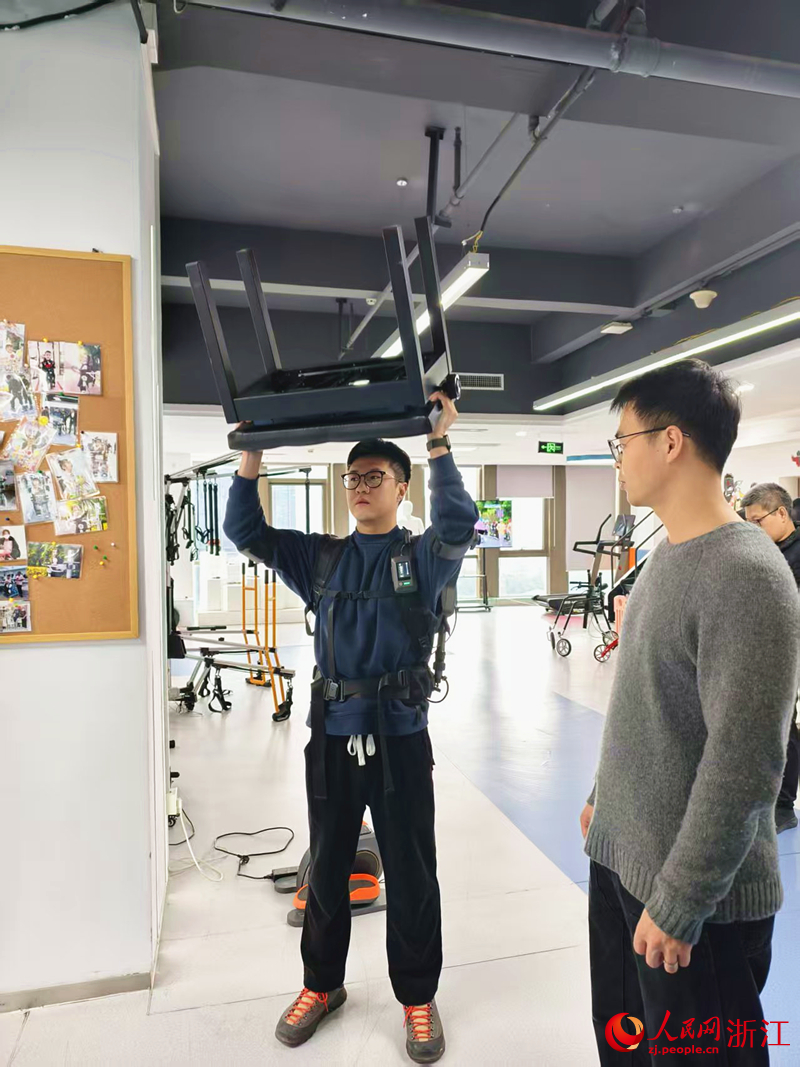
A man tries an industrial handling exoskeleton robot at a shopping event at Wushan Square in Hangzhou, east China's Zhejiang Province. (People's Daily Online/Kang Mengqi)
The exoskeleton robot was developed by startup RoboCT, located in Hangzhou.
The company's smart rehabilitation center also drew visitors, showcasing high-tech equipment, including an industrial handling exoskeleton robot and a health and wellness exoskeleton.
The exoskeletons began as a college side project by the founder of the company, Wang Tian.
"The straps were taken from an old backpack, and the footplates were cut from worn-out slippers," Wang recalled of his first prototype.
He assembled the device by hand in a campus basement, simply hoping it would help him dunk a basketball more easily. He never imagined that this crude prototype would one day help people walk again.
Raised in a family of medical professionals, Wang later realized that the exoskeleton he had built for fun had real potential in rehabilitation. But turning a DIY gadget into a medical-grade product was no easy task.
When patients first tried it on, it didn't accommodate different heights, pressure points caused discomfort, and the motors struggled with heavier users.
To solve these issues, the company's team went back to the lab, developing key components and securing more than 500 patents and other intellectual property rights. After more than 300 clinical trials, the exoskeletons became increasingly comfortable, adaptive and user-friendly.
Today, the company's exoskeletons are used in more than 1,700 hospitals and rehabilitation centers, helping patients rebuild strength and confidence in walking.
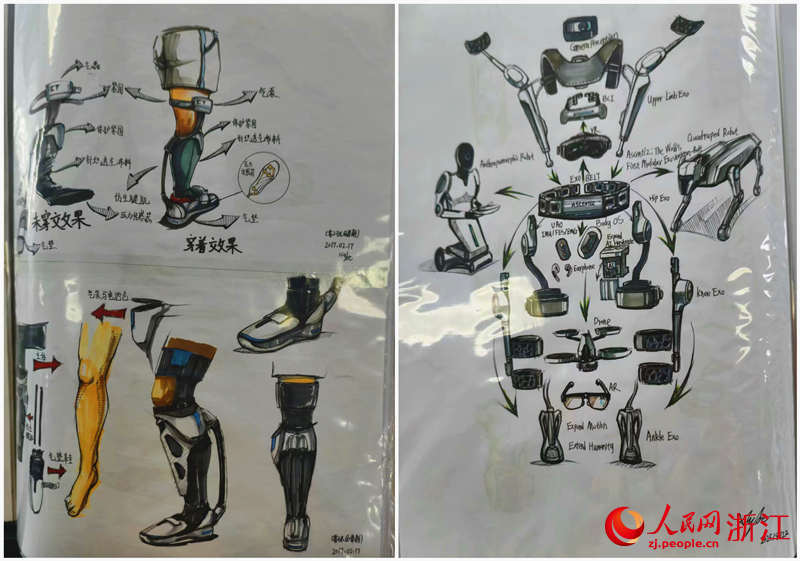
Photo shows exoskeleton blueprints by startup RoboCT, located in Hangzhou, east China's Zhejiang Province. (People's Daily Online/Kang Mengqi)
Yan Hai, chief designer at the company, said the exoskeletons have a "brain" that detects gait in real time and anticipates the user's intended movements, providing not just mechanical support but a more natural, effortless walking experience.
In just a few years, the company has grown from a five-person team in a single room to a company of more than 100 employees with its own manufacturing facility, quickly emerging as a rising player in the tech industry.
Photos




Related Stories
- Exoskeleton climbing device debuts at Mount Taishan, assists tourist during Spring Festival
- Researchers design wearable device for lateral resistance walk exercise
- Robotic exoskeletons expand options for paraplegic patients
- Paraplegic tries exoskeleton robot for rehabilitation training in SW China
- China-developed exoskeletons to support patrol, logistics tasks in high-altitude region
- China develops wearable exoskeleton that mimics human knee
- Real 'Ironman': China's first robot exoskeleton AIDER debuts in Chengdu
Copyright © 2026 People's Daily Online. All Rights Reserved.
