



China's bag charm economy: small accessories, big cultural impact
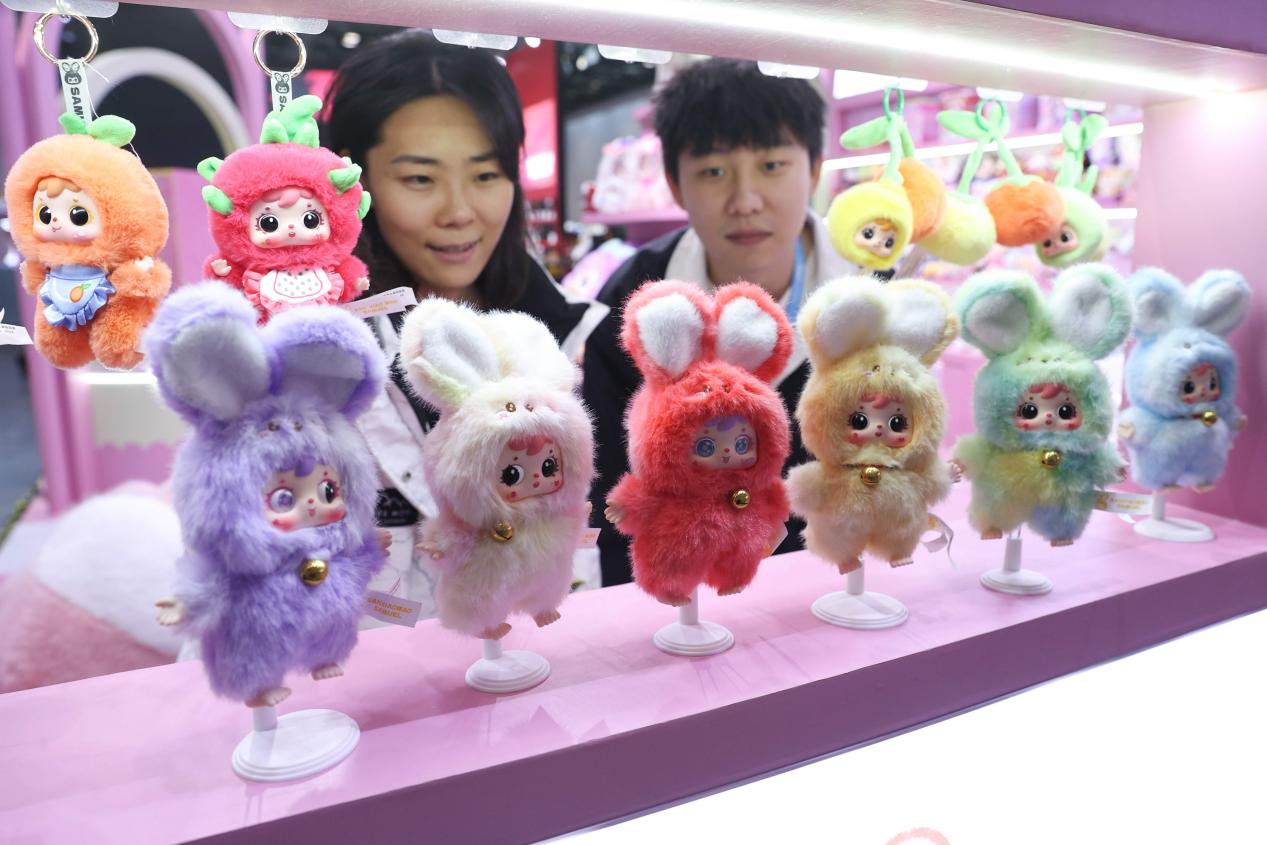
Toys are exhibited at the 4th QDF × ADTS Beijing International Art & Designer Toy Show, December 14, 2025. (Photo/Chen Xiaogen)
From plush vinyl dolls in diverse shapes and museum-inspired cultural creations to unique souvenirs from scenic areas -- an array of accessories now dangle from the backpacks of young people across China.
Portable and lightweight, bag charms are gaining increasing popularity among Chinese consumers. The ever-evolving designs of these small ornaments have fueled a consumption boom, supported by robust industrial clusters, and are now advancing through coordinated efforts in global expansion—together shaping the emerging "bag-charm economy."
At a Beijing designer toy store, shoppers enthusiastically pose with Wakuku characters, sharing photos on social media. "Key features such as small size, affordability and emotional resonance align perfectly with young people's lifestyles," said Hong Yong, an associate researcher at the Chinese Academy of International Trade and Economic Cooperation under the Ministry of Commerce.
He observes that emotion-driven consumption has shifted priorities: young buyers now prioritize products delivering joy, belonging, and self-expression over pure utility.
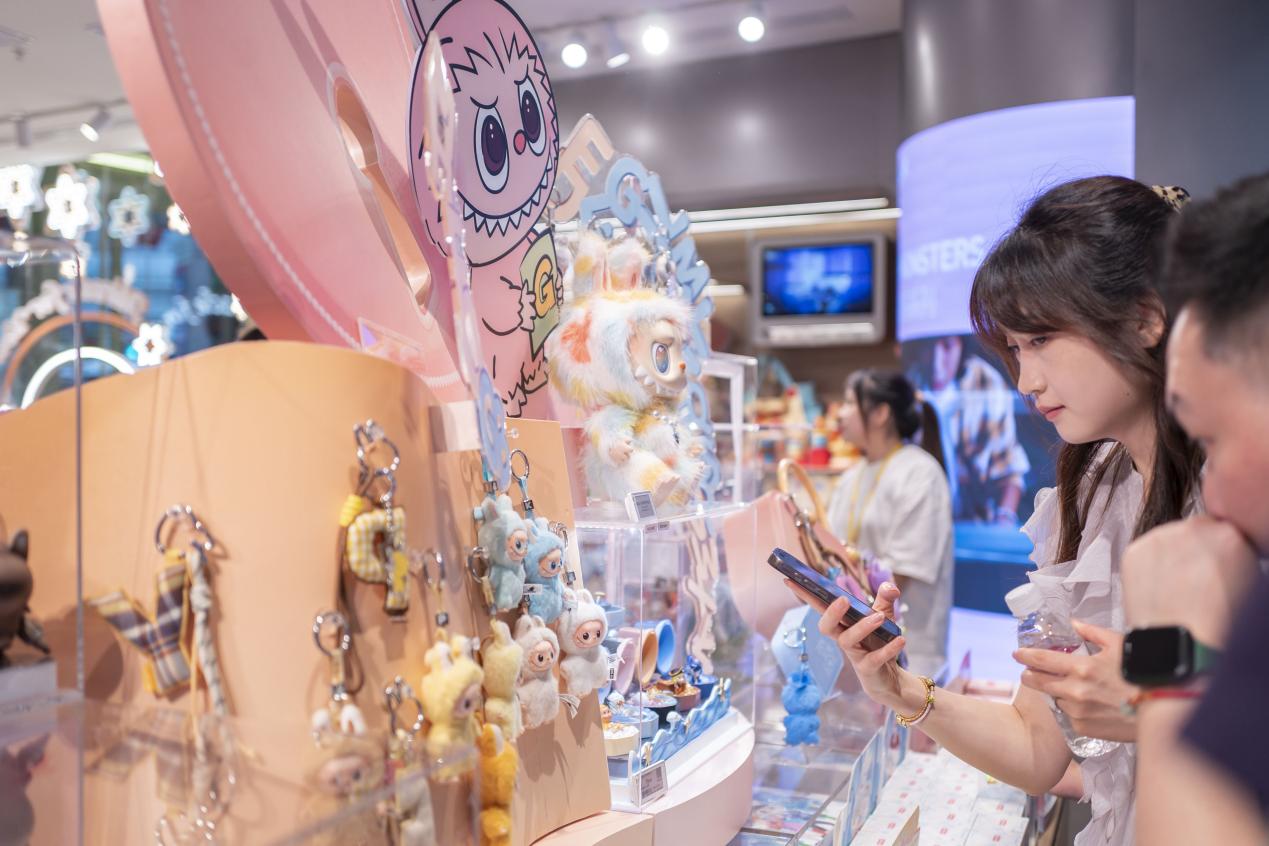
Labubu toys attract shoppers at a Pop Mart store in Shanghai. (Photo/Wang Chu)
As Chinese New Year approached, Nanjing resident Wu Wenjing purchased outfits not just for her family, but for her Labubu charm. "I match charms to my mood and outfits," she explains. "Sometimes they feel like emotional codes -- shared recognition sparks instant connections."
Liang Mei, president of the China Toy and Juvenile Products Association, observed that bag charms offer young people moments of everyday delight through a relatively relaxed consumption model. By fostering emotional connections, they help form interest-based communities with a shared sense of identity. At the same time, collaboration with well-known intellectual properties (IPs) and user participation in co-creation continue to inject vitality into the market.
Manufacturing Innovation Dongguan, China's "designer toy capital," anchors the global industry with over 4,000 manufacturers and 1,500 supporting enterprises. Its complete industrial chain covers design, production, IP licensing, and sales.
At the headquarters of a toy manufacturer in Chashan township, Dongguan, a team of 10 designers was discussing design drafts for a "Baku" series of bag charms.
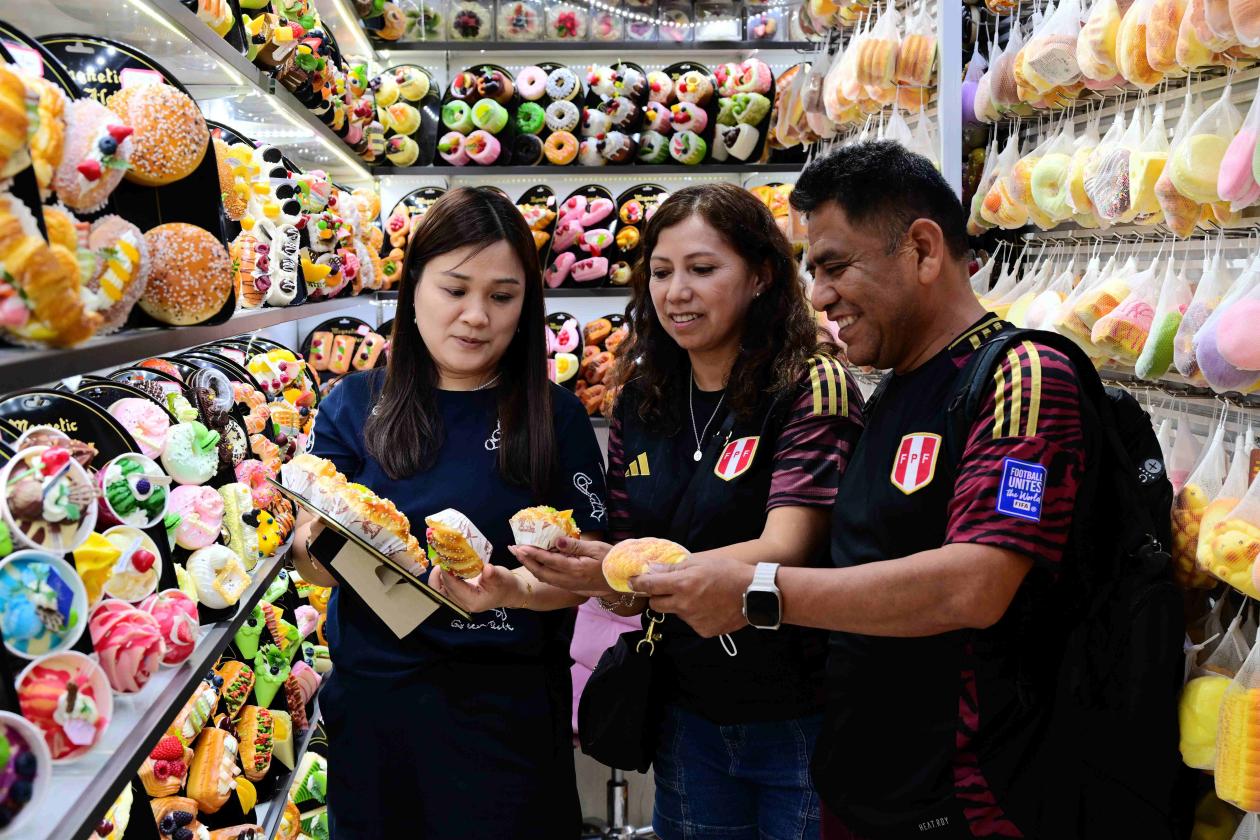
As the International Children's Day approaches, foreign merchants negotiate with a Chinese toy wholesaler (left) over a purchase deal at the Yiwu International Trade Market in Jinhua, east China's Zhejiang province. (Photo/Shi Bufa)
"This China-chic bag charm blends traditional Chinese colors and auspicious symbols with modern design. Inspired by the mythical 'Baku -- a creature said to devour nightmares and bring sweet dreams -- it carries the wish that all good dreams may come true in the coming year," explained Wu Qiaomei, brand marketing director involved in the project.
She noted that from concept finalization to detail refinement, the initial design draft takes about 15 days to complete, with the sample workshop then needing another three to five days to produce the first plush prototype.
"With in-house manufacturing capabilities, we maintain flexibility in production coordination and scheduling," Wu added. "From design confirmation to mass shipment, the entire process can be completed within about 30 days."
With diverse styles and ever-changing market trends, bag charms call for agile production response. The consumer-end enthusiasm is fundamentally supported by a supply-side shift -- from mass manufacturing to flexible customization. The robust production capacity within the toy industry provides the essential foundation for the rapid adaptation and output of these accessories.
In the past, producing a plastic toy required mold development costing tens of thousands of yuan, necessitating mass production runs of tens to hundreds of thousands of units to lower per-unit cost.
Today, smart manufacturing and digital workshops have made small-batch production truly feasible -- minimum orders as low as 50 units or batch productions of merely 100 pieces are now readily achievable, with even single custom toys possible through 3D printing.
Labubu has sparked a worldwide trend in collectible art toys. Following the success of the animated film Nobody, bag charms featuring its characters sold out repeatedly after going viral overnight. Meanwhile, charms shaped like traditional Chinese herbs -- such as goji berries, red dates, and red sage -- have captivated overseas consumers with their creative designs and distinctive Eastern aesthetic.
Time magazine in the United States noted that China's new generation of trendy toys is reshaping the international image of "Made in China" by telling stories rooted in local IPs and showcasing distinctive aesthetics.
In the first half of 2025, Chinese toy company Pop Mart recorded triple-digit growth in markets across Southeast Asia, Europe and the Americas, with growth in the Americas exceeding tenfold. The company's global store count has now surpassed 570.
Products from HERE have reached nearly 20 countries and regions -- including North America, Europe, Southeast Asia, and the Middle East -- via distribution channels. Li Peng, Chairman of HERE, noted, "Breaking down cultural barriers through localized creation and building emotional bonds with global consumers are key to helping Chinese brands move beyond manufacturing and build greater brand value."
Looking ahead, as more Chinese flagship products and brands go global, these small charms, infused with Chinese creativity and emotion, are poised to tell ever more compelling Chinese stories on the world stage.
Photos


Related Stories
- Mis-stitched stuffed horse toys go viral on Chinese Internet
- Chinese-made toys expand global footprint
- Local specialties from NW China become trendy plush toys
- Toy brands secure prime spots in Chinese shopping malls
- Chinese toymakers blend AI with cultural elements for international success
- China's doll clothing craze grows alongside booming designer toy market
- Chinese youth propel bag charm boom as brands target self-expression
- How tin toys geared up manufacturing success
- Trending in China | The Leather Tiger
- Chenghai toys see US order surge amid tariff pause
Copyright © 2026 People's Daily Online. All Rights Reserved.
