



China's opening-up gains momentum in 2025
Throughout 2025, China opened its doors wider with a more inclusive approach, serving as a stabilizing force for the global economy and a powerful magnet for shared development opportunities.
In early 2025, China issued the 2025 Action Plan for Stabilizing Foreign Investment, which includes practical measures to strengthen efforts to stabilize foreign investment and create a favorable environment for foreign businesses operating in China.
The country also unveiled the 2025 version of the Catalogue of Encouraged Industries for Foreign Investment last month. The new catalogue is designed to encourage more foreign investment in advanced manufacturing and modern services, as well as in China's central, western and northeastern regions.
The two documents demonstrate China's sincerity and determination in welcoming foreign investment.
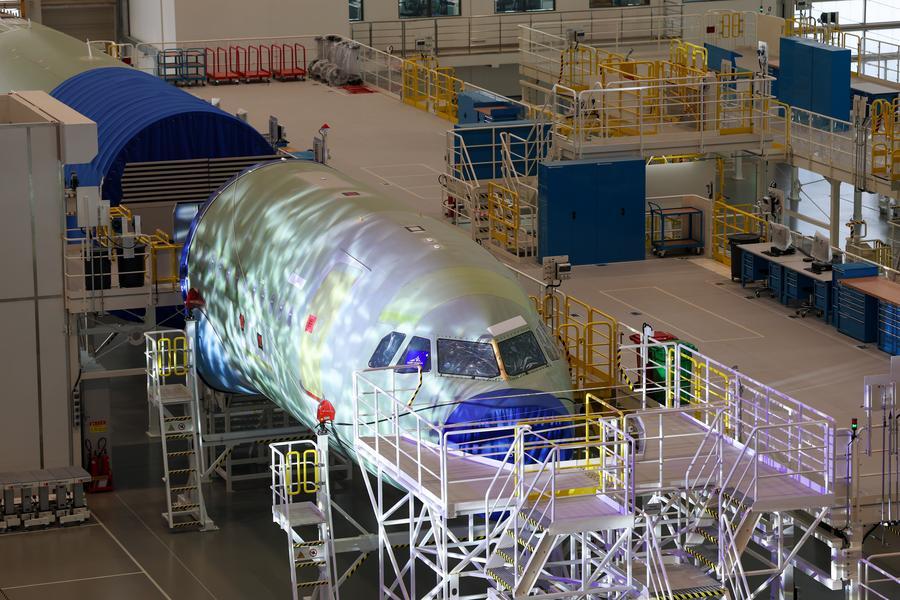
An Airbus plane to be assembled is pictured at the second Final Assembly Line (FAL) for A320 family aircraft in Tianjin, north China, Oct. 22, 2025. (Xinhua/Sun Fanyue)
According to a survey by the German Chamber of Commerce in China, 92 percent of responding German companies plan to remain engaged in the Chinese market, and more than half intend to increase investment in China within the next two years.
The 2025 China Business Climate Survey Report, released by the American Chamber of Commerce in China, shows that nearly half of its member companies still rank China among their top three global investment destinations.
China saw 61,207 newly established foreign-invested firms from January to November 2025, a year-on-year increase of 16.9 percent, according to the latest data released by the Ministry of Commerce (MOFCOM).
MOFCOM spokesperson He Yadong emphasized that China is the world's second-largest consumer market and home to the globe's largest middle-income group, embodying tremendous investment and consumption potential. China remains committed to pursuing high-quality development and accelerating green, digital and intelligent transformation, backed by strong industrial support capabilities that provide some of the best application scenarios for the new round of scientific and technological revolution and industrial transformation.
"China has been and will always be an ideal, safe and promising investment destination for foreign businesses," the spokesperson said.
Throughout 2025, China continued to advance major exhibition platforms, building bridges for communication, cooperation and win-win development between Chinese and foreign enterprises.
The recently concluded eighth China International Import Expo once again demonstrated vibrant trading activity, with intended transaction volume reaching $83.49 billion on a one-year basis, up 4.4 percent from the previous edition and setting a new record.
In Guangzhou, south China's Guangdong Province, the 138th Canton Fair attracted more than 310,000 overseas buyers from 223 countries and regions, marking a 7.5 percent increase compared with the previous session and another record high.
In Beijing, the China International Fair for Trade in Services saw the offline participation of more than 480 Fortune 500 companies and industry leaders, accounting for more than one-quarter of all exhibitors, with both the number and proportion of leading enterprises exceeding those of the previous edition.
The third China International Supply Chain Expo (CISCE) introduced the CISCE Launch zone for the first time, showcasing a continuous stream of new products, technologies, processes and application scenarios. The successful debut of numerous innovative achievements reflects China's complete supply chain and rapid response capabilities, which hold strong appeal among global enterprises.
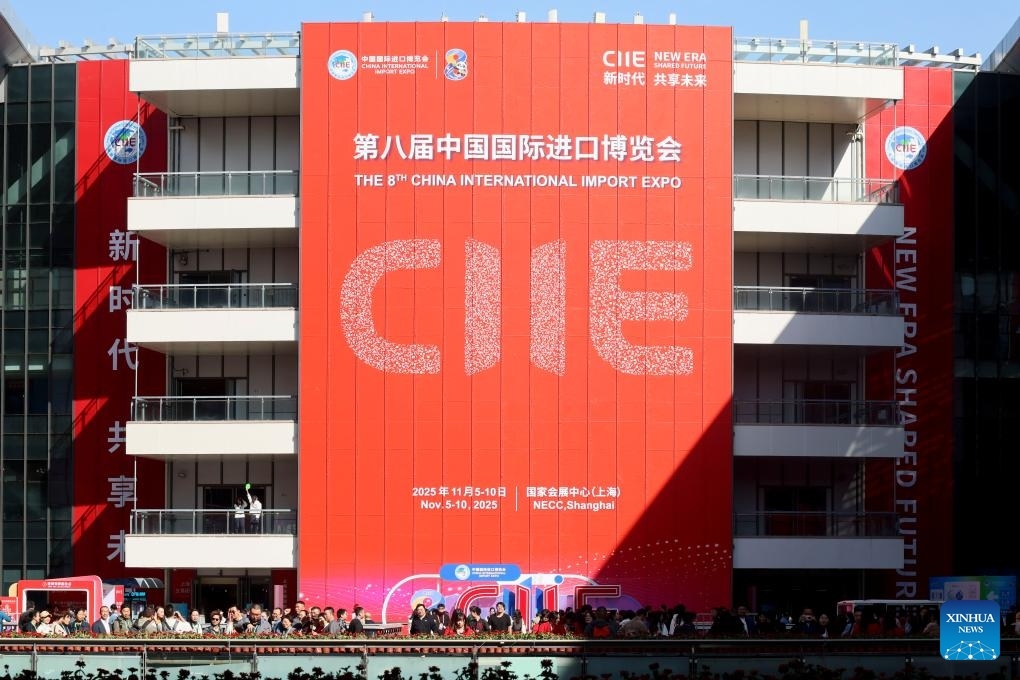
This photo shows a view of the National Exhibition and Convention Center (Shanghai), the main venue of the eighth China International Import Expo (CIIE) in east China's Shanghai, Nov. 10, 2025. (Xinhua/Wang Xiang)
The fifth China International Consumer Products Expo featured a special new product launch area and introduced a global new products plan. Twenty launch entities representing 40 brands from China, the UK, Switzerland, France, Canada, Italy, Singapore, Malaysia, Norway and beyond unveiled nearly 100 new products and product lines.
Today, an increasing number of multinational corporations are establishing global research and development (R&D) centers in China.
Market-driven innovation remains a key motivator for many multinationals. China's market is massive and highly diversified, with continuously rising demand for product upgrades, encouraging companies to increase investment and enhance innovation based on consumer needs, according to Hubert de Haan, senior vice president and chief sales and marketing officer for China at BSH Home Appliances Group.
The concentration of talent provides crucial support for multinationals' R&D presence in China. Data show that China's total expenditure on R&D exceeded 3.6 trillion yuan ($514.55 billion) in 2024, with R&D intensity reaching 2.68 percent — surpassing the average level of European Union countries. The country's total number of people engaged in R&D ranked first globally.
Favorable policies have boosted confidence among multinationals expanding their R&D presence in China. Since MOFCOM and the Ministry of Science and Technology introduced measures to encourage the establishment of foreign-funded R&D centers, multinational firms have accelerated efforts to set up such centers in China, injecting momentum into the development of new quality productive forces.
Statistics show that by May 2025, Shanghai had 603 foreign-invested R&D centers, while Beijing had 221 by January 2025.
Foreign-funded R&D centers have helped attract cutting-edge technologies and high-end talent to China, upgrade the country's industrial technology, build up scientific and technological innovation capabilities, and promote the growth of global industrial and innovation chains, a MOFCOM official said.
China will make greater efforts and adopt more effective measures to support the development of foreign-funded R&D centers, encouraging their establishment in innovation hubs including Beijing, Shanghai, the Guangdong-Hong Kong-Macao Greater Bay Area, the Chengdu-Chongqing economic circle, Wuhan and Xi'an, the official added.
As China's inbound tourism gains momentum, the country is becoming a preferred shopping destination for many overseas consumers.
Throughout the year, relevant departments further optimized tax refund policies and services for departing visitors to enhance consumption experiences and boost inbound spending. The number of overseas visitors claiming China's departure tax refund surged 285 percent year on year in the first 11 months of 2025, while sales of tax refund-eligible goods and the total amount of tax refunds increased 98.8 percent from the same period a year earlier.
In 2025, MOFCOM launched the "Shopping in China" campaign, a nationwide initiative promoting shopping, dining and tourism, creating diverse consumption scenarios and fostering a more welcoming international consumption environment.
Photos


Related Stories
- GE HealthCare's CEO emphasizes confidence in China market investments
- An open China delivers opportunities, confidence globally
- China builds development momentum through self-reliance and global engagement
- Chinese vice premier meets chair of Citigroup, CEO of Carlyle Group respectively
- China remains committed to high-level opening up
Copyright © 2026 People's Daily Online. All Rights Reserved.
