



Sheep farming grows into robust driver of rural revitalization in Huzhou, E China's Zhejiang
Hu sheep, a species native to Huzhou city, east China's Zhejiang Province, has satisfied the taste buds of consumers and spurred the growth of related sectors, such as farming, processing, and e-commerce, contributing to rural revitalization and becoming a key driver of the local economy.
As a valued local specialty of Zhejiang, Hu sheep is known for its superior breed quality, with its distinct characteristics including a long and narrow head and neck, a prominent nose bridge, large drooping ears, a straight back and waist, and long, slender limbs.
From sheep meat and wool to hide and feces, every part of the sheep is valuable, creating a thriving, multi-faceted industry in Huzhou.
The meat of Hu sheep is delicious, the wool can be made into cashmere sweaters, and the hide can be used to make leather garments, according to villagers in Xibao village, Lianshi town, Nanxun district of Huzhou.
Even the sheep manure is considered "gold nuggets," as it serves as excellent fertilizer for local citrus trees after fermentation, villagers said.
This has formed a green, circular agricultural model described locally as "sheep manure fertilizes citrus, and grass from citrus orchards feeds the sheep."
Thanks to this closed-loop agricultural ecological system, many villagers who once had to seek temporary work elsewhere can now find jobs and increase their incomes right in their hometown.
Xibao village has created more than 100 stable jobs for local residents, helping them increase their annual incomes by 20,000 yuan ($2,845.56) to 40,000 yuan per person, according to Fei Huajie, the Party chief of Xibao village.
In an effort to further promote the large-scale development of the Hu sheep-citrus circular industry, Xibao village, in collaboration with 22 neighboring villages, has established a company, transforming the village from an economically backward village to a model of rural prosperity, with operational revenue tripling in the past few years.
By 2027, the full Hu sheep industrial chain, including breeding, processing, cold-chain logistics, and e-commerce, is expected to exceed 12 billion yuan in output value.
The key to the success of Hu sheep farming lies in the quality of the sheep, which is guaranteed through multiple technology-empowered measures.
In Huzhou, each Hu sheep has an ear tag containing its "electronic household registration information" to track its lineage and prevent inbreeding.
More importantly, the introduction of a breeding chip, which functions like a genetic identification (ID) card, helps farmers quickly identify offspring with superior genetic traits, ensuring high-quality future generations.
According to Wang Zhengguang, an expert from Zhejiang University's livestock and poultry industry alliance, this breeding chip enables early genetic selection—within one to three days of birth—dramatically reducing costs and improving efficiency compared to traditional methods that typically take up to 12 months.
Not only has the local economy benefited, but sheep farming in Huzhou has also driven growth in other parts of the country.
In particular, Nanxun district, with a population of over 300,000 Hu sheep, has contributed to sheep genetic improvement across many provinces in China.
In 2018, the first batch of 100 Hu sheep was sent to Guang'an city, southwest China's Sichuan Province, over 1,700 kilometers away, marking the start of their "journey to promoting common prosperity."
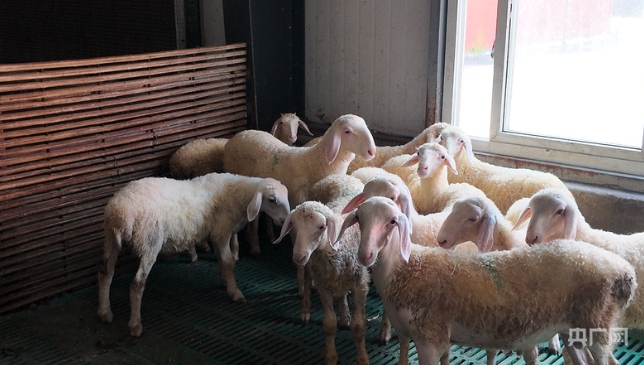
Photo shows Hu sheep at a breeding farm in Guang'an, southwest China's Sichuan Province. (cnr.cn/Chang Sirong)
With funding, technical support, and follow-up services from Nanxun, Guang'an has increased its Hu sheep population to over 10,000 so far.
The success of the Hu sheep industry in Guang'an has sparked the development of an industrial chain serving common prosperity, which encompasses farming, processing, catering, and leisure tourism.
The city has even established the country's first Hu sheep themed park, which has quickly become a popular destination for family vacations.
Since its opening in October 2024, the theme park has received around 100,000 visitors.
The economic benefits are tangible. In 2024, Guang'an's Hu sheep industry generated more than 20 million yuan in output value, with households previously lifted out of poverty participating in Hu sheep farming and 57 village collectives across the district each posting notable gains in average annual income.
Satisfying culinary desires while driving economic growth, Hu sheep is now widely praised for exemplifying the "most fragrant" path to common prosperity.
Photos



Related Stories
- Feature: Red fruits of Funiushan -- how cornus revitalizes a rural Chinese town
- Tech-driven rural revitalization takes roots across China
- From endangered to billion-yuan industry: The revitalization of the Green-Shelled Egg Chicken industry
- Luxembourg retiree witnesses 'tremendous transformation' in rural China
- FAO officials commend east China province's rural revitalization amid eco-conservation
- China's rural revitalization offers lessons for Africa's socioeconomic development
- Chinese vice premier calls for applying Green Rural Revival Program experience to advance rural revitalization
- Rural revitalization breathes new life into east China's ancient village
- Asia-Pacific journalists impressed by happy rural life brought about by China's rural revitalization strategy
- "New farmer" energizes rural revitalization with new models
Copyright © 2026 People's Daily Online. All Rights Reserved.
