



China makes significant progress toward commercial application of autonomous driving
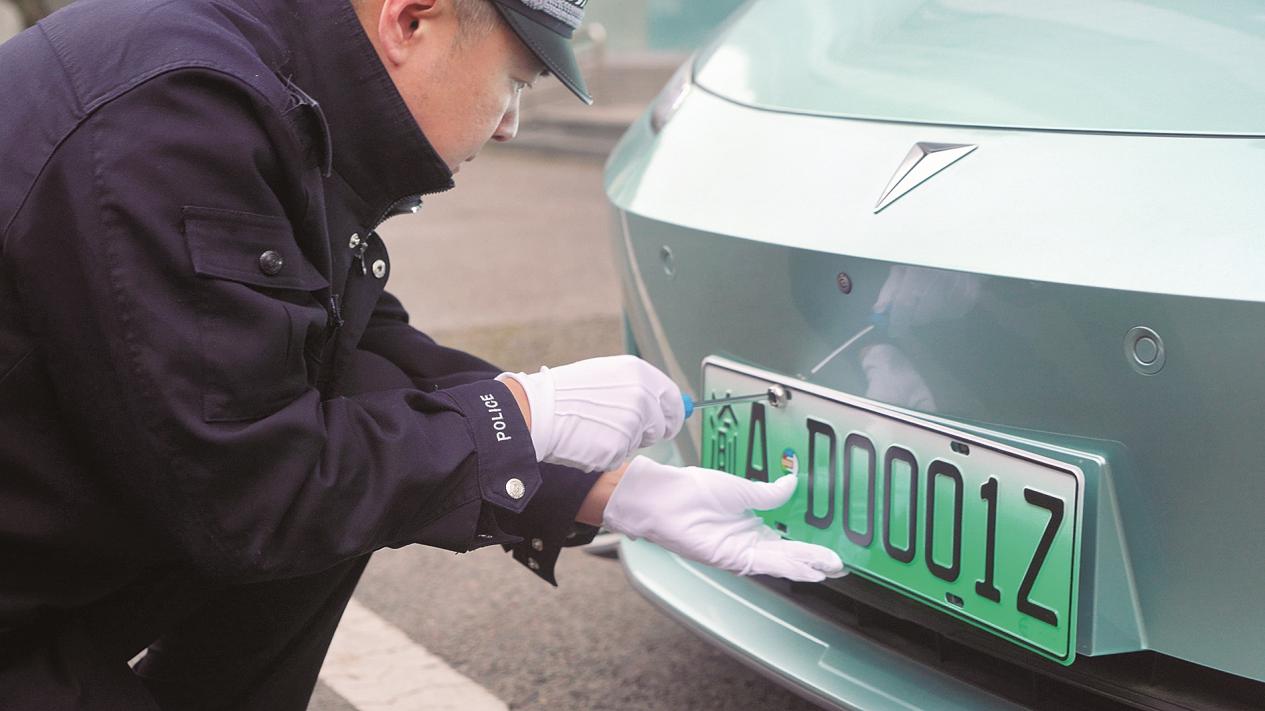
A police officer installs the first official license plate dedicated to Level-3 autonomous driving to a vehicle. (Photo/Xu Chunyuan)
Under the winter sun, a white sedan steadily navigated the Beijing-Taipei Expressway. As Wang Yan, chief engineer of a Level 3 (L3) autonomous driving pilot program at Chinese automaker Beijing Automotive Group Co., Ltd. (BAIC Group), pulled a control stalk, the adaptive cruise control mode was activated, and a blue indicator illuminated on the dashboard of the BAIC Arcfox Alpha S (L3 Edition).
"The vehicle has entered L3 autonomous driving mode," Wang explained. "The driver can remove their hands from the steering wheel and their feet from the brake pedal."
Wang noted that the indicator activates only on designated pilot sections, signaling that the vehicle meets the conditions for autonomous driving. "In these sections, the vehicle can steer, accelerate, and decelerate autonomously within a single lane," he added.
On Dec. 15, 2025, China's Ministry of Industry and Information Technology granted road approval for two electric sedan models equipped with L-3 autonomous driving capabilities, in the first time it has allowed such vehicles to operate on public roads in Beijing and Chongqing. This marked a critical step toward the commercial application of L3 autonomous driving in China.
According to the standards for automated driving levels set by the Standardization Administration of China, driving automation is classified into six levels, from L0 to L5. While L2 refers to partial automation, L3 denotes conditional autonomous driving.
"Currently, most vehicles equipped with L2 systems on the market provide partial automation on expressways and urban roads," said Song Chaosheng, a professor at Chongqing University.
"L2 remains an assisted driving system, whereas L3 represents a higher level of automation," said Liang Fenghua, deputy general manager of AI fundamentals and applications at Changan Automobile.
"Under specific scenarios, L3 systems can fully control dynamic driving tasks, although drivers must be prepared to resume control if the system requests a takeover," Liang added.
L3 systems allow drivers to momentarily take their hands off the wheel and eyes off the road, as the system independently manages driving tasks. However, this is only permitted under the right conditions, such as on designated roads with reliable network and satellite positioning.
The approvals granted for these vehicles are distinct from previous testing permits. "These models are now eligible for official license plates and can legally operate on public roads, a significant departure from vehicles under testing licenses," said Jia Beibei, director of BAIC's L3 autonomous driving project.
Ji Jie, associate professor at the College of Engineering and Technology, Southwest University, noted that these approvals represent a shift from technological validation to mass-production readiness. "This marks a transition from laboratory testing to real-world applications, accelerating the commercialization of autonomous driving," Ji added.
Wang also highlighted the conditional nature of L3 autonomous driving. "The system is designed to operate only on designated pilot road sections and under favorable conditions, such as stable network and satellite positioning."
Once activated, drivers are allowed to divert their attention from the road briefly, but they are not permitted to close their eyes for extended periods, leave the driver's seat, or unfasten their seat belt. If the system detects such behavior, it will issue a takeover request that the driver must respond to immediately.
At present, pilot vehicles in Beijing are authorized to operate autonomously at speeds up to 80 kilometers per hour on designated highways and urban expressways. In Chongqing, pilot vehicles can operate autonomously at speeds up to 50 kilometers per hour in traffic-congested areas.
The technical requirements for these pilot vehicles are correspondingly higher. The Arcfox Alpha S (L3 Edition) is equipped with 34 high-performance sensors, including three lidar units, which provide comprehensive environmental perception and data for decision-making. Changan's model features essential sensing technologies such as 4D imaging, millimeter-wave radar and micro-collision sensors.
"For L3 vehicles, both hardware and software are designed with the principle of 'no failure allowed,'" Liang said, adding that the vehicles must remain safe and operable even if certain critical systems fail.
Changan's approved model employs a seven-level redundant architecture covering perception, control, power supply, communications, braking, steering, and human-machine interaction. In the event of a failure in one of the critical systems, backup systems can take over, ensuring safe deceleration and stopping.
Liang explained that at the current stage, the use of these vehicles is limited to pilot entities, designated road sections, and approved models. "Consumers cannot yet operate these vehicles themselves, but they can book autonomous driving ride services via mobile apps to experience the technology," he said.
To accelerate the commercialization of L3 conditional autonomous driving, a consortium led by BAIC has been selected for the L3 intelligent connected vehicle road pilot program, launched by four government departments. The consortium plans to launch operations in specific scenarios in the first quarter of 2026 to gather real-world data and experience.
Chongqing's diverse terrain, characterized by mountainous landscapes, frequent fog, bridges and tunnels, and complex interchanges, serves as a rigorous testing ground for Changan's L3 models.
"Chongqing's road conditions present comprehensive challenges to vehicle perception, positioning, control, and route-planning capabilities," Song said. "If a vehicle can navigate these conditions successfully, it has the potential to operate effectively in most complex traffic environments."
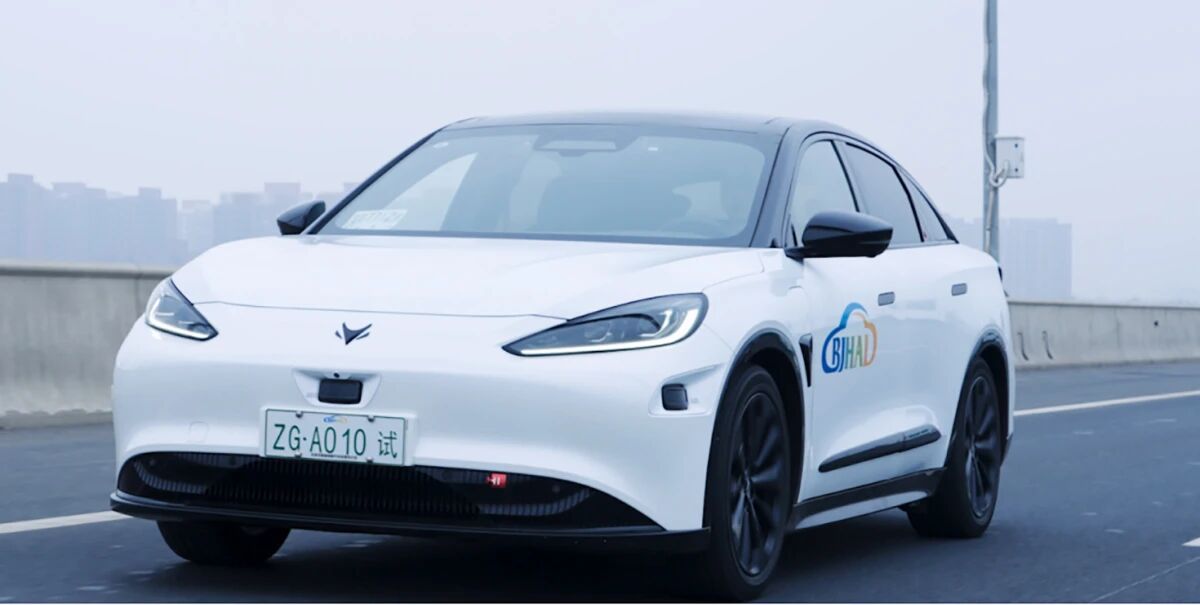
BAIC Arcfox Alpha S (L3 Edition) is in road testing. (Photo provided by BAIC Arcfox)
Photos




Related Stories
- Shanghai unveils plan to build leading zone for high-level autonomous driving
- China speeding up standard-setting for autonomous driving safety
- Smart driving features to go mainstream
- Shanghai has over 2,000 km of roads allowing autonomous driving tests
- New rules on drunken driving released
- Guideline unveiled to make public use of autonomous driving vehicles safer
- Chinese mainland, Macao to mutually recognize driving licenses
- Dramatic driving experience
- Permits edge Beijing closer to full self-driving technological reality
- China's first commercial license for unmanned driving services issued
Copyright © 2026 People's Daily Online. All Rights Reserved.
