



China's green energy transition: A blueprint for global climate action
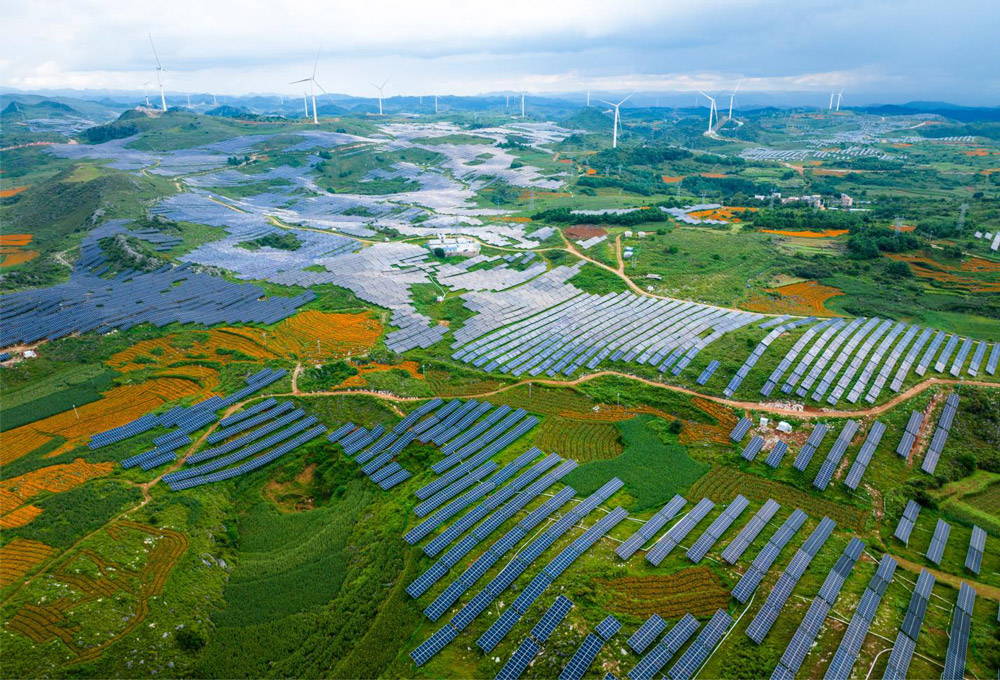
An aerial drone photo taken on Sept. 20, 2025 shows a view of the Jinping West Wind Power project in Qiubei County, Wenshan Zhuang and Miao Autonomous Prefecture, southwest China's Yunnan Province, the largest plateau mountain wind power base in China. (Photo provided to People's Daily Online)
China has long championed green development, and its commitment has become increasingly prominent in the 21st century. Over the past two decades, especially since 2013, the country has steadily transformed its economy by pursuing a low-carbon, green growth model. Supported by technological innovation and large-scale investment in renewable energy, this transition has produced remarkable results.
In September this year, I joined journalists from 13 countries as part of People's Daily's "Belt and Road Media Delegation" and visited the Jinping West Wind Power project, operated by China Datang Corporation Ltd., in southwest China's Yunnan Province to explore this "green engine" standing above the clouds. From an observation deck at 2,200 meters, we witnessed firsthand the technological strength and ecological commitment behind China's advanced green energy projects, with many participants praising it as a "model of energy transformation."
The Jinping West Wind Power project is part of China's largest high-altitude mountain wind power base, with a total installed capacity of 1 million kilowatts. In autumn, fields of golden chrysanthemums blanket the hillsides as local farmers work diligently on the terraced fields, while turbines turn in the distance, sending clean electricity into the grid.
As I stood amid the towering wind turbines, the scale of the project left me in awe as I observed how wind power was harnessed to generate clean, renewable energy. The advanced technology behind the turbines, combined with the picturesque landscape, offered a glimpse into the future of energy.
This project represents a significant step forward in China's broader vision for a green, sustainable future, with the country's commitment to addressing global climate change and promoting sustainable growth clearly reflected in the design and operation of the wind farm.
During my visit to the wind farm, I spoke with project facilitators, who explained how the company integrates development with local livelihoods. Working closely with six ethnic minority villages, the project adopts an enterprise–community model that combines green energy with cultural tourism. This approach not only produces clean electricity but also injects new vitality into the regional economy.
The wind power base has delivered clear benefits to surrounding communities. It has created jobs in construction, maintenance, and operations, providing stable income for local residents and boosting household income and living standards. At the same time, the project has driven improvements in local infrastructure—including roads, electricity and water supply—helping a once underdeveloped region build a stronger foundation for growth.
This initiative exemplifies China's broader strategy of leveraging green energy to tackle environmental pollution and address climate change challenges. At the same time, it acts as a catalyst for local economic development. As part of its rural revitalization efforts, the government has actively supported projects like the Jinping West Wind Power project to reduce poverty and promote long-term sustainability in rural communities. By integrating renewable energy with local tourism, the project has created a dynamic ecosystem that advances both environmental and economic goals, offering a model for sustainable development.
China's green energy journey offers valuable lessons for the world in scaling renewable energy projects. A defining feature of the country's transition has been the rapid deployment of wind, solar, and hydropower technologies, making clean energy more accessible, affordable, and efficient over the past two decades. This progress has been driven by massive investments in infrastructure, research, and development, which have lowered costs, improved technology, and expanded production capacity. As a result, China's speed and scale in clean energy deployment provide a practical model for other nations, demonstrating that with the right policies and innovation, renewable energy can be integrated into national systems at scale.
As the world faces increasingly urgent environmental challenges, it's clear that addressing climate change will require a unified global response. By sharing knowledge, technologies, and resources, countries can work together to create innovative solutions that address climate change, reduce carbon emissions, and protect the planet for future generations.
Photos


Related Stories
- China sees rapid green and low-carbon energy transition from 2021-2025
- Spain-China forum on green energy held in Madrid
- China issues nearly 2.5 billion green electricity certificates in January-October
- Tax data reveals accelerating green transition in Beijing-Tianjin-Hebei region
- China's Shandong develops green energies to advance new energy structure transformation
- Behind "overcapacity" claim: How China's clean-tech footprint powers global green transition
Copyright © 2025 People's Daily Online. All Rights Reserved.
