



Archaeologist in Jingdezhen dedicates over 40 years to ceramic research
Jiang Jianxin, born in 1958 in Jingdezhen, east China's Jiangxi Province, serves as honorary director of the Jingdezhen Imperial Kiln Institute, an executive council member of the Chinese Society for Ancient Ceramics and vice president of the Jiangxi Provincial Archaeological Society.
Since 1982, he has participated in and led more than 10 rescue excavations at the imperial kiln site of Jingdezhen, overseeing the recovery and restoration of tens of thousands of official kiln porcelain vessels and fragments.
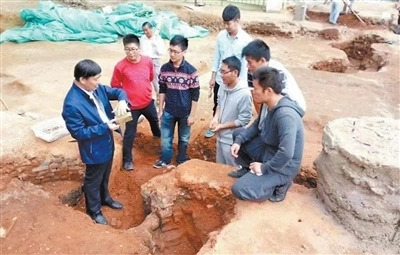
Photo shows Jiang Jianxin (first from left) and team members at an excavation site. (Photo courtesy of the interviewee)
He has also served as chief editor for several academic works, including the book "Chinese Porcelain in the World: History and Trade Routes," which explores the role that Chinese porcelain played in globalization.
For more than four decades, Jiang has used fragments from the imperial kiln site to piece together a vivid narrative of Jingdezhen's firing history and advance the study of Chinese ceramic culture.
Inside the Jingdezhen Imperial Kiln Museum, a three-colored duck-shaped incense burner from the Ming Dynasty (1368-1644) draws crowds of curious visitors. It is one of the museum's most beloved exhibits. Yet for centuries, it lay in pieces at the foot of Zhushan Mountain, just a short distance from where it now sits on display.
The discovery dates back to a winter day in 1979 when construction crews upgrading the city's sewer system stumbled upon countless ceramic fragments. Jiang's mentor, Liu Xinyuan, rushed to the site and retrieved the pieces for examination.
"After cleaning and restoration, we found these fragments could be reassembled into complete pieces," Jiang said. "We concluded that this was an official kiln site."
Over the years, the team carried out three planned excavations and 31 rescue excavations around the site, unearthing a wealth of relics and remains from the Ming and Qing dynasties (1368-1911). "Between 1980 and roughly 2010, we collected more than 6,000 boxes of ceramic fragments," Jiang said.
Jingdezhen's imperial kiln, established in 1369, stands as one of China's longest-operating, largest and most technically accomplished official kilns of the Ming and Qing dynasties, representing the pinnacle of ancient Chinese ceramic craftsmanship. More than 90 percent of the ceramics housed in Beijing's Palace Museum originated from this kiln.
From a sea of fragments, Jiang's team eventually selected more than 60 pieces and successfully reconstructed six three-colored duck-shaped incense burners from the Ming Dynasty. Later, the Jingdezhen Imperial Kiln Institute partnered with the Palace Museum to further restore the reassembled incense burners. In 2023, the Palace Museum transferred the collaboratively restored burners to the Jingdezhen Imperial Kiln Institute.
"Previously, research relied primarily on historical documents," Jiang said. "Our research allows ceramic fragments and archaeological remains to complement written records. Porcelain serves as our window into history."
Beyond porcelain restoration and the study of its history, Jiang sought to share his research achievements with the public.
"When visiting the Palace Museum, I noticed many exhibits that closely resembled our restored pieces from the imperial kiln site. I wanted to display our restored items alongside these surviving masterpieces," Jiang said.
Without hesitation, he set to work. After five years of research and planning, an exhibition opened at the Palace Museum in 2015, featuring archaeological findings from the Ming Dynasty unearthed at the imperial kiln site in Jingdezhen alongside pieces from the museum's own collection.
"The exhibition received tremendous acclaim, and we expanded it into a series," Jiang said. By 2021, the five-part comparative exhibition series had presented 1,137 sets of heirloom artifacts and restored samples side by side, showcasing the design, production and selection processes of the Jingdezhen imperial kiln in the Ming Dynasty, as well as its administrative regulations.
Jiang has also organized more than 80 domestic and international touring exhibitions featuring porcelain from the imperial kiln site, offering audiences fresh perspectives on ceramic culture.
"Porcelain wasn't merely a crucial export commodity in ancient China's overseas trade — it was a cultural ambassador," Jiang said. For instance, starting in the 16th century, artisans in Delft, the Netherlands, began imitating Jingdezhen's techniques, creating decorative patterns strikingly similar to those found on Chinese blue-and-white porcelain.
Weng Yanjun, one of Jiang's students, eventually earned a doctorate in archaeology from Peking University.
"He is now director of the Jingdezhen Imperial Kiln Institute. Beyond archaeological research, he's leading his team in turning the three-colored duck-shaped incense burner into a cultural IP called 'Ducktor Sui,' or 'Sui Sui Duck,'" Jiang said.
Over the years, Jiang has mentored 70 to 80 students. Each time he learns of a student's new achievement in ceramic research, he feels deeply gratified.
Photos




Related Stories
Copyright © 2026 People's Daily Online. All Rights Reserved.
