



New land-sea trade corridor boosts connectivity between China, Southeast Asia
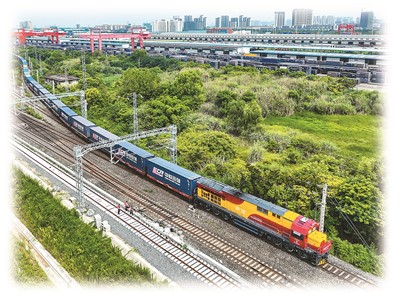
A Lancang-Mekong-Sichuan Express train departs from Chengdu, southwest China’s Sichuan Province, July 7, 2023. (Photo/Bai Guibin)
The New International Land-Sea Trade Corridor (ILSTC), a vital trade and logistics channel connecting regions across China and beyond, saw the transportation of 424,000 twenty-foot equivalent units (TEUs) of goods in the first half of 2023, marking a 10.5-percent increase compared to the same period last year.
Serving as a vital connection between the Silk Road Economic Belt, the 21st-Century Maritime Silk Road, and the Yangtze River Economic Belt, the ILSTC has provided a powerful boost to high-quality cooperation within the Belt and Road Initiative (BRI). The corridor plays a significant role in furthering economic and social development and enhancing international engagement.
The ILSTC's development has gained momentum since the Regional Comprehensive Economic Partnership (RCEP) came into effect for all its 15 members on June 2.
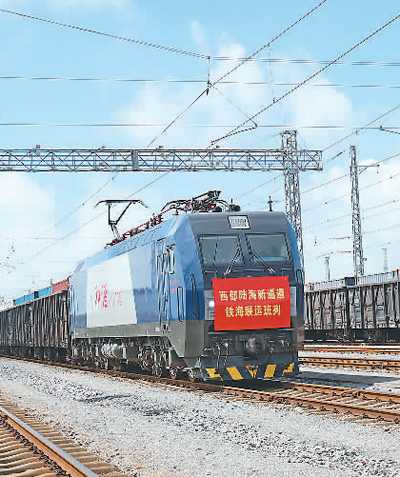
The X9590 freight train runs on a railway along the New International Land-Sea Trade Corridor, July 21, 2023. (Photo/Dai Peiyun)
Originating from the China-Singapore (Chongqing) Demonstration Initiative on Strategic Connectivity, which was launched in November 2015, the ILSTC has undergone significant milestones. In September 2017, the first train of a regular sea-rail transit route linking China and Singapore, the precursor to the ILSTC, departed from southwest China's Chongqing Municipality. By August 2019, this land-sea corridor had been elevated to national strategic status.
Since then, China State Railway Group Co., Ltd. (China Railway) has steadily advanced the construction of railway infrastructure for the ILSTC.
To date, the new land-sea corridor has facilitated access to 120 railway stations across 61 cities within 18 provincial-level regions in China. It has expanded its connections to over 300 ports in more than 100 countries and regions.
The range of goods transported via the new land-sea corridor has grown substantially, expanding to over 940 types in 2022, up from over 50 in 2017. The total volume of container cargo on the corridor has surged 223 times during that same period, according to Liu Wei, director of the ILSTC's Coordination Center for Logistics and Operation.
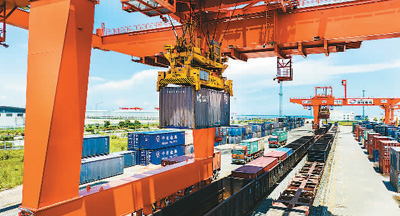
A railway container station in Qinzhou city, south China's Guangxi Zhuang Autonomous Region. (Photo/Chen Lei)
"In the future, the ILSTC will continue to maintain a sound growth momentum and inject strong impetus into deepening cooperation in the joint construction of the BRI and building harmonious regional economic and trade relations," Liu added.
In line with a plan released by the National Development and Reform Commission in August 2021, China is focusing on the high-quality development of the ILSTC during the 14th Five-Year Plan period (2021-2025). The country's aim is to ensure the ILSTC is economical, efficient, convenient, green and safe by 2025.
Among the ongoing projects, a railway between the cities of Fangchenggang and Dongxing in south China's Guangxi Zhuang Autonomous Region is currently under construction. This railway forms part of the ILSTC and is positioned at the westernmost end of the country's coastal railway network.
"The railway is expected to be operational by the end of the year. It will reduce travel time from the two places from 60 minutes to 20 minutes. It will also play a positive role in promoting trade and economic exchanges between China and Vietnam," said Liao Gang with China Railway Nanning Bureau Group Co., Ltd.
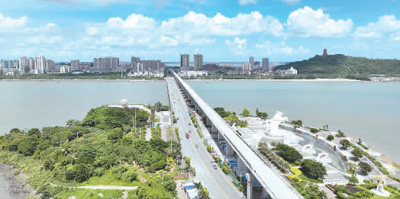
A cross-sea railway bridge connects the cities of Fangchenggang and Dongxing in south China's Guangxi Zhuang Autonomous Region. (Photo/Chen Lei)
The ILSTC's transportation network has expanded consistently. For example, Qinzhou Port in Qinzhou city of Guangxi, an important transit point along the ILSTC, now provides over 30 shipping routes to ports in the Association of Southeast Asian Nations (ASEAN) member states. Additionally, the ILSTC now encompasses 18 railway container center stations across China.
This growth is exemplified by the Qinzhou Railway Container Center Station, a key hub of the new land-sea corridor, which handled 255,000 TEUs of containers as of June 30 this year, reflecting a 44 percent increase year on year.
The acceleration of the ILSTC's construction has led to steady increases in rail-sea intermodal freight trains' trips within the corridor, and the result has been a significant decrease in logistics costs. This reduction has been a major driving force in opening up southwest China to higher levels of international trade.
Goods from Chongqing and Chengdu, the capital of southwest China's Sichuan Province, used to take about 23 days to reach Singapore via the Yangtze River and sea route. The new land-sea corridor has slashed travel time by around 16 days.
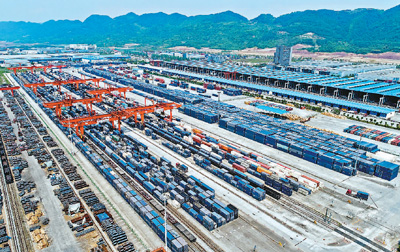
A photo shows Tuanjiecun Station in southwest China's Chongqing Municipality. (Photo/Zhou Shifan)
On June 11, Chongqing welcomed the first direct cold-chain train of Thai durians via the New International Land-Sea Trade Corridor. The entire journey was completed in just four days, a significant reduction from about 10 days via traditional means of transportation.
The corridor is now facilitating the trade of more and more agricultural products from ASEAN members, such as Cambodian rice, Thai coconuts and mangosteens, and Vietnamese passion fruit, all reaching the Chinese market via the ILSTC. Concurrently, goods from China, including new energy products, new materials, and mechanical and electrical products, are being exported via the new land-sea corridor.
Companies are already reaping the benefits. Chongqing Wankai New Materials Technology Co., Ltd., for example, sells its products to Southeast Asia, Europe, and Africa through the ILSTC. The new corridor has helped the company substantially reduce logistics costs and handling times for international orders, giving it a competitive edge in the global market, according to Lin Zheng, the company's logistics manager.
The ILSTC has tackled the challenges of international logistics in western China, helping the country accelerate the establishment of a new development pattern. Moreover, the new land-sea corridor has ushered in fresh opportunities for the development of countries and regions along its path, contributing to the stability and resilience of global supply chains.
Photos


Related Stories
- How China helps preserve cultural heritage sites in Asia
- Asia must not have chaos, wars if it wants greater development: premier
- ADB lowers growth forecast for developing Asia amid global gloom
- Asia must jointly tackle external risks amid looming US-EU ‘subsidy war’
- Economists decode the rise of Asia, reasons for region’s success
Copyright © 2023 People's Daily Online. All Rights Reserved.
