



Mechanization brings more efficiency, income to farmers in S China’s Guangxi
After receiving a message that reads “Now is a great time to fertilize mango trees,” from an agricultural technician, Lu Yufu, a mango grower in Lianpo village, south China’s Guangxi Zhuang Autonomous Region went to his orchard halfway up a hill, where a logistics track network is in place, to prepare work.
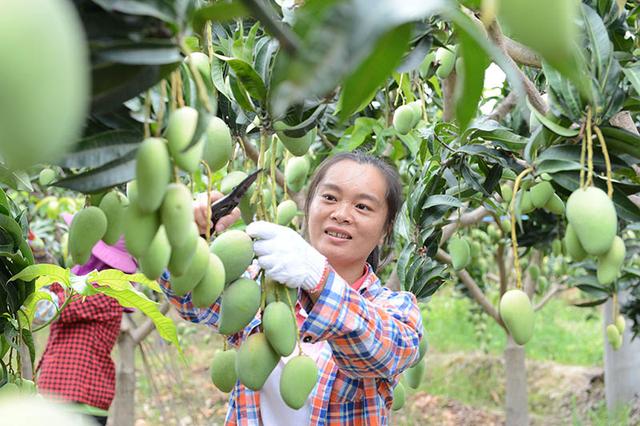
A farmer picks mangoes in an orchard in Tianyang district, Baise city, Guangxi. (Photo/People’s Daily Online)
Lu first signed his name to a document at a duty room located at the foot of the hill to use the network. Shortly after that, about 250 kilograms of chemical fertilizers and farm tools were delivered to Lu’s orchard with an area of 10 mu (about 0.67 hectares).
“Last year, my gross income from the mango trees reached 40,000 yuan (about $6,295) thanks to high yield,” Lu said, attributing it to agricultural modernization in mountainous areas.
Lu recalled that the income per mu ranged between 1,000 yuan and 3,000 yuan in the past, adding that inefficient farming methods in the mountainous village in Tianyang district of Baise city led to low economic efficiency, which caused farmers to feel increasingly reluctant to continue their agricultural work.
Tianyang district raised 386 million yuan to promote a business model that integrates companies, production bases, agricultural cooperatives, and farmers, and make the farmland in hilly areas more suitable for mechanized farming. As a result, crops are planted and cultivated by machines.
Since 2018, Guangxi has set up 34 demonstration bases for full mechanization of crop production. In core demonstration bases, Guangxi has made 8,000 mu of farmland more suitable for mechanized farming and introduced 2,185 agricultural machines, significantly improving farming conditions in hilly and mountainous areas.
Photos



Copyright © 2022 People's Daily Online. All Rights Reserved.
