
 |
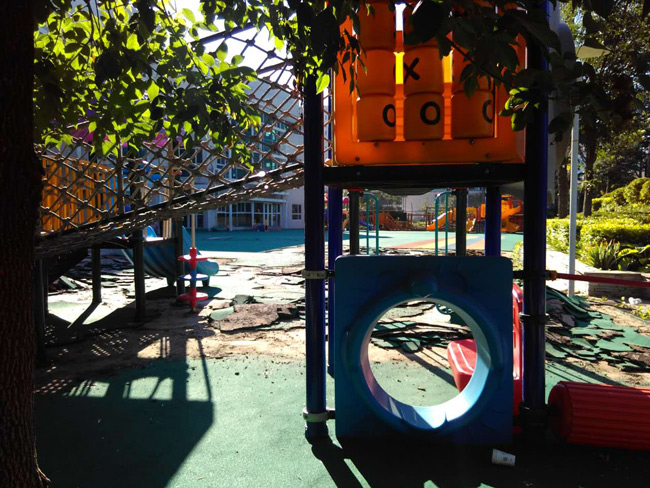
| (Wanxiang Kindergarten in Beijing, whose racetrack has been removed after allegedly causing students sick. Photo: Courtesy of China Biodiversity Conservation and Green Development Foundation) |
The synthetic running tracks on primary school and kindergarten campuses that have allegedly poisoned dozens of students may be the result of a poorly-designed national standard, experts say.
Addressing a seminar held on Aug. 3 in Beijing, Zhao Yu, an engineer with the Central Research Institute of Building and Construction under the Metallurgical Corporation of China (MCC), noted that the current national standard on synthetic tracks, issued in 2011, requires only a test of the track's tactile, physical qualities. There is no compulsory examination of its chemical properties; the standard only suggests that running tracks in schools be examined on the basis of both physical and chemical requirements.
"It should be noted that the standard itself includes only a suggestion, meaning that violators cannot be held accountable economically or legally," Zhao noted.
According to the national standard, synthetic tracks will only be tested for benzene, methylbenzene, dimethylbenzene, toluene diisocyanate (TDI) and heavy metals such as lead and cadmium. “Testing for hazardous materials is not adequate, even though the testing standard is close to that applied to other building materials,” Zhao said.
The problematic test requirements are the root of an issue haunting many students and parents, noted the secretary general with the Beijing-based non-governmental organization China Biodiversity Conservation and Green Development Foundation (CBCGDF), which organized the seminar.
“It is because of the standard that we continue to see poisonous tracks on campuses. The tests read qualified, so the tracks get to stay," the secretary general explained. He also said that diseases related to the chemical composition of school running tracks are increasing, and the problem will become more serious unless something is done to change the standards.
A number of primary schools and kindergartens in Beijing have reportedly witnessed students developing symptoms including rashes, fever and nosebleeds after contact with the synthetic tracks on playgrounds. Several parents whose children allegedly became sick due to contact with the tracks began to shed tears at the seminar, decrying the decision to use such running tracks at schools.
“It may be wrong to have installed synthetic tracks in the first place,” said Xie Chunfeng, a director of the Beijing Education Scientific Research Network. “Kids don’t necessarily need such tracks for competition. They can have fun on grass instead, the same way [kids do] in Western countries.”
However, Jia Zhiyong, an official with the National Institute of Education Sciences, argued that synthetic running tracks are, after all, a technological improvement in the sporting world, and suggested that the quality issue does not constitute a reason to implement a total ban. He believed there should be stricter standards for testing such tracks, and that safer materials should be substituted in to the manufacturing process.
Bian Zhiyong, vice president of Taishan Sports Industry Group Co., Ltd., also agreed that high-quality synthetic tracks or man-made grass are capable of meeting even strict manufacturing standards.
“Running track construction should require an inspection and it should be carried out under strict supervision to guarantee the quality, as well as to sift out outdated or unprofessional manufacturers,” Bian said.
Some Chinese cities, including Shenzhen, Nanjing and Shanghai, have been considering whether to issue their own local standards on synthetic tracks, an idea which was praised by experts at the seminar.
Shenzhen's proposed standards not only require that more hazardous materials be tested for, including total volatile organic compounds (TVOC) and formaldehyde, but that there be a test related to the smell of running tracks, which would also have the authority to prevent a track from passing inspection. The Shenzhen standards make a chemical test compulsory and demand that all failing tracks be immediately uninstalled.
“On the one hand, it is about designing a strict and reasonable standard; on the other, we need to guarantee that it is effectively implemented. All raw materials must be tested, and a second examination should be done before construction. Periodic inspection is also necessary in case of the slow release of toxic materials,” said Yuan Zhenyi, a senior engineer with the MCC institute, at the seminar.
 Spectacular bridge with one of the tallest piers in the world
 Magnificent view of Hukou Waterfall
 A glimpse of Stride 2016 Zhurihe B military drill
 US Navy chief tours Liaoning aircraft carrier
 Chinese American woman wins Miss Michigan
 Centenarian couple takes first wedding photos
 Traditional Tibetan costumes presented during fashion show
 How did ancient people escape the summer heat
 Breathtaking scenery of Hulun Buir grassland
 Top 10 livable Chinese cities
 Top 20 hottest women in the world in 2014
 Top 10 hardest languages to learn
 China’s Top 10 Unique Bridges, Highways and Roads
 Seoul to blame if Korean Wave falters
 Shameful slap leaves tourists with red faces
 Hague court rules Indonesia mass killings were crimes against humanity
 As market approaches saturation, entrepreneurs seek to capitalize on high-end services
Day|Week


