
With an actual yield of 832.1 kilograms per mu (0.0667 hectares), scientist Yuan Longping’s rice cultivation has broken a world record for the yield of “double-season” early rice. This is a step toward success for a project focusing on the production of double-season early rice in southern China.
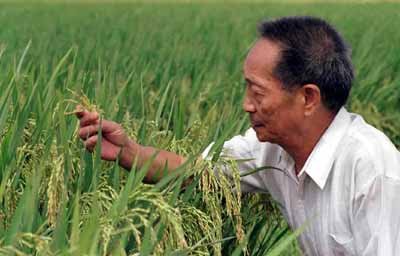
The project, launched in 2015, was organized by Guangdong province’s Department of Agriculture. It is being implemented by the Xingning Agricultural Bureau. The goal of the project is to achieve a total yield of 1,500 kilograms per mu for double-season rice within three years.
In 2015, the average yield of the early rice was 703.9 kilograms per mu, and that of late rice was 759.7 kilograms. The total yield of both harvests was 1,463.6 kilograms, which was just 36.4 kilograms below the goal.
According to Luo Xiwen, an academic with the Chinese Academy of Engineering, the yield of late rice is generally higher than that of early rice in Guangdong. As long as the average yield of early rice exceeds 750 kilograms per mu, then rice growers are on target to reach their goal. However, success still depends on the yield of late rice.
Experts believe that the answer lies in better seeds, better techniques and better opportunities. These upgrades will improve both the yield and quality of rice.
The project in Xingning is the fifth cultivation project related to super hybrid rice undertaken by Yuan Longping’s research team, and this is the first and so far only project focusing on double-season rice.
Recently, the global population reached 7 billion, and estimates say it will reach 8 billion by 2030. To feed such a large population, high-yield hybrid rice will be a necessity. Half the world’s population relies on rice in its daily diet, and 60 percent of Chinese people consider rice a staple food. Therefore, according to Yuan, a high rice yield plays a significant role in guaranteeing food security in the future.
Yuan also points out that the population is increasing while farmland is decreasing. The only way to safeguard the global food supply is to raise the amount of yield per unit area via advanced technologies, including those that focus on water conservancy, fertilizer optimization, soil cultivation and improved seeds.
Of those, the most economical and effective method is improved seeds, which was the main cause of growing yields in the past decade.
 Who Will Fit The Chinese Roles In Game Of Thrones?
 China's Hubei Shennongjia added to World Heritage List
 "Straddling bus" starts production in east China
 Girl goes viral for finger-long toes
 Five made-in-China hi-tech breakthroughs
 HK-Zhuhai-Macao Bridge to open to traffic
 China opens its first combined transport service to Nepal
 Students take stylish bikini graduations photos
 Charming dancing students pose for graduation photos
 Top 10 livable Chinese cities
 Top 20 hottest women in the world in 2014
 Top 10 hardest languages to learn
 China’s Top 10 Unique Bridges, Highways and Roads
 Arbitration creates little more than noise
 Western fast-food firms contribute to China’s economy
 Watching live streaming fur babies is entertaining, interactive and stress-relieving
 Visitors to Rio concerned by virus, crime and high prices
Day|Week


