
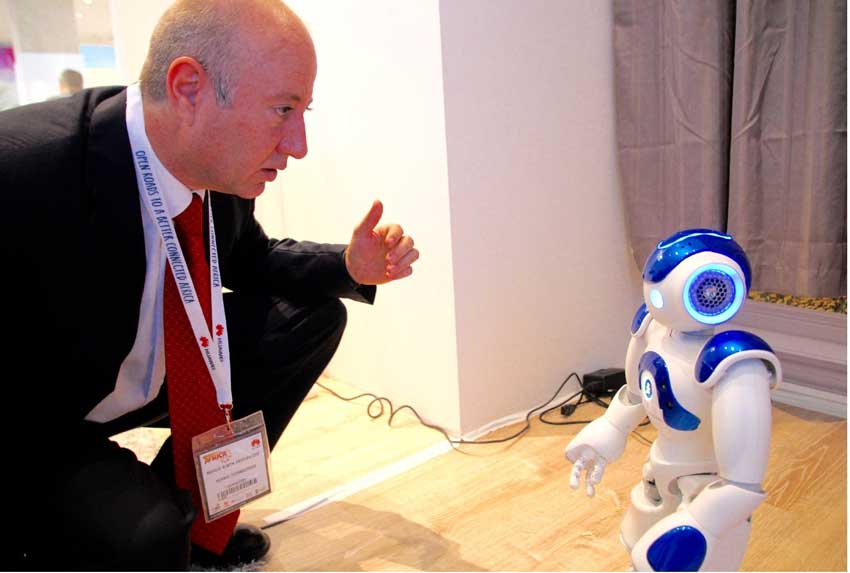
A visitor interacts with a dancing robot with Huawei Smart Home solution at AfricaCom in Cape Town. Picture: ZHANG JIEXIAN / PEOPLE’S DAILY ONLINE
Smart homes, robots connected to all electrical appliances, 4K video on flat screens, ubiquitous ultra mobile broadband, digital business transformation, portable cloud computing solutions with enormous database. All of these were showcased at AfricaCom held in Cape Town last month by China’s telecommunication giant Huawei. These technological advances can be realised in the near future when broadband services becomeeveryday commodities. Yet, it is too early to picture their presence in our life at this stage in Africa because of the lack of access to broadband. In Africa, only about one out of 10 households is connected to the internet.
Comparing to other areas on the globe, broadband coverage in Africa remains low. According to the International Telecommunication Union (ITU), mobile-broadband penetration levels are lowest in Africa (19%), which is only about one third of that in Europe (64%) and the Americas (59%). For fixed network, 44% of all fixed-broadband subscriptions are in Asia and the Pacific, and 25% are in Europe. In contrast, Africa accounts for less than 0.5% of the world’s fixed-broadband subscriptions.
However, household internet access in Africa continues to grow at a double-digit rate. With its huge population and rapidly growing middle class, Africa’s telecommunication industry has got enormous untapped potential,which has been valued by Chinese firms for decades. China’s Huawei and ZTE entered the African market in thelate 1990s, and now operate in more than 50 countries. To provide better telecom connectivity, Huawei has deployed more than 50% of Africa’s wireless base stations, more than 70% of LTE networks and at least 50,000km of optical fibre. It has reduced the cost of internet access for rural areas, saving about 40% in cost
and 80% in time spent online. “Connectivity is the cornerstone to the development of the digital economy in Africa,” said Charles Ding, senior vicepresident of Huawei. Besides increasing its network coverage with telecomoperators, including MTN and Cell C, to enhance information and communications technology (ICT) infrastructure and broadband services in Africa, they have also partnered with governments and the private sector to deployvarious ICT solutions, including e-government, e-health and e- education.
These innovative technologies are improving the lives of all Africans. Taking ZTE’s iRail solution as an example, the railway radio broadband communication solution based on LTE (longterm evolution) technology provides broadband applications such as passenger information service, digital advertisement solutions, and patrol alarm systems, which enable railway operations to be more efficient. As Yang Jun, vice-president of ZTE, says: “ZTE is the first manufacturer in the industry to introduce LTE technology into the railway communication field, going way beyond the standard, and put it into commercial use.” Ding also highlighted how advanced ICT infrastructure can contribute positively to a country’s gross domestic product (GDP) and its competitiveness.
According to the Global Connectivity index, a 20% increase in ICT investment will grow a country’s GDP by 1%. There are more than 50 countries that have invested or committed to invest more than $100bn on the construction of national ICT infrastructure. Jacob Munodawafa, executive secretary of the Southern Africa
Telecommunications Association (Sata), shared the strategy on national broadband deployment: “Broadband network and related ICT applications are regarded as strategic infrastructure which can help tackle themost challenging global issues of the 21st century, such as poverty,illiteracy, unemployment, recession and healthcare.”
The worldwide BroadbandCommission’s Connect 2020Agenda, announced earlier thisyear, hasset new goals for globalICT development. This initiativehas inspired many SouthernAfrican Development Community(Sadc) countries to starttheir own broadband rollouts.Furthermore, SA’s NationalBroadband Policy identifies arange of policy interventions necessaryto achieve the ambitiousbut achievable targets. A universalaverage download speed of100Mbps by 2030 has been set.Progressive targets have been setfor an average user experiencespeed of 5Mbps to be available to50% of the population by nextyear, and to 90% by 2020.SA also signed a Plan ofAction on areas of cooperation inICT with China in June. The plancovers cyber security, e-government,e-skills professional trainingas well as broadband strategiesfor implementation andrural access, electronics manufacturingand technology transfer,and research and developmentin ICT.
“Chinese telecoms enterprisesare welcome because we wantstrong competition,” Telecommunications andPostal ServicesMinister Siyabonga Cwele toldPeople’s Daily Online. “We alsohope that they partner with someof our small business sector andassist them in training.”According to Cwele, SA is currentlylooking at stimulating itsICT manufacturing. “We knowChina is producing a lot of gadgets it would be better if wepartner up and relocate some ofthose manufacturing units to thiscountry, so we can supply thewhole of Africa.”He added that SA had putincentives and developed industrialdevelopment zones withcompetitive tax rates.
“We are dedicated to supportthe regional industry stakeholdersin their efforts to driveAfrica’s connectivity agenda, bylinking up national broadbandinitiatives to drive country tocountry broadband connectivityfrom coast to coast acrossAfrica,” said Xin Dajiang, vicepresidentof Huawei. “By linkingup national broadband initiativesto drive country to countrybroadband connectivity fromcoast to coast across Africa.”Meanwhile, China Telecom,MTN’s counterpart in China,plans to design and build eightvertically and horizontally laidfibre-optic cablenetworks acrossAfrica, with a length of150,000km, covering 48 countries and connecting 82 cities. Ithas invested $50m in Africantelecom infrastructure, includingsubmarine cable resources.However, the continent isneglecting aspects of its telecomindustry. Spectrum allocation isone of them. While spectrum isthe engine that drives national telecom development, itsallocation in Africa is slow.Antony Chigaazira, executivesecretary of the CommunicationsRegulators Association of SouthernAfrica (Crasa), said: “Morespectrum resources canacceleratethe adoption of broadband byindividuals and households, andsupport the development of the Internet of Things (IoT) andsmart cities.”
All these developments havethe power to fuel ICT innovation.“Over the next five years asAfrica transitions fromanalogueto digital television, we are presentedwith an enormous opportunity:new frequencies arebecomingavailable that can beused to increase high-speed wireless internet access for allAfricans,” Chigaazira said. Hesaid Crasa was committed toexpediting the revision of Sadc’sSpectrum Allocation Plan assoon as the final acts from theongoing World Radio Conferencewere out.Over the next five years,mobile broadband deploymentneeds at least 2GHz of spectrum,yet few countries have allocatednew LTE spectrums. Many of therequired LTE spectrum bandsmainly in the 700Mhz and800Mhz frequency bands willnot be available until the finalisationof the digital TV migrationthat transfers the spectrumoccupied by analogue televisionto telecommunications sector,which in many African countries,including SA, is taking longerthan anticipated.“We are working closely withoperators, regulators and allrelated partners to advise on theimportance of early spectrumallocation and we have beendoing this at various conferencesand forums throughout theyear,” said Yang Hongjie, marketingdirector of Huawei Easternand Southern Africa. “Wehave been advising the regulatorsthat spectrum allocation shouldbe consistent with technologyand service neutrality, a guaranteeof coverage and speed.”Currently operators are makinguse of spectrum refarmingtechnology to reuse the existing2G and 3G spectrum to deployLTE. Service providers are workingon alternatives, using otheravailable spectrum bands such aswhite spaces and C-Band andunlicensed spectrum for wirelessbroadband deployment.Local technicians are in greatdemand. With seven technologytraining centres set up by Huaweiacross Africa, more than 30,000ICT professionals have beentrained to date.“We also launched our Seedsfor the Future programme inAfrica.
Through this programme,we are working withlocal governments and universitiesto send students abroad, toget work experience and trainingat our Huawei headquarters,”said Ding. The ICT talent cultivationprogramme has beenrolled out in Kenya, Zimbabwe,Zambia and Angola and is to beimplemented in more countriesin Africa, estimated to benefitmore than 1,000 students in thenext five years.
(The story was originally published on Business Day on December 17th, 2015.)
 |
Day|Week

 China's first intelligent security robot debuts in Chongqing
 A Total of 3,552 Subscribers Vanish In Two Days; YouTube Closes All Doors to Users’ Inquiries
 Out of this world! Futuristic UFO-shaped yacht has its own garden and a stunning underwater viewing deck
 An old tea house in Chengdu
 Furious Customer Crushes All the Buns from Vendor Just Because He Was Given the Wrong Flavor
 20 post-90s couples hold ’naked marriage‘ in E. China
 Female official wearing traditional Han costume to promote local tourism
 Over 12,000 Runners Seek Medical Care in S China’s Marathon
 Six Luxury Sports Cars Totaled after Fail Attempts to Cross China’s Most Perilous Highway Linking SW China’s Sichuan and Tibet
 Incredible Transformation: “Witch Child”Whose Parents Left Him for Dead in Nigerian Makes Speedy Recovery


