

Wan Gang (center), minister of science and technology, interacts with journalists after a news conference on China's scientific reform and progress in Beijing on Wednesday. (WANG ZHUANGFEI/CHINA DAILY)
China will open its State-funded science programs to overseas researchers, Minister of Science and Technology Wan Gang said on Wednesday.
"Every project under the newly launched Major R&D Programs will be open to applications from international partners, and we encourage overseas research institutions to apply for the grants with a mainland partner," Wan said at a news conference hosted by the State Council Information Office.
On Feb 16, the ministry initiated the Major R&D Programs, a new national funding program that will replace previous science projects, including the State High-Tech Development Plan, the National Basic Research Program of China and a number of State-funded projects operated by other ministries.
The ministry initiated 25 special pilot projects under the program, covering a wide range of research fields from quantum technology to forestry cultivation.
Before the integration, some projects were open to foreign researchers and some were not, and only a few foreign scientists had taken the post of chief scientist for major national science and technology programs.
"Openness and cooperation is highlighted in the reform of national sci-tech programs," Wan said.
Besides opening the national programs to overseas researchers, the ministry is also strengthening government cooperation and promoting exchanges among young scientists.
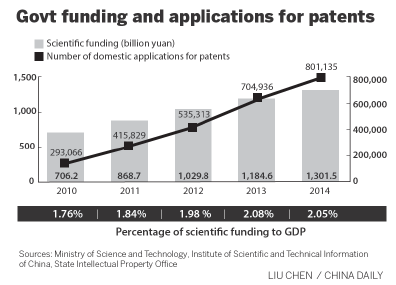
With steadily growing research funding and capacity, mainland research programs are becoming increasingly attractive to scientists from across the globe.
Shi Ling, an associate professor of electronic and computer engineering at Hong Kong University of Science and Technology, said more Hong Kong researchers are turning to the mainland for innovation opportunities.
"While Hong Kong has strength in the financial and service industries, the mainland side has great competitive advantages in manufacturing. The urgent need to upgrade the manufacturing industry on the mainland provides a golden opportunity for Hong Kong," he said in an e-mail to China Daily.
Miguel Esteban, a Spanish scientist who became the first foreign chief scientist for the 973 program in 2010, received 25 million yuan ($3.9 million) in funding for stem cell research.
"In Western countries, if you work on something, you will find it is very difficult to change to something else because you want to develop in a different area or you just want to innovate. You are expected to continue doing what you are doing, and retire just doing that," Esteban, who was a kidney cancer physician at Imperial College London in the United Kingdom, said in a previous interview.
"In China, if you have an idea that is brilliant enough, you can get the right support to change. I think that is a big advantage compared to the Western countries, in particular Europe," he said.
 |
 2016 Miss Chinatown USA pageant held in San Francisco
 Ancient pagodas across China
 Beijing Film Academy starts 2016 entrance exam
 Wedding dress show up in the air
 Have you ever taken these beautiful subways in China?
 Russian photographer brings fairytales to life
 Chinese beauties, foreign models meet in Chengdu
 Awesome! Aerial pictures taken on J-11 fighter
 A foreign girl explains what China should be proud of
 Top 20 hottest women in the world in 2014
 Top 10 hardest languages to learn
 10 Chinese female stars with most beautiful faces
 China’s Top 10 Unique Bridges, Highways and Roads
 US push leaves China no wiggle room
 Don’t let adolescent anger take terrible turn
 The debate about squatting VS sitting rages on
 Family pressure to have second children drives mothers to drop careers
Day|Week


