Press Digest
China Daily
Hot springs, steamy streams enchanting
By Chen Liang
More than 50 years ago, Tengchong, a small county on the bumpy China-Myanmar Road, was the
site of many heroic battles against the
invading Japanese
soldiers. It thus gave rise to the phrase "risking your life to go to
Tengchong."
Today, the saying has lost its historical
context, but the county, hidden away in
the southwestern valleys of the Gaoligong Mountains, is still difficult to reach.
The China-Myanmar Road, linking Yunnan Province's capital Kunming to the Myanmar border
town of Myitkyinbor, remains the only passage connecting the county with the outside
world.
Its remoteness has resulted in Tengchong, once an important land trading port in the
border areas of Southwest China, sliding into oblivion.
 But it's an
enchanting place _ not only because of the 20 volcanoes and lively geothermal activity in
the vicinity, but also because of the dense forests and charming hamlets. But it's an
enchanting place _ not only because of the 20 volcanoes and lively geothermal activity in
the vicinity, but also because of the dense forests and charming hamlets.
To get to Tengchong, you have to go via Mangshi in Dehong Dai-Jingpo Autonomous Region or
Baoshan. And then the China-Myanmar Road
experience starts.
Studded with broken rocks and pebbles, the road is bumpy and full of sharp turns, winding
up and down across the densely forested region.
Along the roadside are towering old trees and virgin evergreen broadleaf forests.
The journey from Mangshi to Tengchong usually
takes about six hours, that from Baoshan about
seven.
Tengchong lies in a flat valley about 1,500 metres above sea level. Against the green
peaks of the Gaoligong Mountains, the rim of the city is often outlined by an orange glow
at sunset.
Nearby attractions are the Tengchong Hot Sea and Zaotang River _ two sites showing off the
county's abundant geothermal resources.
Yunnan has more hydrothermally active regions than anywhere else in the country, while
Tengchong, with 62 such sites, has the most in the province.
Twenty-four hot springs boast temperatures of over 45 degrees centigrade, five reaching
boiling point.
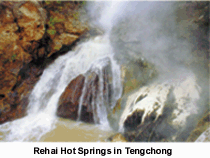
The landscape is spectacular. Travellers entering the Hot Sea valley, through which the
Zaotang River runs, are greeted by the roar of the water tumbling down the Hot Waterfall.
Turning a corner, there is a long, narrow valley shrouded in milky white steam, where the
river glistens in the sunshine.
The heat of the steam is palpable and the smell of sulphur invades your nostrils. The area
is very much like a Turkish bathhouse, but the sunshine penetrating through the thick
stream often creates an elegant rainbow under
the waterfall.
Going further into the valley, visitors can find bubbling water, boiling mud pools and
caves with jets of sulphurous steam.
Even the surface of the ground gives off heat.
At the end of the valley, there is a small village and a hot spring resort.
According to the local people, the mineral hot springs are the source of legendary cures.
Bathing in the springs or lying on the steaming ground can bring remedies to such
conditions as baldness, cerebral haemorrhages, skin diseases and gastric ulcers.
Tengchong is also known as a "museum of volcanoes" and is the only volcanic
geothermal region on the Chinese mainland. A cluster of complete volcanic terraces and
craters sleep silently on the flat valleys near Tengchong.
Villages with tiled roofs and elegant upward-turned eaves huddle along the road to the
volcanoes. Bamboo thickets stand in front of some houses while others have stockaded
gardens with pigs snorting through mud heaps and dogs howling.
The cluster of volcanic craters and terraces are about one hour's drive from the town
centre.
Visitors can climb up a few craters, such as Dakongshan (hill with a big hole). At the top
of the crater, one can get a glimpse of the complete cluster of volcanic craters, and
watch the fat clouds sailing up over the rims of the
distant mountains.
In Heshun Village, 4 kilometres from Tengchong, the houses are neatly arranged and
well-built. Clean cobbled paths, elegant stone bridges and
pavilions connect the village along a babbling brook.
There are well-preserved old temples, and towering old trees are seen everywhere. It is
worth hiking or cycling back to take a closer look at the photogenic village.
The most astonishing building in Heshun is the village library. With buildings in both
traditional and Western style, beautiful gardens and elegant iron railings, it stands up
well to the comparison with some old buildings in big cities.
According to the locals, the library is the largest rural library in China, with a
collection of more than 10,000 volumes of thread-bound Chinese books.
About 10,000 books in its storage were published before 1949, with 30,000 books published
after the founding of the People's Republic of China. More than 150 kinds of newspapers
and magazines are available at the library.
The library was founded in 1928, with financial support from overseas Chinese.
The area is one of the well-known "hometowns of overseas Chinese" in the
country. With a population of more than 5,000, the village is also the hometown of more
than 5,000 overseas Chinese.
To get to Tengchong, fly to Mangshi or Baoshan from Kunming, then follow the China-Myanmar
Road into it by bus. |


 Yunnan
Flowers
Yunnan
Flowers