Feature
Changing clouds are charming
By Ou Shuyi
KUNMING _ Although Yunnan has an abundance of tourist sites, I had difficulty in deciding
where to go for my first trip.
 Xishuangbanna in the south is too hot and primitive. I didn't want to shower
in the river or eat medium cooked meals. Xishuangbanna in the south is too hot and primitive. I didn't want to shower
in the river or eat medium cooked meals.
Lijiang and Zhongdian are too rough. I'd have to trudge for hours from one scenic spot to
another. I worried about having a terrible
headache caused by the thin air.
I decided to visit Dali for the weekend. The city, located in central Yunnan, has become a
legendary backpacker destination which lures many foreign travellers to China.
With more than 1,000 years of history, Dali retains a historical atmosphere which is hard
to come by in other parts of China _ its cobble streets, old walls, old stone houses and a
variety of folk customs.
The city was festive during March Fair (sanyue jie), which began on April 30 and ended on
May 6.
Hotels and guest houses were full. The city's normally quiet atmosphere was forgotten. I
decided, to avoid the crowds, to stay in Xiaguan--"New Dali."
It is 15 kilometres south of old Dali. Unlike other tourists, I did not rush to Erhai
Lake, one of Dali's major attractions. Instead, I planned to spend the first day strolling
around the ancient city.
I walked across town from the south gate to Huguo Road, dubbed "Foreigners'
Street." It is flanked by Western-style cafes.
I relaxed in one shop with a good cup of coffee _ the perfect prescription after
hours on a train.
It was a great place to tune out for a while and forget about airplanes, trains and
bone-jarring buses. The staff recommended I visit Cangshan Mountain.
Actually, the city is at the mountain's base. I could see it clearly from the cafe _ it
looked like a mysterious giant veiled by clouds.
It seemed to be a nice day for hiking. I decided to follow the advice. A 15-minute ride
was interesting. The cobble street was steep and bumpy. I had to hold onto the seat
firmly.
The path winding through country fields and around village houses was free of people.
Cangshan (Verdant) Mountain, also called Diancang Mountain, is to the west of Erhai Lake
at the southern end of the Hengduan Mountains. It is 42 kilometres long and 20 kilometres
wide.
It is famous for its clouds, snow, springs and rocks. The clouds are capricious _
sometimes wispy thin and sometimes thick and black.
The clouds pile up like cotton in the blue sky during the summer. They turn dark and rise
up, creating the image of a woman weeping into Erhai Lake, with her long hair spreading
down her shoulders.
The unique geographic and climatic conditions on Cangshan Mountain create other cloud
images _ like the "jade-belt."
It is formed by clouds floating around the mountain's slopes like a snow-white silk
ribbon. These clouds may extend 40 kilometres.
During the 30-minute chairlift to Zhonghe Temple, located halfway up the mountain, I could
feel the weather conditions changing. The sky turned
cloudy suddenly, then cleared up again.
Branching out from either side of the temple is a trail called "jade-belt path."
It winds along the mountains.
Several restaurants were along the cobbled path, serving a number of special dishes like
fungus and wild vegetables.
"Jade-belt path" took me in and out of steep lush valleys, passing streams and
waterfalls.
Some horsemen encouraged me to ride along the path. I declined _ the steep cliff on one
side of the path had me feeling dizzy.
After walking for an hour, I decided to give up climbing because I was told it would take
three hours to reach the summit.
If you decide to visit Dali, do so after seeing the tropical jungle in Xishuangbanna and
the snow-capped mountains in Lijiang.
This will ensure you have a vacation from travelling.
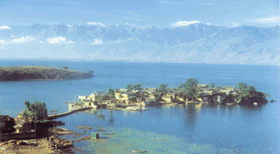
(Photo: A fishing village beside Erhai Lake in Dali. Cangshan Mountain is seen in the
distance.)
Foreign Visitors Marvel At Kunming Horti-Expo Garden
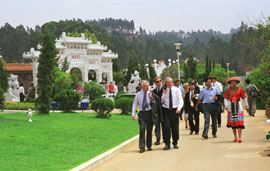
"Bravo!", "Magnificent!", "Really unthinkable!". These are
some of the words uttered by foreign visitors after viewing the gardens of the China '99
International
Horticultural Exposition, which opened Saturday morning in the northeastern suburbs of
Kunming, capital of southwest China's Yunnan Province.
"The world has given China a chance and China has returned with a great and pleasant
surprise," commented a foreign tourist who visited the Exposition, a 218-hectare
Disneyland-sized large
garden, shortly after its official opening.
When Dr. Ahmed Shamakh visited the International Outdoor Exhibition Area three months ago,
he saw practically nothing in the place designated to the Egyptian Garden.
"It is the great assistance by our Chinese friends that has made it possible to build
this beautiful garden within such a short period of time," noted Shamakh, now chief
manager of the Egyptian Garden, which boasts plants and architecture with unique
characteristics of Arab nations.
After viewing the Expo garden, Carlos Mladinic, minister of agriculture of Chile,
described the Kunming garden show as "very impressive" in terms of both scale
and quality.
The minister was echoed by Prof. Klaus Jacobi, former secretary of state of Switzerland
when he said that he had never expected to see such a large and magnificent garden show in
China.
"The theme of this Expo is coordinated development between man and nature, and I have
felt such coordination here in the garden," said French Ambassador to China Pierre
Morel, who led a 20-member French government delegation to the show.
Luzmila Zanabria, Peruvian Ambassador to China said that Kunming is a very beautiful city
with flowers and clean streets and its agreeable weather and rich plant resources have
reminded her of her lovely hometown back in Peru.
The ambassador said that, as a member of the Kunming Expo Steering Committee, Peru is
willing to contribute to the success of the horticultural show.
"The Kunming Expo '99 is a great opportunity for China to increase its exchanges with
the rest of the world, and we're very glad to see our close neighbor Yunnan play host to
the grand event, " said Dr. Bounmy Pabphavong, secretary-general of the Prime
Minister's Office of Laos, which borders on Yunnan.
Emblem and Mascot of Horti-Expo '99
 The emblem of
the China '99 Kunming International Horticulture Exposition features a hand holding a
green flower. The design of a hand symbolizes the movement of star, cloud, air and wind
while the green color represents life. The emblem of
the China '99 Kunming International Horticulture Exposition features a hand holding a
green flower. The design of a hand symbolizes the movement of star, cloud, air and wind
while the green color represents life.
The whole design suggests the harmonious relations of man and nature, which is the
Expo theme "Man and nature -- marching into the 21st Century." At the bottom
part of the emblem is inscribed with the words "Expo '99 Kunming China" in both
Chinese and English.
 The Expo's mascot is the personified Yunnan golden monkey,
a native and rare animal in the province. The Expo's mascot is the personified Yunnan golden monkey,
a native and rare animal in the province.
Dressed in yellow T-shirt with the inscription "Expo '99 Kunming
China" on it, the monkey holds a bouquet of flowers in one hand, seemingly running
around to welcome guests from all over the world. Looking lively and lovely, the mascot is
named "Ling Ling", which, in Chinese, suggests nimbleness and smartness of the
animal and the good wishes for a complete success of the exposition. "
|

 Yunnan
Flowers
Yunnan
Flowers