



Learning to survive: How China's wildlife caretakers prepare young animals for the wild
From learning what to eat and how to interact with others to mastering flight and foraging, young rare animals in China are "taking classes" to acquire the skills they need to survive in the wild.
Giant panda cubs learn to eat, climb, and socialize
Giant pandas aged between 1.5 and 5 years, which are considered subadults roughly comparable to human adolescents, develop the skills they need to live independently in "classes" arranged by their human caretakers in China.
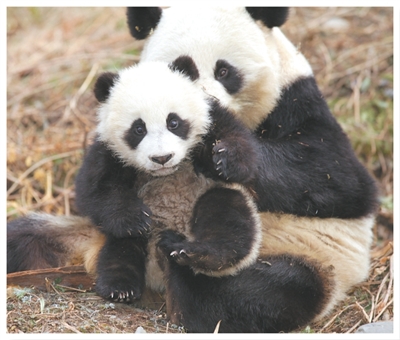
An adult giant panda holds a cub in her arms. (Photo courtesy of China Conservation and Research Center for the Giant Panda)
According to the giant panda-keeping team at the Shenshuping base of the China Conservation and Research Center for the Giant Panda in Wolong National Nature Reserve, southwest China's Sichuan Province, the "classes" help giant panda cubs establish healthy eating habits while learning to interact with others, climb, and evade potential predators.
Giant panda keepers and giant panda mothers are the "teachers."
Liu Huaiting, a giant panda keeper at the base who has years of experience caring for giant panda cubs, said the animals are encouraged to drink milk at relatively fixed times so that they can digest it better and develop an interest in food.
During the transition from milk to bamboo, keepers also provide supplementary foods such as carrots and apples to help maintain a balanced diet, according to Liu.
Social interaction is another important part of their development.
"Like humans, giant pandas have different personalities," Liu said, explaining that some cubs are stronger and more assertive and may compete aggressively for food, while more timid cubs can become stressed.
When competition between cubs becomes too intense, keepers step in to guide their behavior, helping to maintain a healthier environment for the animals.
The keepers also enrich the cubs' living spaces with features that encourage natural behaviors, creating special "classrooms" suitable for learning skills.
Bamboo climbing poles and bamboo climbing frames allow them to practice climbing, while tree hollows and rock shelters provide places to hide and play. Such enrichment encourages exploration and helps the cubs develop active, well-adjusted behavior.
In recent years, the China Conservation and Research Center for the Giant Panda has increasingly sought to let giant panda mothers take the lead in raising their young. As they grow, mothers gradually push them toward greater independence.
This approach helps reduce the animals' dependence on humans and preserve more of their natural instincts.
In the meantime, keepers continue to play a supporting role by ensuring that facilities are safe, monitoring the cubs' growth and development, and providing additional nutrition when needed.
In their spare time, Liu and his colleagues use readily available materials such as bamboo tubes to make toys and enrichment devices for the cubs.
"We always want to give them the best possible environment in which to grow," Liu said.
Tibetan antelope calves take "PE classes" to prepare for the wild
In Hoh Xil, northwest China's Qinghai Province, a makeshift "kindergarten" cares for young Tibetan antelopes that have been separated from their mothers or injured during migration.
The facility, formally the wildlife rescue center of Sonam Dargye Protection Station, is staffed by rangers who take on the role of caregivers, feeding the calves, putting them to sleep, maintaining hygiene, and helping them gradually adapt to life in the wild.
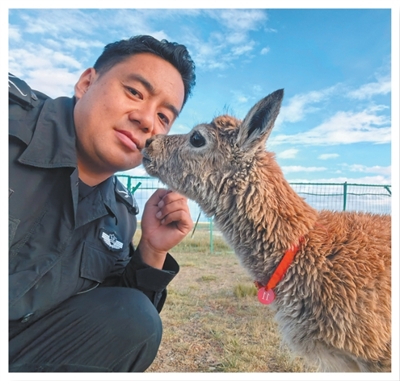
Lodro Wangso, a ranger of the Sonam Dargye Protection Station in Hoh Xil, northwest China's Qinghai Province, poses for a photo with a Tibetan antelope. (Photo courtesy of Lodro Wangso)
From May to July each year, female Tibetan antelopes travel hundreds of kilometers from the Sanjiangyuan area of Qinghai, the Qiangtang Plateau of southwest China's Xizang Autonomous Region and the Altun Mountains in northwest China's Xinjiang Uygur Autonomous Region to give birth around Zhuonai Lake in the heart of Hoh Xil.
"Some newborn calves become separated from their mothers or are injured while avoiding predators or enduring harsh weather. Rangers rescue them and provide temporary care at the Zhuonai Lake protection station before transferring them to the 'kindergarten' after the calving season," said Lodro Wangso, a ranger of the Sonam Dargye Protection Station.
Newly rescued calves may not yet know how to graze and have to be fed milk four times a day, according to Lodro Wangso. "It's just like taking care of human babies. The milk is boiled and then allowed to cool naturally. Bottles are sterilized after each use, and bedding in the pens is cleaned daily," he said.
Afternoons are devoted to "PE classes." Caregivers take the calves outside for walks and light runs, which help them digest their food, build strength, and gradually learn to eat grass.
The rescue center follows a phased process to prepare the animals for life in the wild. The calves initially stay in indoor pens, then move to small outdoor enclosures and eventually to larger ones as they grow.
The entire process generally takes two to three years. Before release, the calves spend three to four months without human contact.
Caregivers monitor their behavior closely: continued attachment to people indicates that an animal is not yet sufficiently prepared, while wariness and the ability to maintain a safe distance are signs that it may be ready for release.
The moment of release is often bittersweet for the caregivers, according to Lodro Wangso.
"We watch them run from the enclosure into the distance. We're happy to see them go, but it's hard to say goodbye," he said.
As the ecosystem of Hoh Xil has continued to recover, the Tibetan antelope population has grown steadily. Since its establishment, the rescue center has helped more than 800 wild animals.
Young crested ibises learn to fly and forage
Young crested ibises at an artificial breeding center of Shaanxi Hanzhong Crested Ibis National Nature Reserve in Hanzhong, northwest China's Shaanxi Province, also go to a "kindergarten," where they learn to fly and forage.
The "kindergarten" is a huge semi-natural aviary covering an area of about 5,000 square meters. With streams, ponds, and tall trees including willows and camphor trees, the enclosure is designed to recreate conditions similar to those the birds will encounter in the wild.
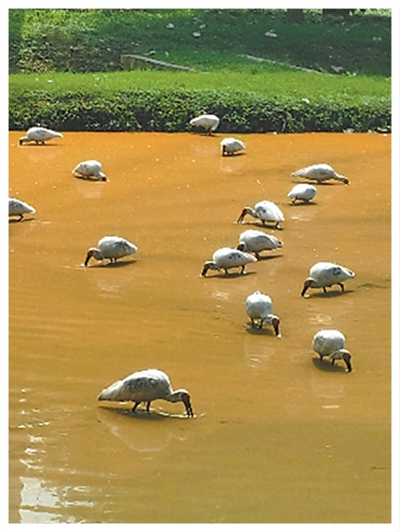
Photo shows young crested ibises foraging. (Photo/Chen Jun)
"Crested ibises raised in captivity have difficulty adapting directly to life in the wild," said Duan Wenbin, an engineer with the reserve administration. "They need to learn essential skills in a semi-wild environment first, just like kids need to go to a kindergarten."
Newly hatched crested ibises first spend about 45 days in small enclosures, which are equipped with perches at two heights, about 1.5 meters and nearly 3 meters above the ground.
"When a young bird can fly up to the higher perch, it has developed basic flying skills and is ready to move to the semi-natural aviary," said Chen Jun, a keeper at the center.
By mid-to-late May each year, batches of young crested ibises with basic flying skills move on to the semi-natural aviary, where they begin the next stage of their training: learning to fly and forage.
The young birds tend to fly in circles rather than in straight lines, and those just starting out may struggle to control their direction, according to Duan, who said some bump into the netting, while others occasionally fly into the arms of keepers.
Foraging skills are also developed gradually. At around 25 days old, the birds begin being fed whole live loaches. Once they enter the semi-wild aviary, hundreds of kilograms of loaches are released into the ponds each week, allowing the birds to forage for themselves.
An adult crested ibis normally eats about 200 grams of loaches a day, while its food intake can exceed 500 grams during the breeding season when it is feeding chicks, said Chen.
According to Duan, young birds generally spend about six months in the aviary. Once they can fly and find food independently, they may be released into the wild.
Each spring, keepers assess the birds' ability to survive in the wild, and only those deemed ready are released.
By the end of 2025, the global crested ibis population had grown to more than 12,000 from just seven birds discovered in 1981.
Photos

Related Stories
- Male Lady Amherst's pheasant tries to woo a female, gets ignored
- Moose spotted at Nanweng River National Nature Reserve in NE China's Heilongjiang
- A glimpse of sika deer in Heilongjiang's nature reserve
- Wild Asian elephant population in China rises to nearly 400
- In pics: red-crowned cranes at Red-crowned Crane Wetland Ecological Tourism Zone in E China
- Wild Siberian tiger, leopard populations see significant growth in China
- Population of milu deer exceeds 8,800 in Dafeng Milu National Nature Reserve
- In China's wild elephant sanctuary, coexistence becomes a way of life
- China's wild Asian elephant population nears 400: report
- Endangered leaf monkeys spotted for first time in Yunnan reserve
Copyright © 2026 People's Daily Online. All Rights Reserved.
