



Hermann Simon: China fuels global growth for "hidden champions"

Hermann Simon (right) is interviewed exclusively by People's Daily journalist Liu Zhonghua. (Photo/Yi Lin)
German management scholar Hermann Simon coined the term "hidden champions" to describe small and medium-sized enterprises (SMEs) that operate below the public radar yet dominate their niche markets -- typically ranking among the top three globally in their sector. These firms are distinguished by deep specialization, relentless innovation, and a fundamentally global mindset.
Having visited China over 70 times and closely tracked its industrial evolution, Simon remains deeply optimistic about the vitality of its SME sector. In an exclusive interview with People's Daily in Hasborn, Germany, he noted that China has systematically cultivated a new generation of "hidden champions" through a phased support framework tailored to different stages of enterprise development.
He spoke highly of China's achievements in technological innovation, industrial upgrading, and through a phased support framework tailored to different stages of enterprise development. He emphasized that Chinese companies have already emerged as global innovators across several cutting-edge industries.
"The outdated notion that China merely replicates foreign technology no longer holds," he said. "Chinese enterprises are now leading the way in innovation within multiple advanced fields."
According to Simon, China's approach centers on long-term strategic commitment. "The country guides its specialized firms to focus on foundational technologies and pursue continuous, incremental innovation. This disciplined approach is essential for overcoming core technological bottlenecks and securing dominant positions in global niche markets."
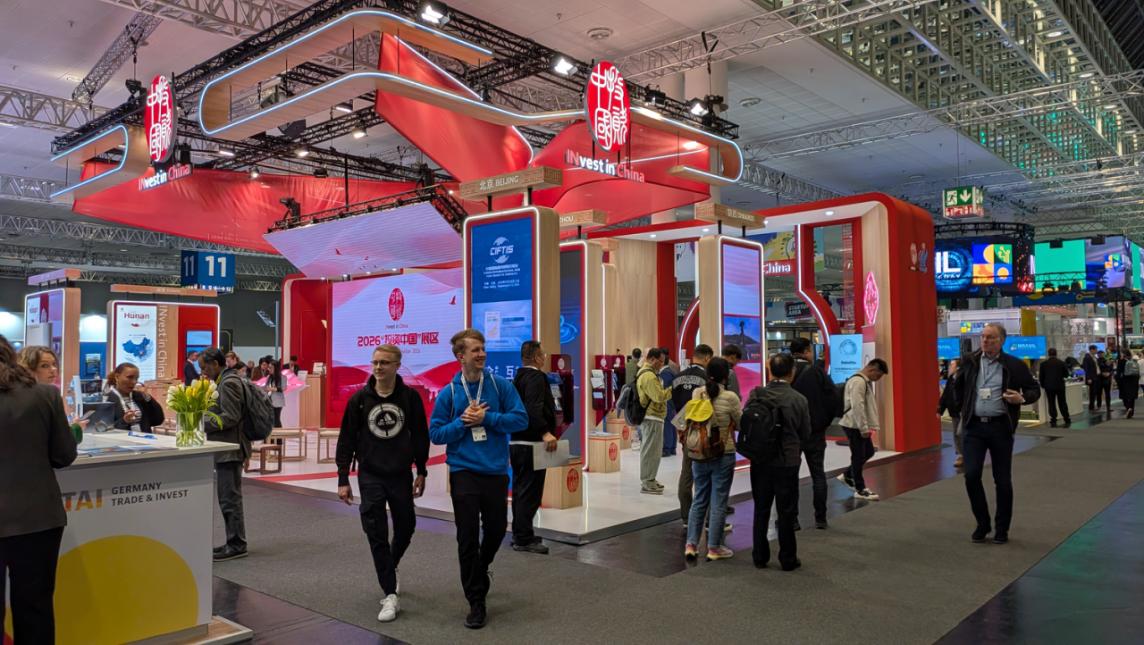
Photo shows an "Invest in China" exhibition booth at the world's leading industrial trade fair Hannover Messe 2026. (People's Daily/Liu Zhonghua)
He highlighted China's five-year plans as a key driver of industrial clarity and strategic foresight. "Well-calibrated assessments of emerging sectors provide businesses with clear developmental pathways, showcasing strong institutional coordination," Simon explained.
Strategic top-down planning, he added, helps consolidate resources, foster fair competition, and nurture globally competitive leaders. Strategic top-down planning, he added, helps consolidate resources, foster fair competition, and nurture globally competitive leaders. For other developing nations seeking to industrialize, he suggested studying China's long-term strategy: leveraging domestic strengths to target distinctive niche industries and cultivate high-value-added champion enterprises offers a practical, scalable model.
Beyond macroeconomic growth, Simon underscored the role of these specialized firms in advancing balanced regional development and shared prosperity.
While large corporations typically concentrate in megacities, many "hidden champions" are rooted in counties, smaller cities, and townships.
He pointed to Shandong Moris Tech, based in Shouguang, east China's Shandong province, which expanded its specialty chemical operations across regions while remaining rooted locally. "Nurturing these highly specialized enterprises distributes high-skilled jobs and value creation across broader urban and rural areas," Simon observed.
"This provides a viable pathway toward more equitable regional development and inclusive prosperity." Simon also pointed to China's unparalleled industrial ecosystem as a major competitive advantage. With over 2,000 German firms operating manufacturing facilities in the country, he noted that dense supply chains and clustered industrial parks remain powerful draws.

A foreign merchant learns about automotive thick-walled light guide components at the fourth China International Supply Chain Expo, June 23. (Photo/Tang Ke)
"Comprehensive infrastructure, a vast talent pool of engineers, and a massive domestic market make China an ideal testing ground for advanced manufacturing technologies and their large-scale deployment," he said. "Ignoring the Chinese market would mean forfeiting access to one of the world's largest industrial hubs, which accounts for nearly one-fifth of global industrial output."
He added that China's resilient domestic demand offers multinational companies valuable medium- to long-term certainty.
Consequently, many German "hidden champions" have established R&D centers and integrated value chains in China, leveraging the country's open, dynamic ecosystem to extend their corporate lifecycles.
China's well-developed and open market is not only a growth engine for "hidden champions" worldwide, but also an important source of their core competitiveness, Simon said.
As competition intensifies across niche industries worldwide, greater coordination and collaboration among specialized companies in Europe and China could become an important force in reshaping the global industrial landscape, Simon said.
Two-way investment between Europe and China can help improve structural imbalances in trade and economic ties. As Chinese companies accelerate their localization efforts in Europe by establishing R&D and production bases and creating local tax revenue and jobs, economic and trade cooperation between China and Europe can evolve from one-way trade in goods toward joint industrial development, helping mitigate the risks posed by trade barriers.

Hermann Simon poses for a picture in a historical block in Taicang, east China's Jiangsu province in September, 2025. (Photo courtesy of Hermann Simon)
Regular in-person exchanges can also strengthen business trust, stabilize expectations for industrial investment and help reduce misperceptions arising from geopolitical competition, Simon said.
Reflecting on the past two decades, Simon acknowledged that China's manufacturing sector has undergone profound transformation. Many specialized enterprises have significantly upgraded their technological capabilities and product quality, successfully surmounting key innovation challenges.
Looking forward, he cautioned that Chinese companies still face hurdles in three areas: deepening their international footprint, building globally recognized brands, and executing localized overseas investments.
"I hope more Chinese manufacturers will expand into European and U.S. markets, achieving tangible progress in brand globalization; promote balanced and mutually beneficial industrial investment between China and Europe; and help preserve a stable, predictable global trade environment while safeguarding supply chain continuity," Simon said.
"By deepening cooperation between Chinese and foreign real-economy sectors on the basis of openness, connectivity, mutual benefit and win-win outcomes, we can help safeguard the long-term stability and development of global industrial and supply chains," he concluded.
Photos




Copyright © 2026 People's Daily Online. All Rights Reserved.
