



Young professionals find their calling in China's countryside

Liu Song checks on the growth of rice in an agricultural-tourism complex in Yong'an village, Yuhang district of Hangzhou, east China's Zhejiang Province. (Photo/Mei Ershuai)
A growing number of young, skilled and educated professionals are heading to the countryside in east China's Zhejiang Province and putting down roots there, bringing their expertise to rural communities.
In an agricultural-tourism complex in Yong'an village, Yuhang district of Hangzhou, Liu Song wrapped up a livestream promoting wine brewed from locally grown rice before rushing off to welcome a visiting delegation from neighboring Anhui Province.
Yong'an is a traditional grain-producing village. Ninety-seven percent of its land is designated as permanent basic farmland, and all 5,429 mu (361 hectares) can only be used for grain cultivation, according to Liu.
In 2020, Liu was appointed manager of the village's collective economy. He spent months getting a thorough understanding of local conditions before presenting a 16-page presentation outlining the village's development plan for the next three to five years.
To attract visitors, the village began organizing a series of agriculture-, culture- and tourism-themed activities such as harvest festivals. As word spread, Yong'an steadily gained popularity.
Under Liu's team, the village collective's operating income climbed from 730,000 yuan ($107,000) in 2019 to 6.35 million yuan in 2025, while villagers' average annual income increased from 42,000 yuan to 66,000 yuan.
The village's success soon drew attention from across the country. Liu then expanded into new ventures, organizing study tours and training programs, and even sending his team to other villages to provide on-site operational services and manage local projects directly.
Jiang Jufang, Party branch secretary and head of the villagers' committee in Feidui village, Qingshi town of Changshan county in Quzhou, begins each day at full speed.
This year marks the seventh year since he returned home to develop the Huyou business. Huyou is a citrus hybrid combining sour orange and pomelo that is unique to Changshan county. Thanks to the industry's growth, villagers' incomes have increased fivefold, while the village collective's income has risen more than tenfold.
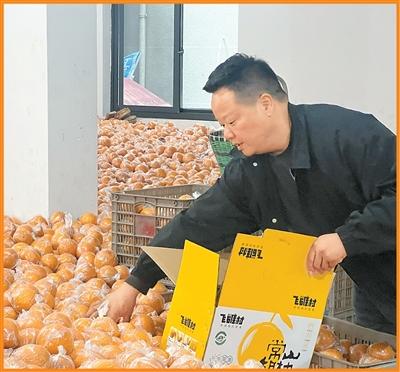
Jiang Jufang packages huyou fruits in Feidui village, Qingshi town of Changshan county, Quzhou, east China's Zhejiang Province. (Photo/Ge Jinxi)
Huyou is Changshan's signature agricultural product, known for its crisp flesh and juicy flavor that appeals to consumers of all ages.
In June 2021, under Jiang's initiative, the village collective transferred the management rights of over 7,000 huyou trees for an annual fee of 430,000 yuan, forming a 317-mu orchard.
Managed collectively by the village, the orchard helped connect farming households with businesses and markets, greatly improving production and management efficiency.
After several years of effort, Jiang said, the quality of the village's huyou has improved significantly. The purchase price for the fruit grown by individual farmers has risen from 0.2 yuan per kilogram to 2.4 yuan per kilogram, while total income for local growers has increased from 1 million yuan to 5 million yuan.
In Qingtan village of Ninghai county, Ningbo, a once-quiet mountain village is undergoing a remarkable transformation.
At the heart of the village, the Jinshi Cultural Park, covering more than 6,000 square meters, now buzzes with activity as study tour groups stream through its grounds. In ancient China, the jinshi was the highest title awarded in the imperial examination system.
In just over a year, the village has become one of Ningbo's rising rural tourism destinations. Behind the transformation is Zhang Zhiming, who manages the cultural park.
Zhang, formerly a finance professional, first visited Qingtan village in 2023. She was immediately drawn to the lush Jiufeng Mountain, a crystal-clear creek, a stone pagoda, and the village's simple, welcoming atmosphere. She soon decided to settle in Qingtan and pursue a career in rural operations.
Zhang developed a comprehensive plan to integrate the village's cultural heritage with modern management approaches, using a model that activates idle resources and leverages cultural strengths to drive all-round rural revitalization.
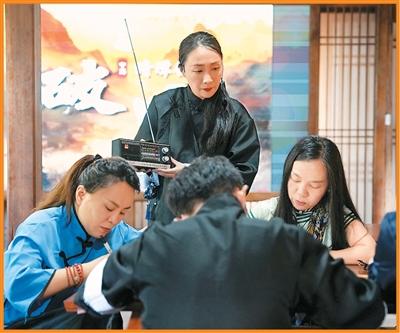
Zhang Zhiming (second from the left in the back row) hosts an immersive role-playing experience in Qingtan village, Ninghai county, Ningbo, east China's Zhejiang Province. (Photo/Ying Jingyun)
Since signing an operation agreement with Qingtan village in 2023, Zhang has delivered strong results. The village has hosted 350 study tour activities, welcomed 35,000 tourists and recorded tourism revenue of over 2 million yuan. More importantly, the projects have created stable jobs for 14 villagers and generated 200,000 yuan in additional income for residents.
In Lianfeng village, Fengqiao town of Nanhu district, Jiaxing, lush greenery now stretches across the springtime countryside. Inside a music art space, Jin Wenkai leads villagers in energetic African drum performances.
A Jiaxing native and graduate of the Shanghai Conservatory of Music, Jin has worn many hats over the years. In early 2022, a chance visit brought him to Lianfeng village. Captivated by its beautiful scenery, he decided to open a music-themed teahouse there.
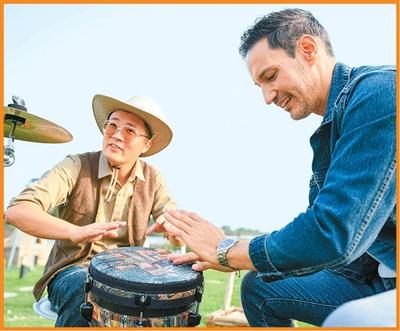
Jin Wenkai (left) discusses African drumming techniques with a foreign blogger in Lianfeng village, Fengqiao town of Nanhu district, Jiaxing, east China's Zhejiang Province. (Photo/Yu Zhongyue)
Jin later launched a music art village project, blending music with farmhouse dining, boutique B&Bs and leisure tourism. Through weekly free training sessions, he teaches villagers instruments such as African drums, using music to draw visitors and boost the local economy.
Music has not only made villagers' lives more vibrant, but also helped them earn more. During the 2025 Spring Festival holiday, a music party attracted more than 11,000 tourist visits and generated over 1 million yuan in tourism revenue.
Photos




Related Stories
- C China's Qianjiang writes story of rural revitalization through crayfish
- Mushroom industry empowers rural revitalization in China's Shandong
- Village in SW China's Sichuan turns distinctive resources into prosperity
- Gong Cai drives rural revitalization in county of SW China's Yunnan
- China steps up financial support for rural revitalization
- Young entrepreneurs boost rural revitalization in Jiaxing, China's Zhejiang
- First Party secretary drives rural revitalization in Hainan village
- Once-isolated village in SE China's Fujian emerges as a model of rural revitalization
- Young Party secretary leads rural revitalization in Zhejiang village
- NPC deputy leads a cliffside village toward rural revitalization
Copyright © 2026 People's Daily Online. All Rights Reserved.
