



Slow trains provide mobile libraries for students in SW China's Sichuan
A slow, green-painted train pulled into Xide railway station in Xide county, Liangshan Yi Autonomous Prefecture, southwest China's Sichuan Province, along the Chengdu-Kunming Railway.
Known locally as the "slow train," Train No. 5633 shuttles between Puxiong town in the prefecture and Panzhihua city on a nearly 10-hour journey, stopping at all 25 railway stations along the route. With the lowest ticket priced at 2 yuan ($0.29), it has been a lifeline for residents for more than half a century.
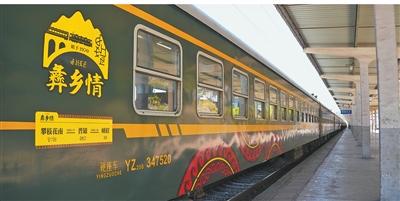
Train No. 5633, the "slow train" known for its mobile library, arrives at Xichang south railway station in Xichang city, Liangshan Yi Autonomous Prefecture, southwest China's Sichuan Province. (Photo/Tian Weipeng)
"Nearby people rely on the slow train to travel, attend school, and sell their farm produce," said Shi Youyuan, head of Xide railway station.
Over the years, the train has had bookshelves and reading seats added to Carriage No. 3, effectively turning it into a "mobile library."
Shortly after 9 a.m., the waiting hall at Xide railway station was already packed. Some passengers carried suitcases, and others shouldered bamboo baskets or hauled large bags. But the most eye-catching were the children in school uniforms with backpacks on their shoulders. Most were headed for Xichang city, just five stops and a little over an hour away — a crucial leg of their daily commute to school.
Among them was 14-year-old Jike Chenxue from Waku village in Lianghekou town of Xide county. She walked straight into Carriage No. 3. After selecting a book, she sat quietly at a reading seat.
"This carriage is different from the others — it is specially designed as a study carriage, which has around 800 books," said conductor Jibu Riha. "We rotate the collection regularly based on the categories in our library storehouse."
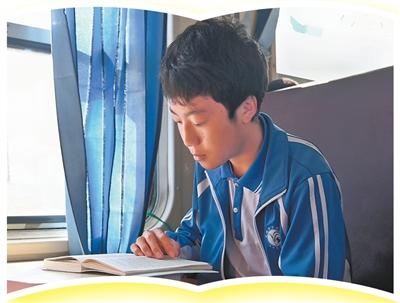
A student reads a book in Carriage No. 3 of Train No. 5633, the "slow train" known for its mobile library. (Photo/Zhou Zeping)
In recent years, the Sichuan Provincial Library and the Chengdu passenger transport department under China Railway Chengdu Group Co., Ltd. have jointly introduced mobile libraries on two pairs of public-benefit slow trains — Train No. 5619/5620 and Train No. 5633/5634. The libraries occupy Carriage No. 3 on each train, serving students and local residents along the route.
"To date, we have supplied a total of 8,800 books to the slow trains — 8,000 of them teaching materials for primary and secondary school students based on local demand, and 800 covering literature, history, travel and science," said Liu Liu, head of the circulation and reading service department at the Sichuan Provincial Library. "We also rotate the books regularly to keep the collection fresh."
"Rather than building a stationary library in a remote area that would be difficult to maintain, it is better to let books travel with the people. It's practical, accessible, and sustainable. That's how the idea of the mobile library was born," said Wang Long, director of the library.
Leveraging the advantages of railway transport has become a vital way to bring high-quality cultural resources directly to grassroots communities and address long-standing gaps in public cultural services.
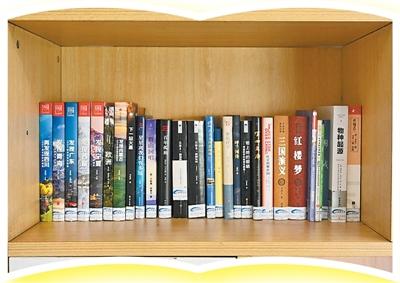
Books line a shelf on Train No. 5633, the "slow train" known for its mobile library. (Photo/Zhou Zeping)
Reading activities are regularly held on Train No. 5633, according to Jibu Riha.
During one such session, he recommended Nikolai Ostrovsky's "How the Steel Was Tempered," a Soviet classic widely read in Chinese schools. "Pavel Korchagin's courage and determination in the face of hardships can inspire every one of us," he told the children. He then handed each of them a sticky note and invited them to write down their wishes.
"My dream is to become a music teacher or a professional singer," one student wrote.
"I don't have a clear dream yet. But I know I must venture out of the mountains. I want to contribute to the development of our country and help make my hometown better," wrote Jike Chenxue.

Jibu Riha, conductor of Train No. 5633, the "slow train" known for its mobile library, poses with students for a group photo. (Photo/Han Xugang)
"Reading broadens horizons and sparks dreams. We may not be able to change their living environment immediately, but we can at least make sure they have one more book to accompany them on their journey to school. That's what we mean by narrowing the gap through reading," Wang said, explaining the significance of providing mobile libraries on trains.
Jibu Riha calls himself a "ferryman." He has spent more than 10 years riding the slow train — first as a passenger, then as a crew member, and now as a conductor. "This green-painted train has long since become part of my life," he said.
Photos



Related Stories
- Technology enhances immersive reading experience in Beijing
- North hall of Shenzhen Library: A library and a smart booking sorting "factory"
- Check out Shenzhen's stunning library of the future!
- China had 3,246 public libraries by end of 2023: ministry
- World's second largest floating library visits Cambodia
- China-Russia Library Forum focuses on AI application in libraries
- Century-old countryside library still shining, evolving
- China's national library starts collecting representative documentaries
- Changsha Library creates accessible reading environment for visually impaired group
- 24h self-service library opens to public in Haikou, China's Hainan
Copyright © 2026 People's Daily Online. All Rights Reserved.
