



S China's Hainan brews up booming coffee industry
In recent years, south China's Hainan Province has been ramping up efforts to promote its coffee industry.
The province has developed superior crop varieties to increase yields and improve quality, integrated agriculture, culture and tourism to create a distinctive identity, and leveraged its geographic and policy advantages to open new avenues in international trade.
The island now has more than 4,000 coffee shops — roughly four for every 10,000 residents. Xinglong town in Wanning city, home to just over 30,000 permanent residents, has more than 200 coffee shops, with each person consuming an average of more than 200 cups of coffee a year.
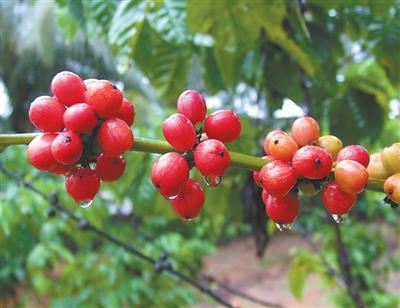
File photo shows coffee cherries in south China's Hainan Province.
Hainan was among the first places in China to develop a coffee industry. It was home to the country's first coffee factory, first dedicated coffee research institute and first instant coffee production line. By 1988, coffee plantations covered 238,000 mu (15,900 hectares) of land in Hainan, making it one of China's leading coffee production and consumption regions.
But the boom did not last. In the 1990s, farmers began switching to more profitable, faster-yielding crops — tropical fruits and winter vegetables — while turbulence in global coffee prices added further pressure. Planting areas shrank steadily, and by the end of 2009, barely 3,000 mu of coffee remained across the entire province.
Since the establishment of the Hainan Free Trade Port, the province has been developing a modern industrial system, including high-efficiency tropical agriculture with distinctive local characteristics. The provincial agriculture and rural affairs department rolled out a package of support measures — free seedlings, planting subsidies and technical assistance — and as domestic coffee consumption climbed rapidly, farmers' enthusiasm for the crop returned.
Today, the province's coffee-growing area has steadily recovered to around 26,000 mu.
Research has kept pace with the revival. Yan Lin, director of the Coffee Research Center at the Spice and Beverage Research Institute under the Chinese Academy of Tropical Agricultural Sciences, said that the institute's years of sustained research have produced 10 superior varieties suited to Hainan's climate and growing conditions. One of them, "Reyan No. 5," stands out for both its consistently high yields and exceptional flavor and has now been introduced across the province.
Hainan's coffee sector also boasts a growing roster of established brands, with Xinglong Coffee and Fushan Coffee both recognized as national geographical indication products.
Longyuan Coffee Estate in Xinglong town has become a 200-mu agritourism complex combining coffee cultivation, processing, leisure and sightseeing. The estate has developed dozens of coffee-related products, attracting large numbers of tourists.
In 2023, the estate was designated a provincial-level "shared farm," receiving greater support in planning, funding and services. Together with nine other coffee-themed shared farms across Hainan, it has become a pioneer in the province's push to build premium coffee estates.
Encouraged by the results of integrating agriculture, culture and tourism, Zeng Weimao, the estate's manager, is already thinking ahead.
"Wanning city has become famous for surfing — it attracts huge numbers of young visitors," he said. "We're planning to upgrade our facilities and diversify our offerings so tourists can fully immerse themselves in Xinglong's coffee culture."
Hainan's thriving tourism sector provides a natural foundation for the local coffee industry. In 2025, the province received 106 million domestic and international tourist visits, up 9.1 percent year on year.
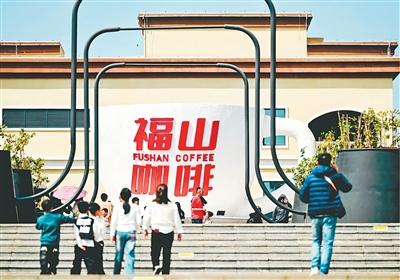
File photo shows a view of Fushan Coffee Culture Town in Chengmai county, south China's Hainan Province.
Fushan Coffee Culture Town in Chengmai county is another example of this integration model. The town was once just a cluster of local coffee shops. It has since transformed after embracing market-based management.
A professional team built the Fushan Art Museum and a coffee culture museum, giving young visitors a place to enjoy a cup while exploring exhibitions on weekends. A vocational training school for baristas was established, and local cultural activities and intangible cultural heritage performances were introduced to enrich the visitor experience.
Within two years of operation, it became the country's first coffee-themed 4A-level tourist attraction, drawing 225,000 visitors during the Spring Festival holiday in 2026.
Policies have provided further momentum. In February 2025, an updated zero-tariff policy on raw and auxiliary materials under the Hainan Free Trade Port took effect, adding 297 items — including unroasted coffee beans — to the zero-tariff list. The move significantly boosted businesses operating on the island.
With operating costs falling, a growing number of international players have come to Hainan seeking opportunities. Before 2022, Hainan imported only modest quantities of coffee from countries such as Brazil and Vietnam.
The situation has changed dramatically. According to Haikou Customs, in 2025 Hainan enterprises imported more than 9,000 tonnes of coffee beans and related products, a 5.6-fold increase year on year, with their value reaching 480 million yuan ($65.75 million), up 8.3 times. Imports came primarily from 15 Belt and Road partner countries.
"Developing value-added coffee products in Hainan requires a reliable supply of beans from abroad," said Ye Jian, general manager of Charoen Pokphand (Hainan) Xinglong Coffee Industry Development Co., Ltd.
"Hainan's proximity to Southeast Asia, combined with its access to China's vast domestic market, gives it an ideal position to leverage its geographic advantages," Ye said.
He added that the province's special customs operations would deliver multiple benefits for the coffee industry in terms of costs, supply chains and talent, helping Hainan shift from a raw material importer to a global hub for coffee processing.
Photos


Related Stories
- Lincang in SW China's Yunnan cultivates thriving coffee industry
- 4th Jiangmen Coffee Culture Festival kicks off in China's Guangdong
- China's Puyang develops full-industry-chain coffee production system
- New platform facilitating Ethiopian coffee entry into Chinese market launches in central China
- Hillside cafe wins viral fame as farmer becomes coffee "flame brewer"
- China's zero-tariff policy opens new doors for Ugandan coffee exports: entrepreneur
- Coffee plants enter harvest season in Baoshan, China's Yunnan
- China becomes fourth-largest importer of Ethiopian coffee
- China's coffee boom spawns new professions
- PD Vlog | A journey into Yunnan coffee
Copyright © 2026 People's Daily Online. All Rights Reserved.
