



Young Chinese workers are turning to AI for emotional support, raising concerns about social isolation
A growing number of young professionals in China are turning to AI for emotional support, but psychologists warn that relying on it for deep, long-term conversation could weaken their ability to form real relationships.
Zhang Xinyu, a teacher at a middle school in Urumqi, capital of northwest China's Xinjiang Uygur Autonomous Region, has grown used to sharing her workplace worries with AI.
Last year, she considered changing jobs, torn between the stability of her public-sector post and the uncertainty of her career prospects. Talking to colleagues was awkward, and friends might not fully understand, so she told AI everything.
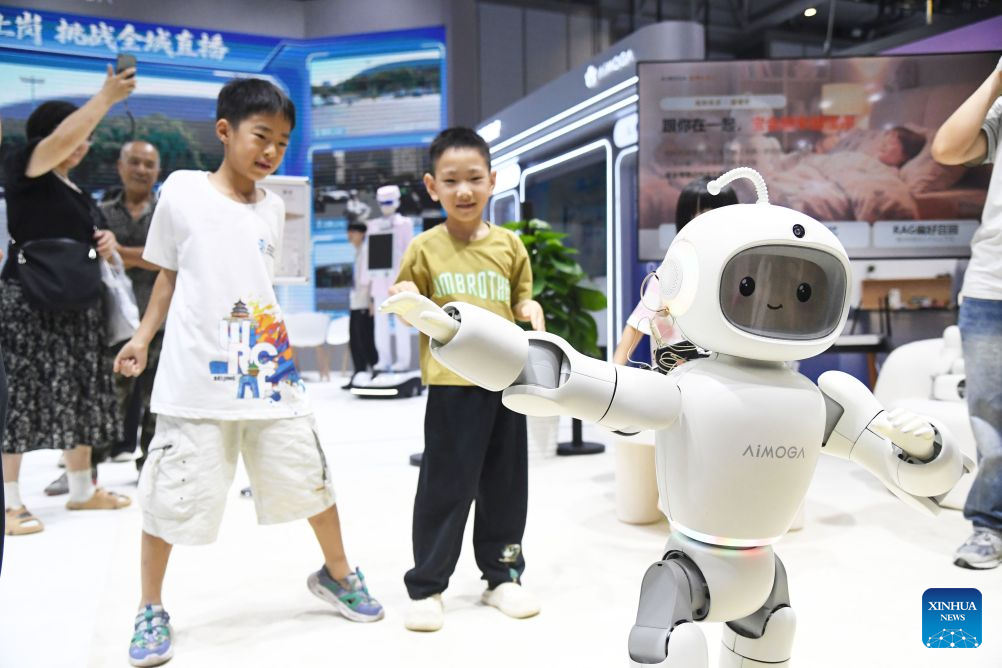
A cartoonized robot interacts with children during the 2026 World Robot Conference in Beijing, capital of China, Aug. 19, 2026. (Xinhua/Ren Chao)
AI advised her to keep her job while exploring a side business or other interests. "I don't necessarily follow its advice, but afterward I feel clearer and much less anxious," she said.
Available anytime, endlessly patient and rarely pushing back, AI offers instant responses and judgment-free attention that many young people find comforting.
Tan Yingying, who works at an internet company, also chats with AI regularly. After she shared a chat record from a disagreement with a colleague, AI told her: "You've done very well. Keep being yourself." "It feels like it really understands me," she said.
In Tan's view, AI is available around the clock and can offer analysis and advice — the most convenient sounding board she has.
Shen Jiahong, a registered supervisor with the Chinese Psychological Society, said working people perform "emotional labor" every day, having to appear professional, emotionally stable and sociable. After work, they often lack the energy for relationships that require explanation, waiting and risk-taking. AI offers what real relationships rarely can: it is always available, non-judgmental, confidential and focused on the user.
AI has lowered the "cost" of interpersonal communication in terms of money, time and emotion, said Xie Tian, a council member of the Chinese Association of Social Psychology and associate professor at the School of Journalism and Communication at Wuhan University.
But the convenience may come at a price. Zhang Xinyu said she has grown less patient since she began chatting with AI so often. When people don't follow her point quickly, she sometimes thinks she might as well ask AI instead.
Chen Li, who works in Changsha, central China's Hunan Province, likened AI's emotional support to pethidine, a powerful opioid painkiller. "It relieves pain quickly, but doesn't cure the root cause," she said.
Shen called the pattern "compensatory dependence." AI can offer short-term comfort, he said, but the risk comes when it shifts from a supplement to a substitute.
Xu Ke, a clinical psychologist, warned of a "negative reinforcement loop" — as people get less practice at real-life interaction, their tolerance for disagreement shrinks and their reliance on AI grows.
Xu suggested treating AI as a "thinking add-on," "electronic diary" or information-organizing tool, not "the only confidant who understands me." After sorting out their thoughts with AI, people should return to real life to resolve conflicts and meet friends, and maintain diverse outlets such as exercise, hobbies and professional counseling, Xu added.
Xie said individual willpower alone is not enough to overcome the social disconnection that comes with AI dependence. Companies and organizations, he urged, should cut unnecessary overtime and give employees genuine free time — hours that belong to them, and to the people around them.
Photos

Related Stories
- Out of the robot classroom: China's embodied AI takes on real-world jobs
- AI breathes new life into China's time-honored TCM tradition
- AI products move closer to real-life needs at Hangzhou expo as demand reshapes wearables, robots and specialized applications
- 2026 Apsara Conference opens in Hangzhou, China's Zhejiang
- Chinese premier stresses faster development of emerging, future industries
- China rolls out AI "classrooms" to fuel humanoid robot boom
- The world's first large-scale embodied AI theme park opens in Zhuhai, South China
- Chinese AI-driven telescope earns place in Stanford AI Index Report
- Singaporean healthcare professional experiences futuristic smart living in China
- China's AI supercluster completes 10-day global forecast in under an hour
Copyright © 2026 People's Daily Online. All Rights Reserved.
