



China continues to strengthen and expand advanced manufacturing
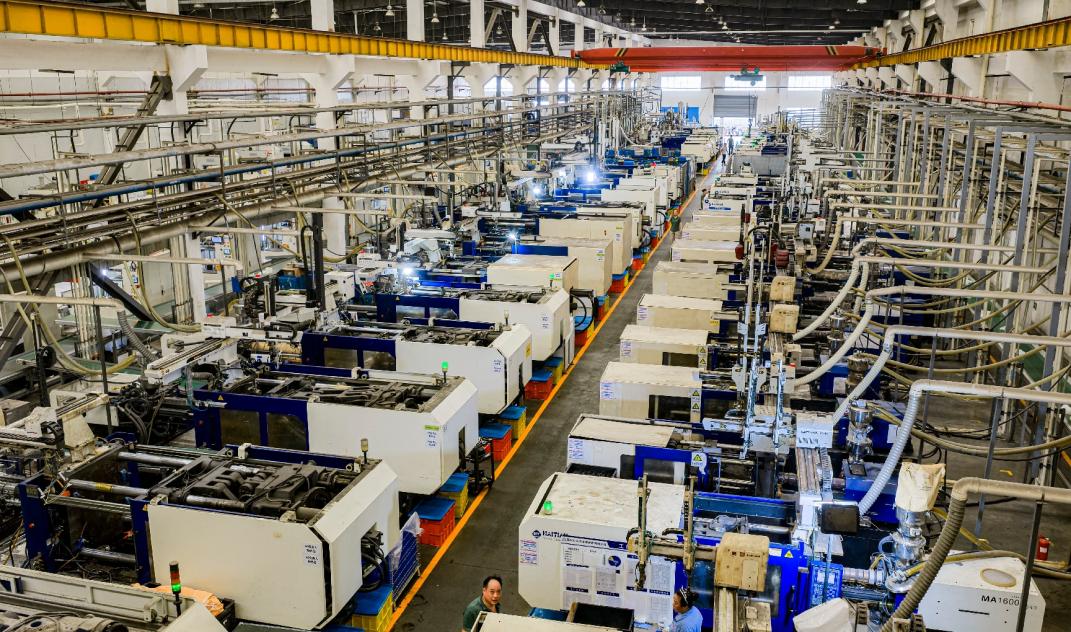
Intelligent production lines operate efficiently at an auto parts company in Taicang, east China's Jiangsu province. (Photo/Ji Haixin)
Globally, one in three cars sold today is manufactured in China. Since 2013, sales of new energy vehicles in China have surged more than 930-fold, while their share of the auto market has grown more than 590-fold, giving rise to a rapidly expanding emerging industry worth trillions of yuan.
The automotive sector exemplifies the broader growth and upgrading of China's advanced manufacturing sector.
China's manufacturing value added has ranked first in the world for 16 consecutive years, accounting for nearly 30 percent of the global total.
Over the past decade, value-added output in high-tech and equipment manufacturing has grown at average annual rates of approximately 10 percent and 8 percent, respectively.
China now holds a leading global position in sectors such as photovoltaics, telecommunications, high-speed rail, and shipbuilding, while robotics, AI, and innovative pharmaceuticals are accelerating rapidly.
As the Chinese economy pivots toward innovation-driven, high-quality growth, advanced manufacturing has become a central pillar of this transition.
Against a backdrop of unprecedented global shifts and a new wave of industrial transformation, China is navigating a pivotal phase of economic restructuring. To ensure long-term stability and sustainability, the country is doubling down on the expansion and refinement of its advanced manufacturing capabilities.
Even a single sheet of ultra-thin steel foil illustrates the sophistication of China's manufacturing evolution.
In Shanxi province, a subsidiary of Taiyuan Iron & Steel (Group) Co., Ltd. produces precision stainless steel strips through fully automated processes -- rolling, cleaning, polishing, leveling, slitting, and packaging. These materials, colloquially known as "hand-rip steel," have seen their minimum thickness reduced from 0.02 mm to 0.015 mm. Having moved seamlessly from research and development to full-scale commercial production, these high-end alloys now trade at prices rivaling precious metals.
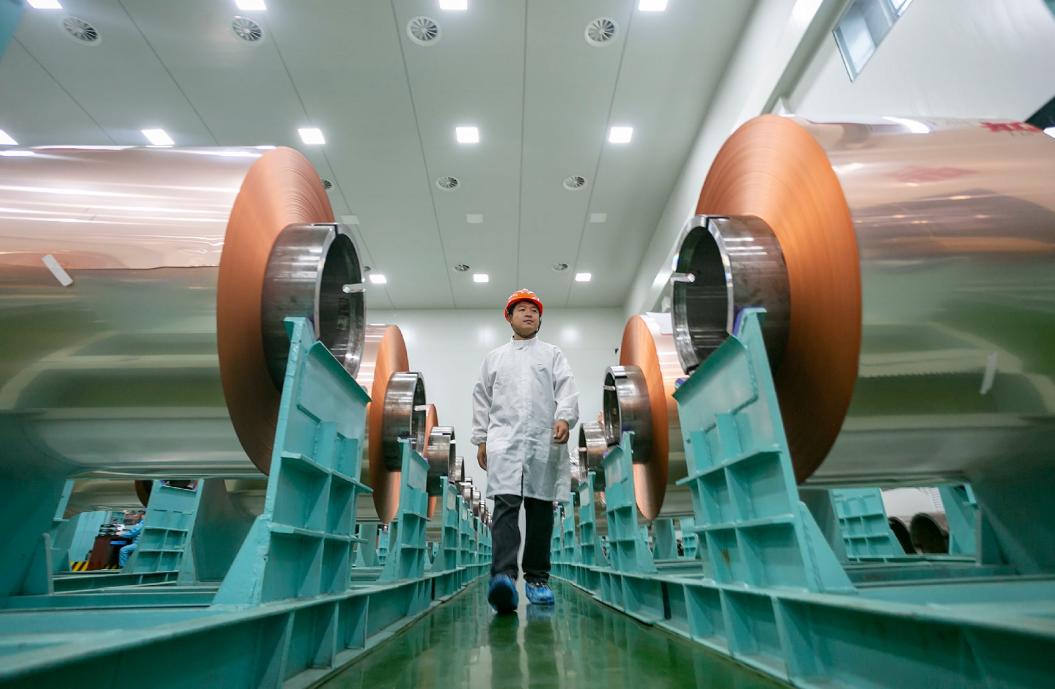
Workers inspect products in a copper foil production workshop of a new material technology company in Yuncheng, north China's Shanxi province. (Photo/Jiang Hua)
To sustain this progress, China is targeting the core drivers of "advanced" manufacturing, strategically moving beyond mid-stream assembly to capture greater value at both ends of the global supply chain -- from innovation and design to branding and services.
Intelligence is reshaping China's industrial landscape.
Leveraging cutting-edge digital technologies, the country has established over 56,000 basic-level smart factories, over 9,000 advanced-level smart factories and more than 500 excellence-level smart factories, while cultivating 15 flagship smart factories. Integrated with next-generation AI, big data analytics, and cloud infrastructure, these operations place China at the vanguard of global industrial digitization.
Global innovation in AI is now entering an exceptionally active period. Focusing on intelligent transformation, China is making next-generation intelligent manufacturing a key direction, advancing the "AI + manufacturing" initiative in greater depth and promoting comprehensive digital and intelligent transformation across more industries and enterprises.
Sustainability is equally critical to unlocking new growth trajectories.
Green development has become a hallmark of advanced manufacturing. China now hosts over 8,000 nationally recognized green factories, while sectors such as solar panels, electric vehicle batteries, and energy-saving and environmental equipment have secured early-mover advantages in emerging competitive markets.
Guided by a firm commitment to ecological conservation, China is simultaneously advancing green industrial upgrading, technological innovation, and structural optimization. This integrated approach is steadily reinforcing the country's competitive edge in clean technology and sustainable industries.
New growth drivers for industry are also cultivated through deepening integration.
Cross-sector integration is another vital catalyst for industrial advancement. Take AI-powered eyewear, for instance: it merges machine learning, micro-sensors, and wireless connectivity to deliver real-time translation, navigation, and voice recognition.
Similarly, Luogang Park in Hefei, Anhui province, serves as a living testbed, hosting over ten distinct application scenarios -- from cultural tourism to high-speed rail inspection -- where emerging technologies can prove their commercial viability.
Recent years have witnessed significant breakthroughs across information technology, advanced materials, and biotechnology. These innovations are increasingly converging, giving rise to highly integrated products and multifaceted application ecosystems.

A foreigner (right) tries on AI glasses at the 2026 World Manufacturing Convention in Hefei, east China's Anhui province, Sept. 20. (Photo/Fang Dongxu)
Through strategic integration, China is fostering closer ties between advanced manufacturing and modern service industries. This synergy accelerates the commercialization of novel technologies and use cases, elevating value creation across the entire production chain, stimulating cross-industry spillovers, and injecting sustained dynamism into the broader economy.
Expanding advanced manufacturing requires a coordinated, systemic approach. China is implementing targeted policies and institutional frameworks designed to translate strategic objectives into measurable outcomes.
Fundamental research remains the foundation of scientific progress and technological problem-solving. Recognizing that modern manufacturing depends on robust scientific backing, China is refining its research architecture and ramping up funding to bolster foundational science and original innovation.
Concurrently, the country is intensifying efforts to overcome bottlenecks in critical and core technologies. By accelerating the translation of research findings into commercial applications, China is helping innovative solutions transition from laboratories to production lines and consumer markets, thereby converting scientific breakthroughs into tangible economic productivity.
Ultimately, the success of this industrial transformation hinges on millions of enterprises. The challenge lies in unlocking the full creative and operational potential of diverse market participants.
To address this, China is aligning market efficiency with strategic government guidance, refining institutional frameworks to ensure coherence across fiscal, tax, financial, industrial, and science-and-technology policies. High-value resources -- including capital, skilled talent, and data -- are being strategically channeled into advanced manufacturing. By cultivating a business environment that is market-driven, rule-based, and aligned with international standards, China aims to build a resilient, innovation-friendly ecosystem capable of sustaining long-term industrial advancement.
Photos

Related Stories
- Intelligent connected NEVs set to boost China's auto industry upgrade
- Interview: China's auto innovation creates opportunities for global suppliers: Bosch executive
- Rongcheng grows into China's RV manufacturing and export hub
- Chinese automaker GAC launches new electric model in Israel
- China aims to join ranks of global auto powerhouses by 2030
Copyright © 2026 People's Daily Online. All Rights Reserved.
