



Xi-Trump summit provides new strategic guidance for China-U.S. ties
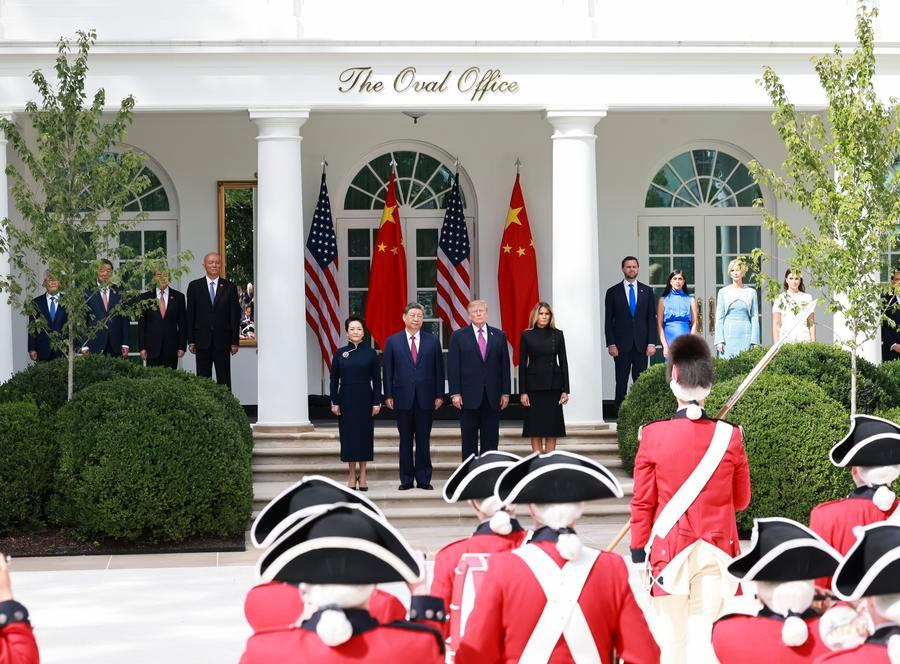
U.S. President Donald Trump holds a welcome ceremony for Chinese President Xi Jinping, who is on a state visit to the United States, at the White House in Washington, D.C., the United States, Sept. 24, 2026. (Xinhua/Wang Ye)
* Chinese President Xi Jinping engaged intensively on Thursday with his host, U.S. President Donald Trump, at the White House during his state visit to the United States, reaching common understanding on many issues.
* Xi's visit comes less than half a year after Trump's state visit to China in May, when the two presidents agreed to build a constructive China-U.S. relationship of strategic stability.
* While China and the United States compete in AI, they have even more reasons to cooperate, Xi said, urging the two major countries in AI to leverage respective strengths rather than guard against each other.
* At the state dinner, both presidents looked back on the long history of exchanges between the Chinese and American peoples, underscoring the importance of people-to-people ties.
WASHINGTON, Sept. 25 (Xinhua) -- From a welcome ceremony and a formal meeting to a state dinner, Chinese President Xi Jinping engaged intensively on Thursday with his host, U.S. President Donald Trump, at the White House during his state visit to the United States.
The two leaders conducted sincere and in-depth exchanges and reached common understanding on many issues, which has added new substance to the constructive China-U.S. relationship of strategic stability, and provided new strategic guidance for China-U.S. relations.
PUTTING VISION INTO ACTION
"I am ready to work with you to steer the giant ship of China-U.S. relationship on a steady course toward the future," Xi said at the welcome ceremony at the White House.
Xi's visit comes less than half a year after Trump's state visit to China in May, when the two presidents agreed to build a constructive China-U.S. relationship of strategic stability.
Later at his White House meeting with Trump, Xi called for translating that vision into action and finding the right way for the two major countries to get along with each other.
The two sides need to work toward a relationship featuring cooperation as the mainstay, moderate competition, manageable differences, and promises of peace, Xi said.
Xi noted that China and the United States should, and fully can, achieve mutual benefit and win-win results through practical cooperation, help each other succeed through healthy competition, properly manage differences by seeking common ground while respecting differences, and build peace by fostering mutual trust, so that a constructive China-U.S. relationship of strategic stability can better benefit the two peoples and people around the world.
Trump, for his part, said he and Xi are good friends who have maintained in-depth and close communication, and expressed confidence that U.S.-China relations would be handled well under the leadership of the two heads of state.
The meticulous arrangements for Xi's state visit, down to the details and with care and consideration, reflected the importance Trump attached to Xi's trip.
After receiving Xi in person at the airport one day earlier, Trump hosted the grand welcome ceremony at the White House.
Xi and his wife, Peng Liyuan, watched a performance by the United States Marines in the company of the U.S. presidential couple. The ceremony also featured a military review, with U.S. honor guards from different military services performing traditional drills and playing instrumental music. Multiple combat aircraft flew over the White House in honor of the Chinese and U.S. presidents and their wives.
Following the talks, the two presidential couples met again for the state dinner. Inside, red blossoms and red linens decorated the room, a choice a White House release said reflected the color's longstanding cultural significance in China.
"In less than half a year, the Chinese and American presidents have exchanged state visits, making history in our bilateral engagement," Xi said at the state dinner hosted by Trump.
The strongest signal to the world is that the leaders of the world's two most consequential major countries, though overtly competitive, can meet in harmony and with good spirit, which is the headline achievement, commented U.S. scholar Robert Lawrence Kuhn.
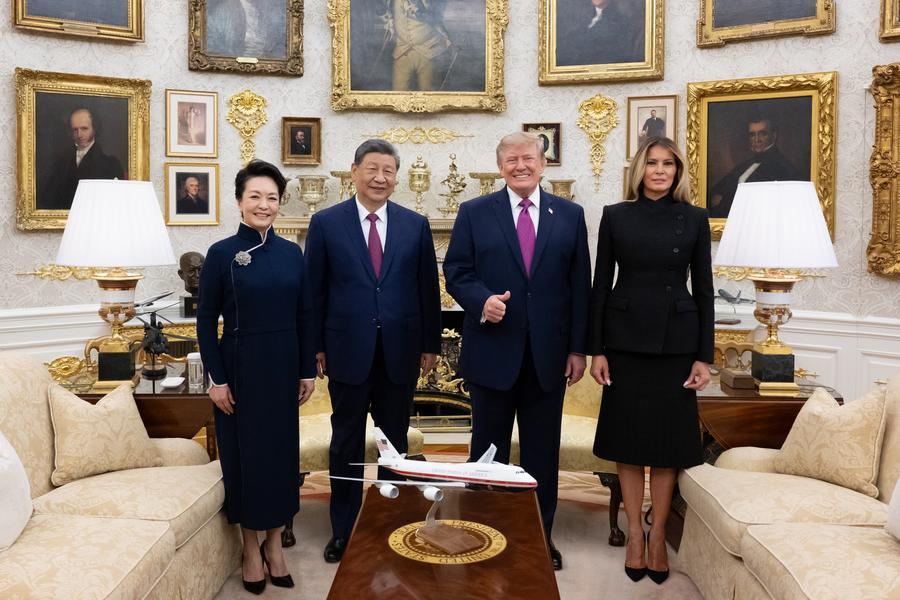
Chinese President Xi Jinping and his wife Peng Liyuan, together with U.S. President Donald Trump and his wife Melania Trump, pose for a group photo in the Oval Office after a welcome ceremony at the White House in Washington, D.C., the United States, Sept. 24, 2026. (Xinhua/Xie Huanchi)
COOPERATION GOES BOTH WAYS
From Beijing in May to Washington in September, practical cooperation has remained high on the agenda of China-U.S. interactions.
At the ceremony, Xi called on the two countries to "cooperate with sincerity."
Xi said the two sides share "deeply intertwined" interests and ample room for cooperation, noting that China-U.S. collaboration "may not solve every problem in the world," but many would be hard to resolve without it.
During his talks with Trump, Xi said the latest round of trade and economic consultations between the two countries had produced a new joint arrangement, calling it good news for industries and people of both countries, as well as the global economy.
Noting that cooperation is a two-way street, Xi said as long as the two sides uphold the spirit of equality, mutual respect and mutual benefit, they can find a way out of problems.
The state dinner offered another glimpse of the breadth of economic ties between the two countries. Executives from major U.S. aviation, technology and financial firms were among the guests, including some who had accompanied Trump to Beijing in May, such as Nvidia CEO Jensen Huang and Tesla CEO Elon Musk.
Artificial intelligence (AI) was another area discussed by the two leaders.
While China and the United States compete in AI, they have even more reasons to cooperate, Xi said, urging the two major countries in AI to leverage respective strengths rather than guard against each other.
The two sides should keep AI under human control, uphold a human-centered approach and use AI for good, ensuring that it serves human progress, Xi added.
Trump also stressed the importance of maintaining dialogue on AI, calling it the technology that bears on the future of humanity.
CARRYING ON FRIENDSHIP
At the state dinner, both presidents looked back on the long history of exchanges between the Chinese and American peoples, underscoring the importance of people-to-people ties.
Xi recalled how the two peoples stood shoulder to shoulder in the fight against Japanese militarist aggression more than 80 years ago, and how Ping-Pong Diplomacy reopened the door to bilateral exchanges more than half a century ago.
He also recounted the story of American Ronald Sakolsky, who supported Chinese desert control worker Yin Yuzhen's tree-planting efforts more than 20 years ago, calling it a shining example of friendly exchanges between the two peoples.
Such exchanges, Xi said, have promoted heart-to-heart communication between our peoples and strengthened public support for China-U.S. friendship and cooperation.
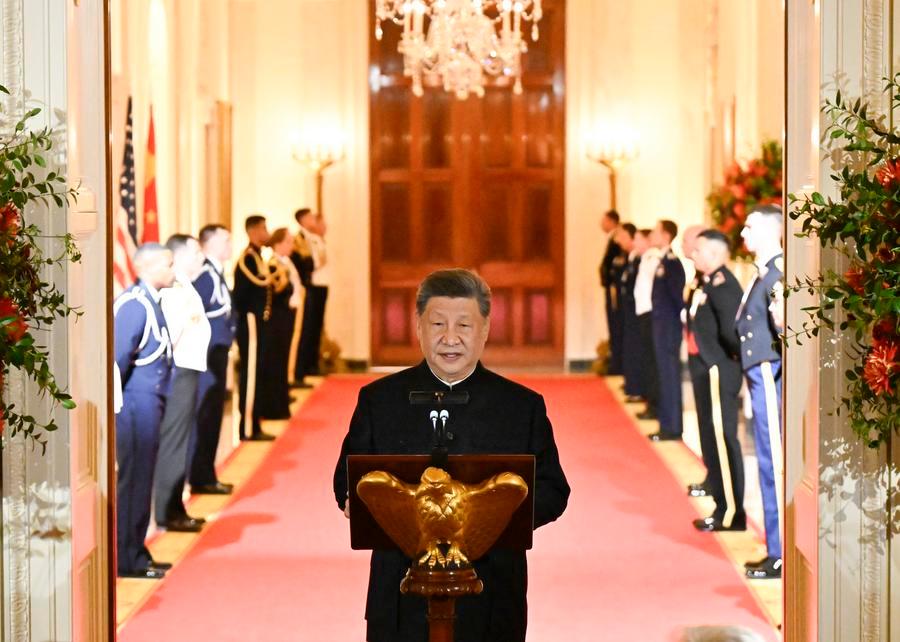
Chinese President Xi Jinping addresses a welcome banquet at the White House in Washington, D.C., the United States, Sept. 24, 2026. (Xinhua/Shen Hong)
Trump, meanwhile, reviewed the long history of U.S.-China exchanges, pointing to early commercial ties and the exchange of "goods, knowledge, customs and ideas."
"As the leaders of our two nations, President Xi and I both understand that we represent different systems, but the ties between our people endure, and we've never gotten along better," Trump said.
New steps are now being taken to carry that friendship forward.
At the welcome ceremony, Xi announced that two pandas, Ping Ping and Fu Shuang, will soon arrive at Zoo Atlanta and meet the American people. He also invited 100,000 young Americans to visit China for exchange and study programs over the next five years.
"The hope of the China-U.S. relationship lies in our people, and its future lies with the young," Xi said.
In 2023, during his visit to San Francisco, Xi announced a similar initiative inviting 50,000 young Americans to China over five years. That target has already been achieved.
"President Xi announced that he wants to double the number of students over the next five years. That's very positive, very significant, because I believe that those kinds of exchanges and students going back and forth are very, very important," said Kenneth Quinn, president emeritus of the World Food Prize Foundation.
Photos



Related Stories
- Full text: Xi's remarks at state dinner held by Trump at the White House
- Xi attends state dinner held by Trump
- Chinese, U.S. first ladies visit National Museum of Asian Art
- Xi calls for translating new vision of China-U.S. relationship into action
- Full text: Xi's remarks at arrival ceremony at the White House
Copyright © 2026 People's Daily Online. All Rights Reserved.
