



Time-honored Pingyao beef finds new life on China's shelves
Just outside the UNESCO World Heritage-listed Pingyao Ancient City in Pingyao county, north China's Shanxi Province, many tourists stop by a specialty beef supermarket, its shelves packed with everything from vacuum-sealed portions to small snack packs for different kinds of buyers.
"Our best-seller is the small-bag 'one-bite' beef — chewy but not greasy," said Shao Yan, the store's manager, pointing to a rack of best-selling small packages. "Tourists and locals alike buy it as an everyday snack."
Pingyao beef, a famous specialty with roots stretching back more than 1,000 years, has become one of the top souvenirs sought after by visitors to the Pingyao Ancient City.
Known as one of the "three treasures of Pingyao," Pingyao beef is recognized as both a national intangible cultural heritage item and a "China Time-Honored Brand".
Pingyao county is now home to dozens of beef processing companies. Among them, time-honored brands like Baojuyuan and Guanyun have held to traditional methods while rethinking packaging and distribution — turning a specialty that once spoiled too quickly to travel into a shelf-stable product sold across the country.
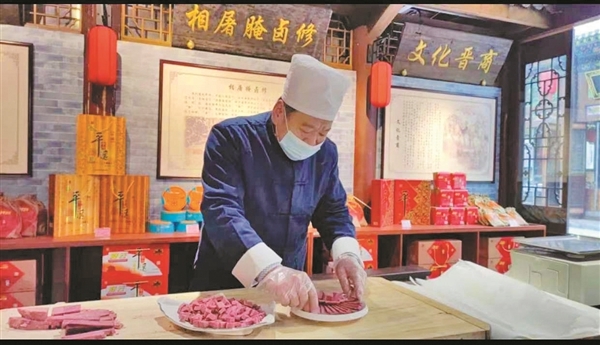
Wang Tianming, a national-level representative inheritor of the intangible cultural heritage project "beef and mutton cooking techniques" (Guanyun Pingyao Beef traditional processing techniques) shows Pingyao beef in Pingyao county, north China's Shanxi Province. (File photo)
The craft of cooking Pingyao beef can be traced back to the Western Han Dynasty (206BC - AD25). The craft originated when people discovered that curing meat in salt before cooking greatly improved its flavor, texture and shelf life — a breakthrough that became the foundation of the craft's thousand-year history, said Zhang Weidi, deputy general manager of Baojuyuan Meat Products Co., Ltd. Baojuyuan, one of the leading producers of Pingyao beef, was founded in 1888 and has operated for more than 130 years.
Production follows five core steps — selecting, slaughtering, curing, braising and trimming. Each one, down to every stage of heat control, adheres to strict standards, Zhang said. Traditionally, the beef was cured with salt alone at 0 to 4 C, a method that helped preserve its distinctive flavor.
Beef and mutton cooking techniques — including Guanyun's traditional Pingyao beef processing method — were added to China's national intangible cultural heritage list in 2008. Automated production lines now bring the traditional craft and industrial-scale manufacturing together, raising both quality and output.
"In the past, making beef depended entirely on the weather and experience. Temperatures varied by season, curing times couldn't be standardized, and the quality of the finished product would inevitably fluctuate," said Chen Zegang, deputy general manager of Pingyao Beef Group. Curing is key to developing the beef's flavor, he said, and the unpredictability of manual methods made quality difficult to standardize.
Guanyun has since overhauled its entire production system. Curing now takes place in a controlled environment at 3 to 4 degrees Celsius over three to five days, with automated brine-injection equipment replacing hand-salting to ensure the seasoning penetrates evenly and the meat absorbs it more thoroughly — preserving the essence of traditional methods while addressing long-standing gaps in efficiency and consistency.
In the company's braising workshop, more than 100 standardized pots have replaced small-batch cooking. The production line has an annual capacity of 20,000 tonnes of beef, making it one of the largest and most complete beef production lines in Pingyao county, Chen said.
Traditionally cured beef lasted only a few days. Vacuum-sealing and high-temperature sterilization has changed that — stretching shelf life to 12 months and turning a once-regional specialty into a product sold nationwide.
To keep pace with demand, the company has invested more than 30 million yuan (about $4.47 million) in upgrading its equipment and automation, plus an additional 1 million yuan in new production lines for snack products such as beef jerky and spiced beef shank, Chen said. Its lineup now includes more than 200 products, spanning gift boxes, snacks and fresh cuts.
E-commerce has also driven growth: Guanyun's online sales exceeded 200 million yuan in 2025, including 90 million yuan from its own livestreaming sessions.
Today, time-honored brands like Guanyun and Baojuyuan have opened their production lines to visitors — a shift from the closed factory floors of the past that brings cultural heritage and tourism closer together.
Free and open since 2011, Guanyun's factory is rated as a national 3A-level tourist attraction and draws about 300,000 tourist visits a year.
The Pingyao beef industry has grown from small-scale local trade into a distinctive pillar industry that boosts residents' incomes and drives development across the county, said Wen Jiangping, deputy director of Pingyao's bureau of industry and information technology.
As of the first six months of 2026, the county had 68 beef processing companies, employing more than 2,200 people directly, with the industry's full supply chain supporting more than 10,000 jobs in total.
Qi Hongliang, Party chief of the county, said the Pingyao beef industry's total output value reached 2.35 billion yuan as of the first half of 2026, with sales revenue of 2.12 billion yuan.
Photos


Related Stories
Copyright © 2026 People's Daily Online. All Rights Reserved.
